Key to getting ahead

Key to getting ahead

Sorry, but lessons on The Blue Tree work only on a computer or a tablet.

Bardzo mi przykro, ale lekcje na platformie The Blue Tree działają jedynie na komputerze lub tablecie.

Do zobaczenia na większym ekranie 🙂

Zespół The Blue Tree

Key to getting ahead
Learn more words

THE BLUE TREE

Personal
Productivity

CEF B1

CEFR C1

Advanced

warm up

Answer the questions below. Then listen to some model answers. Read the transcript.

Does your company offer career development opportunities? Are you taking advantage of them?
TRANSCRIPT

Absolutely, my company offers a ton of career development opportunities. I work at a bank, and they really invest in our growth. I’m 48 and have been with the company for over 20 years. I’ve taken advantage of various training programs, which have helped me stay updated with industry changes and new technologies. Plus, having a mentor has been invaluable. My mentor has guided me through some tough career decisions and helped me set and achieve my professional goals. Honestly, these programs have played a big part in my career progression.

TRANSCRIPT

In my experience, the person who can help you get ahead the most is a good mentor. My mentor at the bank has been crucial to my career growth. He’s provided guidance, shared his experiences, and connected me with the right people. Besides a mentor, having a supportive manager also makes a big difference. My manager encourages me to take on new challenges and supports my professional development. Building a strong network within the company is essential too. Colleagues can offer advice, share opportunities, and give feedback that helps you improve.

Is it useful to have a plan for one’s career? Do you have such a plan or a strategy?
TRANSCRIPT

Definitely, having a plan for your career is really useful. It gives you direction and helps you focus on your goals. I’ve always had a rough plan for where I wanted to go in my career. Over the years, I’ve adjusted it based on new opportunities and changes in the industry. Right now, my strategy includes continuing my education through the bank’s training programs, seeking out challenging projects, and regularly checking in with my mentor to stay on track. Having this plan has kept me motivated and on course, even when things get tough.

part one

KEY LANGUAGE

Go through the flashcards below. Make sure you understand all the words and expressions.

VIDEO

Watch the first part of the video.

COMPREHENSION

Answer these questions. Refer to the information from the video.

100:35What is a “roundtable”?
200:48How were people divided during this kind of evaluative process?
300:54What was the consequence of being put in one of the buckets?
401:17What three roles of people at the roundtable did Carla mention?
501:40Why was Carla excited to be at this meeting for the first time?
601:58How do many companies advertise their culture?
702:05How does a meritocratic organisation work in theory?

part two

VIDEO

Watch the next part. 

COMPREHENSION

Answer these questions. Refer to the information from the video.

102:58How were Joe, Mary and Arnold assessed?
203:17What question came to Carla’s mind at that moment?
303:28What did she realize about the idea of a meritocratic organisation?
403:38What prevents the meritocratic process from being objective?
504:00What did she realize about her own situation?

part tHREE

KEY LANGUAGE

Go through the flashcards below. Make sure you understand all the words and expressions.

VIDEO

Watch the next part of the video.

COMPREHENSION

Answer these questions. Refer to the information from the video.

104:08What did Carla want to know about this person who should speak on her behalf?
204:30Why shouldn’t this person be called “a mentor”?
305:20What name did she finally come up with for this person?
405:32What questions came to her mind at that point?

part four

KEY LANGUAGE

Go through the flashcards below. Make sure you understand all the words and expressions.

VIDEO

Watch the next part of the video.

COMPREHENSION

Answer these questions. Refer to the information from the video.

105:45Why do we need a sponsor?
206:02Why is subjectivity an issue?
306:18What do we have to make sure as regards our sponsors?
406:45What is the ideal, if unrealistic, scenario of getting a sponsor?

part five

VIDEO

Watch the next part of the video.

COMPREHENSION

Answer these questions. Refer to the information from the video.

107:01What are the two types of currencies?  
207:11How do we earn performance currency?
307:52What are the three benefits of the performance currency?
408:05Why may sponsors be attracted to a person who earns performance currency?
508:19What kind of power can we exercise if we are looking for a sponsor?

part six

VIDEO

Watch the next part of the video.

COMPREHENSION

Answer these questions. Refer to the information from the video.

108:28What type of currency becomes most important at this point?
208:36How do we earn relationship currency?
309:06What can we invest and what should our goal be?

part sEVEN

KEY LANGUAGE

Go through the flashcards below. Make sure you understand all the words and expressions.

VIDEO

Watch the next part of the video.

COMPREHENSION

Answer these questions. Refer to the information from the video.

109:48What three characteristics should a good sponsor have?
210:28How can you approach your sponsor? What might we say?
311:18What are the three reasons they might say no to your request?
411:33Why is getting rejected by your sponsor valuable information for you?
511:54Why is it critical to have a sponsor in any organization?
612:01What question should we ask ourselves regularly?

part EIGHT

video

Watch the last part of the video.

COMPREHENSION

Answer these questions. Refer to the information from the video.

112:23Who does Carla address at the end?
212:34What reponsibility do people at the table have?
312:45What might these people worry about?
412:50What does Carla encourage them to do?
512:58What did she learn during her time on Wall Street?

POLL

Cast your vote in the poll.

1️⃣ What matters most for getting ahead in a large organisation?
2️⃣ If a “roundtable” discussion about you happened today, what would help you most?
3️⃣ How strategic are you about your career growth?
2 votes

×

DISCUSSION

Dialogue

Friday evening. Sven and Pete are leaving the office. Sven has just found out he didn’t get the promotion he was hoping for.

Read or role-play this dialogue.

Sven:
I can’t believe it. I really thought this was my moment. I’ve worked so hard this year… and still nothing.

Pete:
I’m sorry, Sven. That must hurt. Did they give you any specific feedback?

Sven:
Not much. They said I’m reliable and solid, but they went with someone “more visible.” I don’t even know what that means.

Pete:
It probably means what Carla Harris talks about — performance currency isn’t enough. You also need relationship currency and visibility.

Sven:
So doing a good job isn’t enough?

Pete:
In theory it should be. In reality, someone has to speak for you in those roundtable meetings. If no one advocates for you, your name might not even come up strongly enough.

Sven:
That’s frustrating. I thought merit would speak for itself.

Pete:
That’s the myth. The real question is: who is going to speak on your behalf? Do you have a sponsor?

Sven:
Not really. I have a good relationship with my manager, but I’ve never asked anyone to support me strategically.

Pete:
Maybe that’s your next step. Identify someone influential. Show them your results. Ask for honest feedback. And make sure more people know what you’re working on.

Sven:
So I need to be more intentional?

Pete:
Exactly. Keep performing — that’s your foundation. But build relationships. Increase your visibility. And next time, don’t just hope you’ll be promoted. Prepare for the roundtable.

Sven:
You know what? That actually makes me feel better. At least now I have a strategy.

Pete:
That’s the spirit. This wasn’t the end of your story. It was just data.

OVER TO YOU

Discuss these questions.

BulletIn large organisations, what makes a person “visible” during promotion decisions?
BulletWhy might strong performance alone not guarantee career advancement?
BulletWhat role can a sponsor play in professional growth?
BulletHow can someone build relationship currency without seeming artificial or manipulative?
BulletHow can rejection from a promotion become useful information for future growth?

MIND-MAP

Use the mind-map below to have a more in-depth conversation about this topic.

Getting Ahead Carla Harris

lesson glossary

COMMENTS

What do you think of the idea of a sponsor? How do you feel about performance and relationship currencies? Has anybody played a role of a sponsor in your career?

Share your views and experience here.

MY ENGLISH DICTIONARY

Add new and interesting words from this lesson to your English dictionary.

Store your words and expressions in this handy dictionary. You can create groups and play games based on your entries. There is also a practical importing feature.

You must log in to see content.

Your Goals Need Stamina

Your Goals Need Stamina

Your Goals Need Stamina
Learn more words

THE BLUE TREE

Personal
Productivity

CEF B1

CEFR B2

Upper
Intermediate

warm up

Answer the questions below.

TRANSCRIPT

It’s hard to achieve our goals because staying committed over time can be challenging. Life gets busy, we lose motivation, or we hit setbacks that make us doubt if we can really succeed. Also, big goals can feel overwhelming, and without a clear plan, it’s easy to lose focus. I’ve realized breaking down goals into smaller steps helps, but even then, it takes discipline and patience.

TRANSCRIPT

Change affects our goals in significant ways, sometimes making us rethink or adjust them. Whether it’s changes in our personal lives or the workplace, we often need to adapt to new realities. A change can also create new opportunities, but it might also bring challenges that make it harder to stay on track. I think the key is to stay flexible and open to adjusting our plans as needed.

How can we increase our chances of success as regards reaching goals?
TRANSCRIPT

We can increase our chances of success by staying consistent and disciplined. It’s about developing good habits that support our goals and sticking with them, even when things get tough. Also, setting up a system for tracking progress and regularly evaluating what’s working and what’s not is important. Getting feedback from others and continuously improving can help us stay on course.
key language

Go through the flashcards below. Memorise as many words and their definitions as you can.

watch the video

Watch a short video summary of the book “Choosing Change. How leaders and Organizations Drive results one person at a time” by Walter McFarland and Susan Goldsworthy.

COMPREHENSION

Answer the questions below. Throw some newly learned words and phrases into your answers.

  • ⌚ 0:21 How should leaders view change?
  • ⌚ 1:16 Why do goals need to be specific?
  • ⌚ 1:21 What is the idea behind “time-stamped” goals?
  • ⌚ 1:28 What makes goals achievable?
  • ⌚ 1:34 What else, apart from performance indicators, should goals have?
  • ⌚ 1:45 When is it particularly useful to have inspiring goals?
  • ⌚ 1:53 What is the benefit of adding a narration to our goals?
  • ⌚ 1:59 What adds momentum to our goals?
  • ⌚ 2:13 How can STAMINA goals help us when we hit a bump in the road?
w

DISCUSSION

STAMINA IN REAL LIFE

Alita missed the training session on STAMINA goals, so Pete is giving her a friendly, simple walk-through as they grab a quick coffee before work.

Listen to their dialogue.

Now read or role play this a slightly different version of this conversation between Alita and Pete.

Alita:
Ugh, I can’t believe I missed yesterday’s training. You mentioned something about “STAMINA goals”? Can you give me the short version?

Pete:
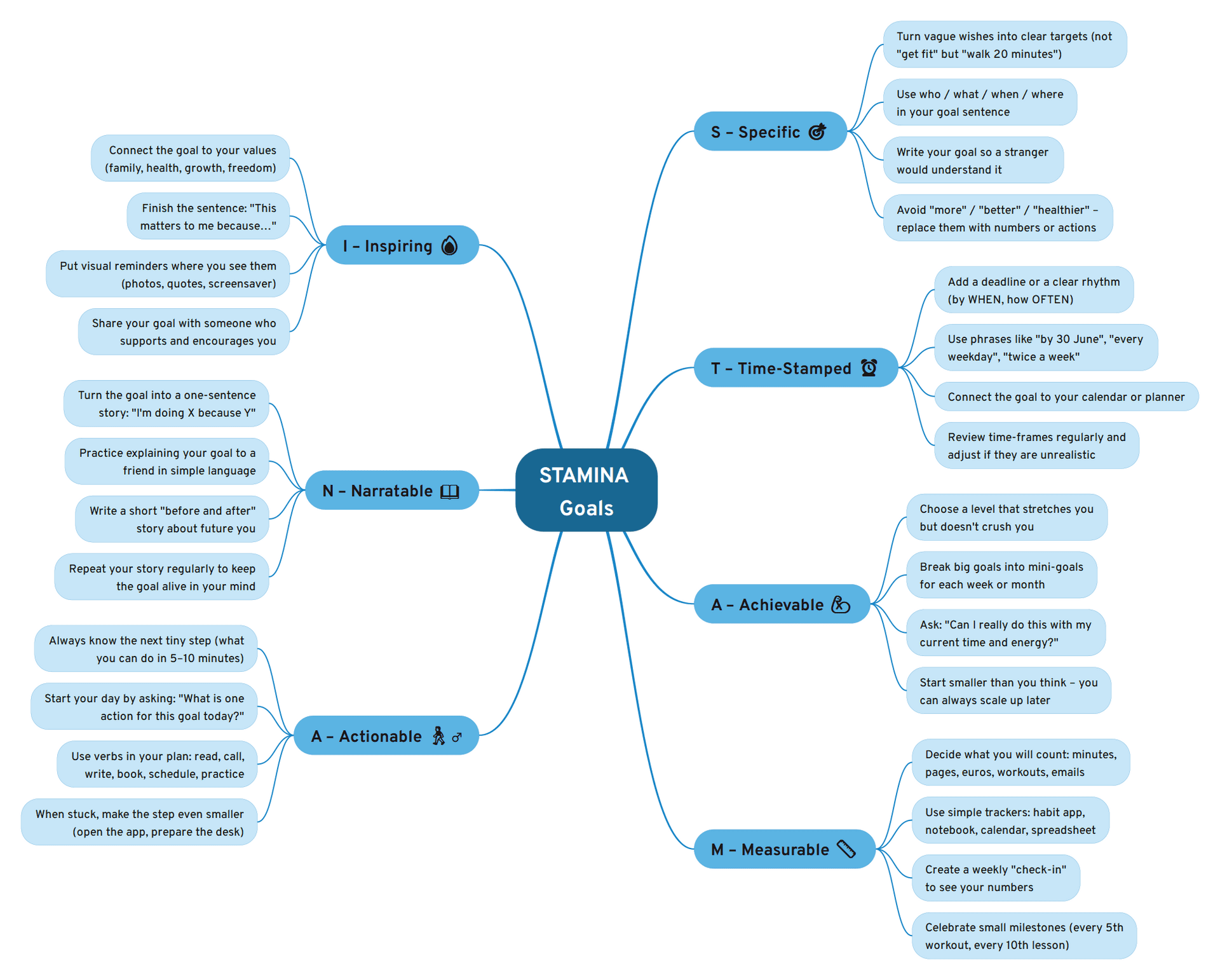
Sure. STAMINA is just a way to make goals easier to stick to. Think of it as a checklist. The first one — S for Specific — means you should say exactly what you want. Not “I’ll get healthier,” but “I’ll go for a 20-minute walk every morning.”

Alita:
Okay, that already sounds more doable.

Pete:
Then comes T for Time-Stamped. A goal needs a deadline or a rhythm. Like “by March,” or “three times a week.” No time? No progress.

Alita:
Right, otherwise it lives in that magical land called “later.”

Pete:
Exactly. Next is A for Achievable. It should challenge you but not destroy you. If you haven’t run in years, a marathon next month is a bad idea. A 5 km run is better.

Alita:
So it’s about building confidence, not torture?

Pete:
That’s a nice way of putting it.
After that comes M for Measurable. You need a way to track your progress. Kilometres run, pages read, money saved — anything you can count.

Alita:
I love ticking boxes. It makes me feel productive even when I’m not.

Pete:
Same here.
Then we move to I for Inspiring — something that actually motivates you. “Because my doctor said so” works for a week. “Because I want more energy for my kids” lasts longer.

Alita:
So the emotional part matters too.

Pete:
A lot.
Next up: N for Narratable. Basically, can you explain your goal in a simple story? “I’m learning Spanish because I want to travel to Peru next year.” When your goal has a story, people remember it — and you remember it too.

Alita:
That’s true. A story makes it feel real.

Pete:
And finally A for Actionable — meaning you know the next step. Not the whole plan, just the next tiny action. “Open the app,” “Book a class,” “Write the first paragraph.” When in doubt, do the smallest step.

Alita:
This actually sounds… friendly. Not like another system that makes you feel guilty.

Pete:
That’s the point. STAMINA gives your goals structure but also energy. It keeps them alive when life gets messy — which it always does.

Alita:
Thanks, Pete. I think I’ve got it. Maybe missing the training wasn’t such a disaster after all.

Pete:
Happy to help. Now… about that coffee — is your goal to buy it or make it?

Alita:
Buy it. Definitely buy it.

Answer these questions on the basis of the dialogue between Alita and Pete.

  • Why does Pete say goals need to be specific?

  • What example does Pete give to explain Time-Stamped goals?

  • How does Pete describe an achievable goal?

  • Why is the measurable element important according to Pete?

  • What kind of motivation fits under the inspiring element?

  • What does Pete mean by making a goal narratable?

  • What is the purpose of making goals actionable?

  • What does Alita think about STAMINA after hearing the explanation?

  • How does Pete say STAMINA helps “when life gets messy”?

  • Which example at the end shows the difference between “buying” and “making” as an action step?

dive deeper into stamina

Use the mind-map below to dive deeper into this topic or to remember key ideas.
POLL

Cast your vote in the poll.

Which of the elements from the STAMINA framework is the most important in your opinion?

×
Slow down the passage of time

Slow down the passage of time

Sorry, but lessons on The Blue Tree work only on a computer or a tablet.

Bardzo mi przykro, ale lekcje na platformie The Blue Tree działają jedynie na komputerze lub tablecie.

Do zobaczenia na większym ekranie 🙂

Zespół The Blue Tree

Learn more words

THE BLUE TREE

Travel & Nature

CEF B1

CEFR B1

Intermediate

warm up

TRANSCRIPT

Yes, definitely. Sometimes I can’t believe how fast the weeks go by. Monday turns into Friday in what feels like a blink. When I was a child, summer holidays felt endless, but now even a whole year seems short. I think routine plays a big role. When every day looks similar, my brain stops noticing details. That’s probably why time feels like it’s speeding up.

TRANSCRIPT

Yes, I do. There are periods when my days feel predictable and repetitive. I wake up, work, come home, repeat. Nothing dramatic, nothing new. It’s comfortable, but also slightly frustrating. When I notice that feeling, I try to change something small – take a different route, start a new project, or meet new people. Even a small change can break the routine and make life feel more alive again.

TRANSCRIPT

If I’m honest, I probably waste too much time scrolling on my phone. I tell myself it’s just five minutes, but it often turns into half an hour. Social media gives quick entertainment, but it rarely gives real satisfaction. I also waste time overthinking small decisions. Instead of acting, I analyse too much. I know that if I used that time better, I could learn something new or develop a skill.

part one

KEY LANGUAGE

Go through the flashcards below. Make sure you understand all the words and expressions.

VIDEO

Watch the first part of the video.

COMPREHENSION

Answer these questions. Refer to the information from the video.

  • ⌚ What did Jedidah learn when he spoke to elderly people? [0:26]
  • ⌚ What was he afraid of? [0:54]
  • ⌚ What did he promise himself he would do? [1:02]
  • ⌚ What are some of the places he visited? [1:20]
  • ⌚ What is the enemy of time? [1:32]
  • ⌚ How can adults slow down the passing of time? [3:13]

POLL

Cast your vote in the poll.

1️⃣ What makes time pass the fastest in your life?
2️⃣ When do you feel most “wide awake” and present?
3️⃣ If you wanted to slow down the passage of time, what would you change first?
1 vote

×

PRACTICE

Complete the exercise below.

w

DISCUSSION

DIALOGUE

Read or role-play this dialogue.

Alita:
What stayed with me most from the film was the idea that routine makes time disappear. I’ve never thought about it this way before, but it makes sense. When every day looks the same, my brain kind of switches to autopilot.

Pete:
Exactly. I liked when he said it’s not really about the bike. It’s about breaking patterns. The bike is just a tool. The real point is doing something new and shocking your brain awake.

Alita:
Yes! And I loved the idea of being amazed again, like a child. When we’re young, everything feels new. Even small things are exciting. As adults, we stop noticing details.

Pete:
I’ve felt that. Last year I went hiking in the mountains. It wasn’t a huge adventure like cycling to South America, but it completely changed my perspective. I was exhausted, but I felt alive.

Alita:
That’s what he meant by wanting to feel “exhausted” at 85, right? Not tired of life, but tired because you really lived. I find that idea powerful.

Pete:
Me too. And it made me think: maybe adventure doesn’t have to be extreme. It could be learning something new, changing jobs, starting a project… anything that breaks routine.

Alita:
So maybe the real message is this: if we want time to slow down, we need to stay curious. It’s not about escaping life — it’s about paying attention to it.

OVER TO YOU

Discuss these questions. Refer to the topic of the lesson and your own experience.

BulletWhy do you think routine makes time feel shorter? What happens to our brain when nothing changes?
BulletWhat kind of “adventure” could be realistic in everyday life, without cycling across a continent?
BulletIn what situations do adults feel truly amazed, like children? Why do these moments matter?
BulletWhat small change could break your current routine and make your week more interesting?
BulletImagine you are 85 years old. What kind of life would make you feel satisfied and “exhausted” in a good way?

lesson glossary

COMMENTS

What do you think of Jedidah’s idea to slow down the passage of time? Is this something you would like to do yourself? How can we incorpate his ideas in our lives?

Share your thoughts and ideas below.

DUNE by Frank Herbert

DUNE by Frank Herbert

Sorry, but lessons on The Blue Tree work only on a computer or a tablet.

Bardzo mi przykro, ale lekcje na platformie The Blue Tree działają jedynie na komputerze lub tablecie.

Do zobaczenia na większym ekranie 🙂

Zespół The Blue Tree

DUNE by Frank Herbert
Learn more words

THE BLUE TREE

Entertainment

CEF B1

CEFR B1

Intermediate

warm up

Answer these questions. Listen to Alita offer her answers to these questions. Report what you heard.

What kind of books do you like reading? Has it changed over time?

TRANSCRIPT

Well, I’m totally into self-help books. Learning new stuff about myself, figuring out how to be the best version of me, it’s all super interesting. Those books can be a real eye-opener! But I’m also a sucker for a good science fiction story. Spaceships, other worlds, all that futuristic stuff – it just gets my imagination going wild.

My all-time favorite has to be “Dune” by Frank Herbert. It’s such a crazy, epic story with politics, a totally weird desert planet, and those giant sandworms… It’s just the coolest!

I guess my taste in books has kind of changed over time. When I was younger, I was more into adventure stuff, things with nonstop action. But now I find I like those deeper books, ones that make me think, you know?

What impact do books have on you and people in general?
TRANSCRIPT

Books have this amazing power, you know? With self-help books, it’s like… you get this whole toolbox of ideas for improving yourself. They give you a chance to step back, see things differently, and figure out what really matters to you. It’s pretty inspiring!

And with sci-fi books like “Dune,” they can totally blow your mind. They open up your imagination to all these crazy possibilities, different ways of living, and questions about the future. They make you wonder, ‘What if…?‘ It’s kind of like mental exploration.

I think books are important for everyone. They help you grow, they spark your imagination, and they make you think about the bigger picture. Plus, reading is just plain relaxing and fun, which is always a bonus!

What is your favourite film adaptation of a book?
TRANSCRIPT

Ooh, that’s a tough one! There are some good ones out there… But I might have to go with the newer “Dune” movie – the one by Denis Villeneuve. I know a lot of people were big fans of the older version, but I think the new one is incredible.

They did such a great job with the visuals. The world of Arrakis feels so real and alien at the same time. Plus, the acting is awesome, and they nailed the whole epic feeling of the book. It really takes you on this wild ride through the story. I loved it!

part one

KEY LANGUAGE

Study these words.

VIDEO

Watch the first part of the video.

COMPREHENSION

Answer these questions.

  • When was DUNE published and by whom?
  • When is the story set?
  • Why aren’t there any computers or robots in this universe?
  • What special powers do humans possess?
  • What is the most essential resource?
  • Where can it be found?

part two

KEY LANGUAGE

Study these words.

VIDEO

Watch the second part of the video.

COMPREHENSION

Answer these questions.

  • Who is the key figure in the DUNE story?
  • What happens when Paul arrives on Arrakis?
  • What did Frank Herbert spent five years on?
  • Who is Jessica and why is she important?
  • Who are the Fremen?
  • How did Frank Herbert incorporate a sense of scale in the book?
  • Can this book’s message be relevant in today’s world?
  • Would you like to read it or watch the film (if you haven’t already laughing)?

PRACTICE

FROM SCIENCE FICTION TO REALITY

Read this dialogue. Alita is talking to Kat about the impact science fiction books have on our daily lives. Who do you agree with?

Alita: So, what do you think about all this sci-fi stuff anyway? I know you’re not as into it as I am.

Kat: Honestly, it all just seems so unrealistic to me. Cool lasers and spaceships are fun for a movie, but come on, it’s not like we’re actually gonna be zooming around in flying cars anytime soon.

Alita: True, maybe not the flying cars, not yet, anyway. But sci-fi has a way of inspiring stuff that seems crazy until it…well, isn’t. Think about video calls! Remember how that felt like some futuristic thing out of “Star Trek”? Now we’re zooming each other every day.

Kat: Okay, okay, you got me there. One example doesn’t change my mind.

Alita: Alright, how about this – remember those old sci-fi movies where robots walk around and talk? Now we’ve got Boston Dynamics robots doing backflips and Alexa telling us the weather.

Kat: I suppose… but those are still kind of gimmicky, right? I mean, we’re not exactly living on Mars yet!

Alita: Gimmicks are the first step! And don’t forget about medical stuff. Remember those sci-fi books where they heal people with lasers and weird machines? Now we have robotic surgeries and 3D-printed organs – that stuff used to sound nuts! Sci-fi shows us the ‘what if’ and then scientists start working on making it real.

Kat:Alright, maybe you’re onto something. Maybe sci-fi isn’t just about entertainment.

Alita: Exactly! It’s like this massive brainstorming session for the whole world. It pushes the boundaries and makes us ask, ‘Hey, why can’t we do that?

Kat: Hmm, I might need to borrow one of your crazy sci-fi books sometime. You’re starting to make me curious.

Alita: Anytime! And hey, I’m telling you, you’ll want to start with “Dune”!

COLLOCATIONS

Play this game about some of the collocations used in the film.

POLL

Cast your vote in the poll.
Coming Soon
Science-fiction books and films are great
Total Votes : 2

lesson glossary

Learn the language from this lesson using this practical glossary.

COMMENTS

Share your opinions here.

MY ENGLISH DICTIONARY

Add new and interesting words from this lesson to your English dictionary.

Store your words and expressions in this handy dictionary. You can create groups and play games based on your entries. There is also a practical importing feature.

You must log in to see content.

How to talk about prices

How to talk about prices

How to talk about prices
Learn more words

THE BLUE TREE

Learn Words

CEF B1

CEFR B1

Intermediate

What's happening in this picture? How does this woman feel? Does shopping evoke such strong feelings in you too?

warm up

Let’s go Dutch

Answer these questions. Move your mouse over the words to see the Polish translations.

  • Have you ever bought anything that cost an arm and a leg?
  • Do you like hunting for bargains?
  • Do you usually go Dutch or foot the bill when you eat out with friends?

kosztować majątek

polować na okazje

każdy płaci za siebie

pokryć rachunek

It’s Black Friday this week

Read a dialogue between two friends. They are discussing the topic of Black Friday. After you read it discuss how you feel about hunting for Black Friday deals.

Jamie: Hey Alex, are you excited about Black Friday?

Alex: Honestly, not really. I think it’s more of a scam. They just mark up prices before lowering them.

Jamie: I see your point, but I believe it’s a great opportunity to snag some real bargains. Last year, I got an amazing deal on a laptop.

Alex: Really? But don’t you think the crowds and chaos are a bit too much?

Jamie: It can be overwhelming, but with online shopping, it’s much easier now. Plus, you can compare prices from different stores.

Alex: True, online does make it more convenient. I just worry about impulse buying and overspending.

Jamie: That’s a valid concern. It’s important to plan and set a budget. By the way, did you know Black Friday originated in the 1950s in Philadelphia?

Alex: Really? I didn’t know that.

Jamie: Yes, it was used to describe the heavy traffic after Thanksgiving. Retailers started using the term in the 1960s to mark the start of the holiday shopping season.

Alex: That’s interesting! So, it has a long history.

Jamie: Exactly. And while it’s true that some deals aren’t as good as they seem, with a bit of research, you can find genuine discounts.

Alex: I guess you’re right. Maybe I’ll give it a try this year, but I’ll be cautious and do my research first.

Jamie: That sounds like a plan! It’s all about being a smart shopper.

useful collocations

Match a few collocations from this reading.

DEFINITIONS

Do research
To do research means to find information about something.
For example, you can read books, search online, or watch videos.
Research helps you understand a topic better.


Genuine discount
A genuine discount means a real price reduction.
For example, a jacket usually costs $100, but now it costs $70.
The price is really lower than before.


Valid concern
A valid concern is a worry that makes sense.
For example, feeling unsafe when walking alone at night is a valid concern.
It is important to think about your safety.


Amazing deal
An amazing deal is a very good offer.
For example, you buy something good for a much lower price.
You get great value for your money.


Smart shopper
A smart shopper buys things in a careful way.
They compare prices, look for good quality, and wait for discounts.
This helps them save money.


Impulse buying
Impulse buying means buying something suddenly, without planning.
For example, you see a chocolate bar at the checkout and buy it.
You didn’t plan it — you just felt like it.

part one

Words for talking about cheap

Study the language for talking about cheap prices. Listen to examples and repeat them.

WHEN SOMETHING IS VERY CHEAP
Dirt cheap – This shirt was dirt cheap. It only cost me $10.
Be a snip – The new computer package is a snip at only £599 plus tax.
At rock-bottom prices – In our summer sale, we have clothes from top designers at rock-bottom prices.
WHEN YOU GET SOMETHING FOR A GOOD PRICE
Value for money – There’s a special ticket that means you can see six concerts, which is definitely good value for money.​
Be a good buy – The Brazilian white wine is a good buy at only $2.99 a bottle.
Bargain – I got this shirt when I was in Turkey. It was a real bargain.
WHEN SOMETHING DOESN'T COST MUCH MONEY
Inexpensive – The furniture is inexpensive but well-made.
Economical – This is a well designed car that is also very economical to run.
Affordable – We have a vast range of cars to choose from at affordable prices.
NOT TOO EXPENSIVE WHEN COMPARED WITH OTHER PRICES
Reasonable – Only £15 a night? That sounds reasonable.
Competitive – I am confident you’ll find our prices are extremely competitive.
Competitively priced – Call this number for our free catalogue of competitively priced cosmetics.

GIRLS SHOPPING

Read this dialogue. Notice how these women are using the language of prices from this section.

Emma: Hi Sarah! I heard there’s a big sale at the mall. Everything is at rock-bottom prices!

Sarah: Really? I’m on the lookout for some affordable winter clothes. Last year’s jacket isn’t warm enough anymore.

Emma: You should definitely check it out then. I got a jacket there last week, and it was dirt cheap!

Sarah: That sounds great. I love finding things that are value for money. How’s the quality of the jacket?

Emma: It’s really good! It’s definitely a good buy, especially considering how much I saved.

Sarah: Nice! I also need some new shoes. Do you think I’ll find a bargain there?

Emma: Absolutely! Their shoe section is known for being economical without compromising on style or comfort.

Sarah: Perfect! Oh, and do you remember that boutique we visited last month? I heard they’re offering some items that are a snip now.

Emma: A snip? That’s hard to believe for that boutique; their stuff is usually pricey. But if it’s true, I might pick up a few things myself.

Sarah: Yeah, it’s a rare opportunity. I’m thinking of getting that handbag I saw. It would be affordable now.

Emma: Sounds like a plan. Let’s make a day of it and hunt for the best deals!

Sarah: I’m in! Shopping is always more fun with a friend, especially when there are so many good deals to find.

part two

I can’t afford it

Stidy the language of talking about expensive prices. Listen to and read the examples.

WHEN SOMETHING IS EXPENSIVE
Costly – The finance committee rejected their plan because they said it was too costly.
It’s going to cost you – There are some places that can mend the suit in a couple of hours, but it’s going to cost you.
Not come cheap – Gibson guitars sound great, but they don’t come cheap.
WHEN SOMETHING IS VERY EXPENSIVE
Cost a fortune – What a beautiful car – it must have cost a fortune.
Cost the Earth – Good shoes needn’t cost the earth.
Cost an arm and a leg – Getting good health insurance these days costs an arm and a leg.
WHEN SOMETHING IS EXPENSIVE AND FASHIONABLE
Luxurious – Atlantis is one of the world’s most luxurious cruise ships.
Fancy – We stayed in a fancy Victorian hotel in San Francisco.
Upmarket – New upmarket shops are driving some of the older businesses out of the neighbourhood.
WHEN SOMETHING IS TOO EXPENSIVE
Can’t afford – I really need a new coat, but I can’t afford it before I get paid.
Be a rip-off – Eighty dollars for a pair of jeans? What a rip-off!
Steep – It’s hard to find an apartment around here, and when you do the rents are pretty steep.

Buying a new car

Read another dialogue. This time it’s between two friends who are talking about cars. They are using the language from this section.

Dave: Hey John, I see you’re in the market for a new car?

John: Yeah, Dave, but it’s a bit overwhelming. Everything seems so costly these days.

Dave: Tell me about it. Remember, buying the car isn’t the end of it. It’s going to cost you a lot in upkeep and other expenses.

John: I know. I’ve been checking out some new models, and they certainly do not come cheap. It’s like every feature adds thousands to the price.

Dave: And if you’re eyeing luxury cars, they can cost a fortune. Have you thought about second-hand cars?

John: I’ve looked into that, but good ones still cost the Earth. It seems like a decent car is a luxury.

Dave: It’s a big investment for sure. Anything reliable nowadays costs an arm and a leg. What’s your budget?

John: I’ve got a figure in mind, but to be honest, I can’t afford the cars I really like without stretching my finances too thin.

Dave: You’ve got to watch out for those seemingly great deals, too. Some of them are just rip-offs.

John: Oh yeah, I’ve seen a few. The prices are steep, especially for cars with high mileage or out-of-warranty.

Dave: It’s a tricky situation. Sometimes, it’s better to pay a bit more initially than deal with endless repairs later.

John: Agreed. I guess it’s about finding something that’s worth the investment.

Dave: Exactly. Take your time to find the right car. It’s a big decision, after all.

part three

LEARN WHAT IT MEANS

Go through theses flashcards and learn to talk about prices. 

Now, play this Multidecker game. Check how well you remember the language of prices.

matching game

Play this Quizlet game. Make everything disappear! Drag corresponding items onto each other to them disappear. Do it quickly!

w

DISCUSSION

Smart shopper

Read the article below. It discusses the idea of a smart shopper. Are you one?

Being a Smart Shopper

Being a smart shopper is about making informed and thoughtful decisions while shopping, aiming to get the best value for your money. It’s not just about finding the lowest prices, but understanding the quality, necessity, and long-term value of the items you buy.

Firstly, a smart shopper does thorough research. This means comparing prices and reading reviews before making a purchase. For example, if you’re buying a smartphone, look at different models, check their features, and read customer feedback. This way, you avoid impulse buys and ensure you’re getting a good deal.

Secondly, it’s crucial to distinguish between ‘wants’ and ‘needs.’ Smart shoppers prioritize items they actually need over those they simply desire. For instance, buying a warm winter coat is a need if you live in a cold climate, whereas the latest fashion trend might be a whim.

Budgeting is another key aspect. Setting a budget and sticking to it helps in avoiding overspending. Smart shoppers often use lists and set spending limits for themselves to stay on track.

Taking advantage of sales and discounts is also a smart strategy. However, it’s important not to be swayed by sales alone. Just because something is on sale doesn’t mean it’s a worthwhile purchase. A smart shopper evaluates whether the discounted item is something they really need or will use.

Lastly, considering the longevity and quality of a product is vital. Sometimes, investing in a more expensive item that will last longer is more economical in the long run than buying a cheaper, lower-quality alternative.

In conclusion, being a smart shopper means being informed, discerning, and mindful about your purchases. It involves doing your homework, understanding your needs, budgeting wisely, and thinking about the long-term value of the items you buy. This approach not only saves money but also leads to more satisfying and responsible shopping experiences.

przemyślane decyzje

dogłębne badanie

dokonaniem zakupu

impulsywne zakupy

upewnić się, zdobyć pewność

rozróżnić pomiędzy

kaprys

Ustanawiać budżet

nie zbaczać z obranego kursu

dać się przekonać czemuś

wartościowy zakup

ocenić, oszacować

długotrwałość

istotny, bardzo ważny

w dalszej perspektywie, na dłuższą metę

rozeznanie, mądrość

Are you a smart shopper?

Discuss these questions. Use the information from the article and your own experience.

  • Personal Experiences:
    Have you ever made a purchase that you later regretted?
    What would you do differently now to be a smarter shopper in a similar situation?
  • Needs vs. Wants:
    How do you differentiate between what you need and what you want when shopping?
    Can you give an example of a time when this distinction was particularly challenging?
  • Budgeting Strategies:
    What strategies do you use to stick to a budget while shopping?
    Share an experience where maintaining your budget helped you make a smarter shopping decision.
  • Research Importance:
    How important do you think research is before making a purchase?
    Can you describe a time when doing research (or not doing it) significantly impacted your shopping experience?
  • Sales and Discounts:
    Do sales and discounts influence your shopping decisions?
    Discuss a time when a sale led you to a good or bad purchase.
    How do you decide if a sale is actually worth it?
  • Long-term Value:
    Share an example of a time when you chose to spend more on a high-quality item rather than going for a cheaper alternative.
    Do you think it was a smart decision in the long run?

TEST

Do you remember the exact words used in the examples above? Complete these sentences below with the same words which were used in the examples.

READY! STEADY! GO!

1.

In our summer sale, we have clothes from top designers at prices.

2.

There’s a special ticket that means you can see six concerts, which is definitely good for money.

3.

We have a vast range of cars to choose from at prices.


Well done! You are doing great! Keep up the good work!

4.

A: How much is a single room for one night?
B: It's £15 a night.
A: Only £15 a night? That sounds .

5.

A: No way! I ruined my new suit.
B: There are some places that can mend your suit in a couple of hours, but it’s going to you.

6.

Getting good health insurance these days costs an and a leg.


Well done! You're almost there!

8.

A: Where did you stay on your honeymoon?
B: We stayed in a Victorian hotel in San Francisco.

9.

A: It's $80 dollars. Would you like to pay cash or by credit card?
B: Eighty dollars for a pair of jeans? What a -off!

DOWNLOAD

This package contains two mindmaps. First mindmap is a traditional printable PDF file. The second mindmap is interactive. Open it in your browser.

download a mind-map

Learning is more effective when you use mind-maps!

LESSON GLOSSARY

COMMENTS

Post your answers to these questions here.