Ultra-Learning by Scott Young

Ultra-Learning by Scott Young

Sorry, but lessons on The Blue Tree work only on a computer or a tablet.

Bardzo mi przykro, ale lekcje na platformie The Blue Tree działają jedynie na komputerze lub tablecie.

Do zobaczenia na większym ekranie 🙂

Zespół The Blue Tree

back to HOME > Personal Development  > How to learn > Ultra-learning

Learn more words

THE BLUE TREE

How to Learn

CEF B1

CEFR C1

Advanced

warm up

Answer the questions below. Then listen to the audio answers and report back on what you’ve heard.

Do you have a favourite method of learning new things?
TRANSCRIPT

My favorite method of learning new things is using visuals. I love making mind maps, diagrams, and charts to help me see connections between concepts. It helps me break down complicated ideas into simpler parts, making them easier to understand. Plus, I enjoy adding a creative touch, so it becomes more engaging and memorable.

Have you learnt anything recently? How easy/difficult it was?
TRANSCRIPT

Recently, I’ve been learning how to code. At first, it seemed pretty overwhelming with all the different programming languages, but once I found some good resources and broke it down into small steps, it became easier. It’s challenging, for sure, but I’ve been sticking to a practice routine, and I can see myself improving little by little.

Have you ever tried learning something but it didn’t work out? What happened?
TRANSCRIPT

Yes, I once tried to learn guitar, but it didn’t quite work out as I had hoped. I think I lacked a proper plan, and every time I hit a difficult part, like switching between chords quickly, I got frustrated. Eventually, I lost motivation because I didn’t feel like I was making progress. Looking back, I realize I should’ve focused on practicing specific areas more and being patient with the process.

part one

KEY LANGUAGE

Go through the flashcards below. Make sure you understand all the words and expressions.

VIDEO

Watch the first part of the video.

COMPREHENSION

Answer these questions. Refer to the information from the video.

  • How did Scott and his friend learn three languages in 12 months?
  • How is ultralearning different from standard learning?
  • What does ultralearning require?

part two

KEY LANGUAGE

Go through the flashcards below. Make sure you understand all the words and expressions.

VIDEO

Watch the second part of the video.

COMPREHENSION

Answer these questions. Refer to the information from the video.

  • What are the three components of ultralearning?
  • What is a meta-learning map?
  • What three questions does it answer?
  • How did Scott’s friend use it to land a job as an architect?

part three

KEY LANGUAGE

Go through the flashcards below. Make sure you understand all the words and expressions.

VIDEO

Watch the second part of the video.

COMPREHENSION

Answer these questions. Refer to the information from the video.

  • What are practice drills?
  • How should you design them to help you learn better?
  • How did they help Scott learn to sketch portraits?

part four

KEY LANGUAGE

Go through the flashcards below. Make sure you understand all the words and expressions.

VIDEO

Watch the fourth part of the video.

COMPREHENSION

Answer these questions. Refer to the information from the video.

  • What does it mean to overlearn?
  • How did Scott’s friend use overlearning when he was getting ready for the speech contest?
  • Do you remember the three components of ultralearning? 🙂

POLL

Cast your vote in the poll.

Coming Soon
How practical, in your opinion, are these insights from "Ultralearning" by Scott Young?
Total Votes : 2

lesson glossary

Most Beautiful Places

Most Beautiful Places

Sorry, but lessons on The Blue Tree work only on a computer or a tablet.

Bardzo mi przykro, ale lekcje na platformie The Blue Tree działają jedynie na komputerze lub tablecie.

Do zobaczenia na większym ekranie 🙂

Zespół The Blue Tree

Most Beautiful Places
Learn more words

THE BLUE TREE

Travel & Nature

CEF B1

CEFR B1

Intermediate

warm up

Answer these questions in the fullest possible way. 

TRANSCRIPT

“The most beautiful place I have visited was Lake Bled in Slovenia. The water was so clear and blue, and the small island with a church in the middle looked magical. I went hiking around the lake and the views were breathtaking.”

TRANSCRIPT

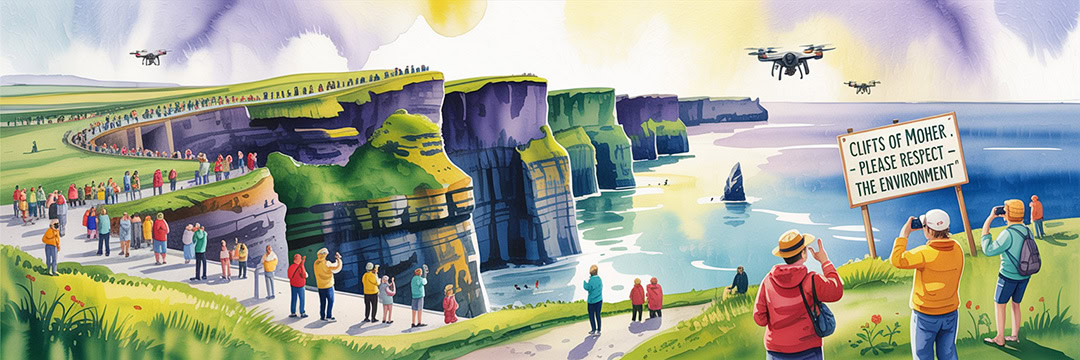
“If I had the time and money, I would love to see the Great Barrier Reef in Australia and the Cliffs of Moher in Ireland. I have seen pictures and videos of them, and they look so unique and powerful. I think it would be unforgettable to stand there and see them in real life.”

TRANSCRIPT

“I think people should protect these places by following the rules, not leaving rubbish, and respecting the animals that live there. Governments should also limit the number of visitors and invest in keeping the area clean and safe. That way, future generations will also be able to enjoy them.”
key language

Go through this flashcard set and check some of the vocabulary from the video you are going to watch.

watch the video

Watch the video. Make notes about the places it mentions. 

COMPREHENSION

DO YOU REMEMBER

Answer the questions below. Use the information from the video.

1. 

Palawan Island is a busy holiday destination for tourists from all around the world.

2. 

Palawan Island is home to many aquatic animals which can only be found there.

3. 

Seljalandsfoss waterfall is fed by the water from a nearby lake.

4. 

Seljalandsfoss waterfall is easily accessible from a nearby road.

5. 

Plitvice Lakes National Park features 18 interconnecting lakes.

6. 

Plitvice lakes change colour thanks to minerals, organisms and the sun.

7. 

Algar de Benagil used to be a fishing place.

8. 

Algar de Benagil can only be accessed by a car and a long walk.

9. 

Cliff of Moher was built by Napoleon.

10. 

Cliff of Moher are home to many species of birds.

11. 

The Great Barrier Reef is the world's second largest structure made by a living organism.

12. 

The nearby beach has a special sand that does not get hot.


Well done! You are doing great! Keep up the good work!

13. 

Antelope Canyon was made by gold prospectors.

14. 

Antelope Canyon looks the best in the summer when there is the most sunlight.

15. 

Iguazu Falls is the largest waterfall of this kind.

16. 

Iguazu Falls most spectacular part is called the Devil's Throat.

17. 

Moraine Lake is surrounded by the Rocky Mountains.

18. 

Moraine Lake was featured on the Canadian 50 dollar bill.


Well done! You're almost there!

19. 

Salar de Uyuni used to be a normal lake in pre-historic times.

20. 

Salar de Uyuni is interesting not only for it's beauty but also for rare minerals which can be found there.

Travel Brochures

Complete the fill-in-the gaps activity below.

POLL

Cast your vote in the poll below. Compare your answer with these submitted by other respondents. 

Which of the ten places shown in this lesson would you like to visit most?

×
w

DISCUSSION

DIALOGUE

In this conversation, Alita and Pete talk about stunning natural places they’ve visited or dream of visiting. Through their discussion, they reflect on what makes a place truly memorable.

Alita: Pete, have you ever seen a place so breathtaking that you just stopped and stared?

Pete: Absolutely. Last year I went hiking in the Alps, and the jagged rock formations with snow on top were just jaw-dropping.

Alita: That sounds amazing! I once discovered a hidden gem in northern Scotland—this tiny loch surrounded by majestic cliffs. There was no one around, just birds and silence. It felt almost… eerily perfect.

Pete: I love moments like that. I think nature has a way of making you feel both small and connected at the same time. The vast open spaces really help you reset.

Alita: I agree. And the colors—some places have such vivid tones. I remember a sunset in Morocco that looked like a painting.

Pete: Sounds glorious. I also think places that allow you to explore till your heart’s content are the most special. Whether it’s a long hike trail or a peaceful beach.

Alita: Exactly! It doesn’t even have to be a famous site. Sometimes the places that don’t feature on travel blogs are the best. I once snuck into an old castle ruin in Ireland—it had been mostly dismantled, but it felt magical.

Pete: You know, I used to chase places that got the lion’s share of attention on social media. But now I prefer those quiet, adorable spots that make me feel at peace.

Alita: So true. I think beauty is not just about the view, but how a place makes you feel.

Pete: Well said. I guess the real treasures are the ones that make us stop, breathe, and truly take in the moment.

OVER TO YOU

Discuss these questions. Refer to the topic of the lesson and your own experience.

BulletHave you ever visited a place that you would describe as breathtaking? What made it special?
BulletDo you prefer popular tourist spots or hidden gems? Why?
BulletHave you walked a hike trail that left a lasting impression on you?
BulletWhich places in proximity to your home are worth exploring?
BulletHave you ever felt insignificant in nature, like when standing by the sea or looking at the stars? What was that experience like?

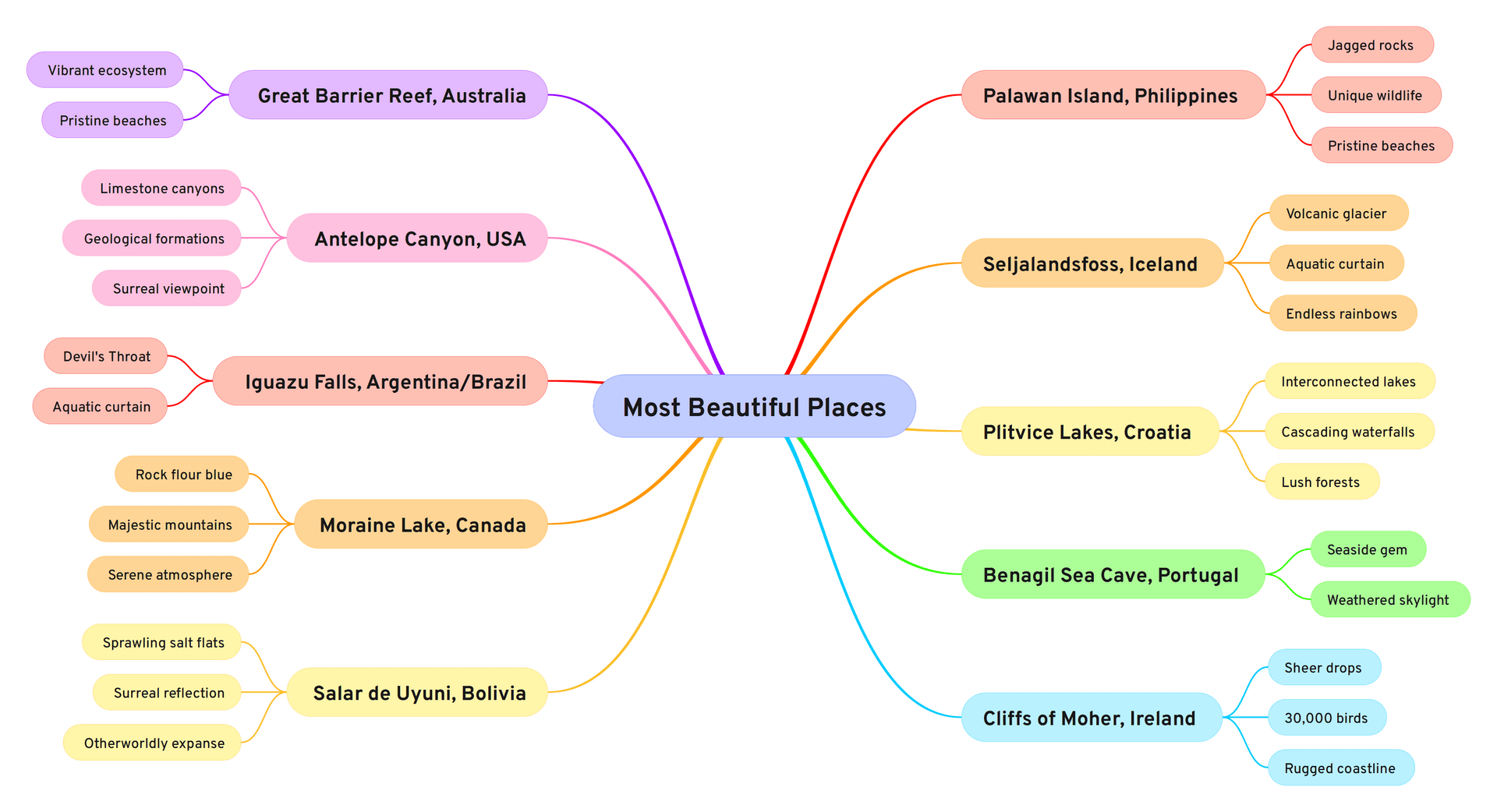
MIND-MAP

Check out (and download) this neat mind-map about these travel destinations. Use it to learn and remember what they are famous for.
lesson glossary

Check out the language from the lesson. You can download this table in many practical formats. 

Why don’t you add new words from this class to your Dictionary?

COMMENTS

Have you seen a place which should be on this list? Describe it here.

How Focus Music Hacks Your Brain

How Focus Music Hacks Your Brain

Sorry, but lessons on The Blue Tree work only on a computer or a tablet.

Bardzo mi przykro, ale lekcje na platformie The Blue Tree działają jedynie na komputerze lub tablecie.

Do zobaczenia na większym ekranie 🙂

Zespół The Blue Tree

How Focus Music Hacks Your Brain
Learn more words

THE BLUE TREE

How to Learn

CEF B1

CEFR B2

Upper
Intermediate

warm up

Answer the questions below. Then listen to audio answers and report back on what you’re heard.

TRANSCRIPT

Yes, I do listen to music when I study! I find it helps me get into the zone, especially when I’m working on something that requires a lot of focus. I usually put on instrumental or classical music because it doesn’t have lyrics, so it doesn’t distract me. It just sort of fades into the background while I concentrate.

TRANSCRIPT

When I want to relax, I like to listen to soft jazz or acoustic music. There’s something about the calming rhythms and melodies that help me unwind after a long day. Sometimes, I’ll even listen to nature sounds or ambient music, which has this amazing way of making me feel peaceful and grounded.

Does music help you focus, or does it distract you?
TRANSCRIPT

Music can sometimes be distracting for me, especially if it’s a song I know really well or if it has lyrics. I tend to get caught up in the words or the beat. But when I need to focus, I go for ambient or lo-fi music. It’s simple enough to not grab my attention but still creates a nice environment that helps me stay on task.

part one

KEY LANGUAGE

Go through the flashcards below. Make sure you understand all the words and expressions.

VIDEO

Watch the first part of the video.

COMPREHENSION

Answer these questions. Refer to the information from the video.

  • Does music affect our brain?
  • What is Brain Entrainment and how is it used in shops and offices?
  • Why is regular music not ideal for focusing?

part two

KEY LANGUAGE

Go through the flashcards below. Make sure you understand all the words and expressions.

VIDEO

Watch the second part of the video.

COMPREHENSION

Answer these questions. Refer to the information from the video.

  • What is Amplitude Modulation?
  • How can we know which rhythms are good for focus, rest and sleep?
  • What do you think of the idea of data-driven sound design?

POLL

Cast your vote in the poll.

Coming Soon
Would you like to try out these sounds to see if they work on you?
Total Votes : 5

lesson glossary

COMMENTS

How important is music for you?

Do you have a favourite type of music?

Does music affect how you feel?

Share your views and experience here.

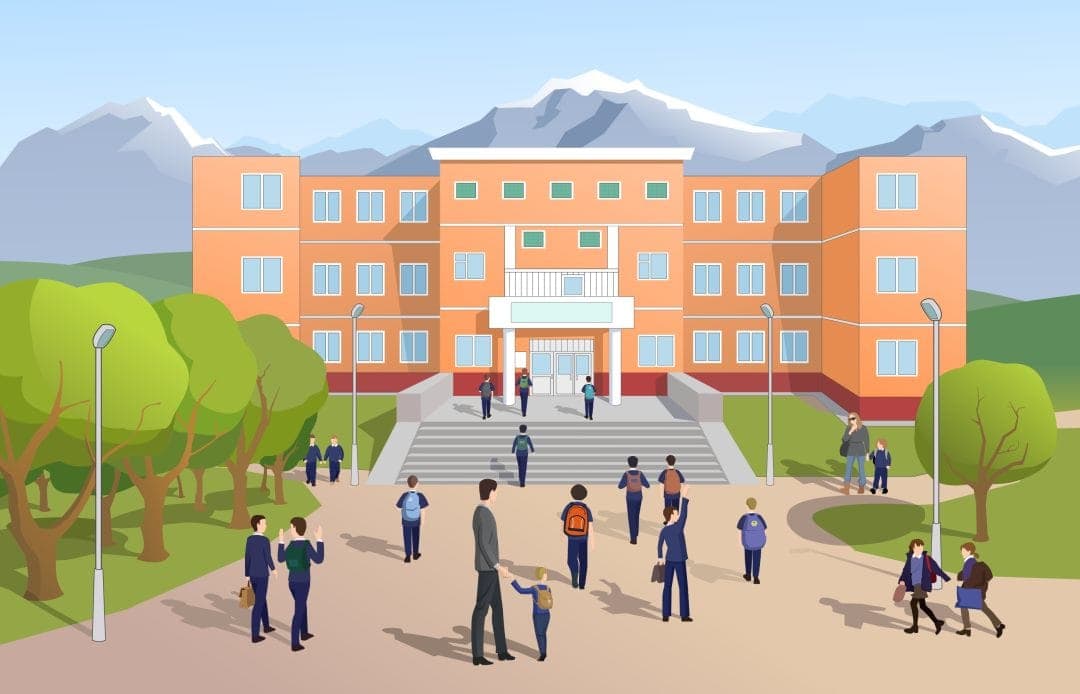
Do schools kill creativity?

Do schools kill creativity?

Sorry, but lessons on The Blue Tree work only on a computer or a tablet.

Bardzo mi przykro, ale lekcje na platformie The Blue Tree działają jedynie na komputerze lub tablecie.

Do zobaczenia na większym ekranie 🙂

Zespół The Blue Tree

back to HOME > Personal Development  > How to learn > Do schools kill creativity

Learn more words

THE BLUE TREE

How to Learn

CEF B1

CEFR B2

Upper
Intermediate

warm up

Answer the questions below. Listen to the answers below.

TRANSCRIPT

I had a mixed experience with school. I liked learning new things, especially when it came to subjects I was passionate about, like literature and art. But sometimes, the structure felt too rigid, and I didn’t always feel like there was enough room for creativity. There were parts of school that I enjoyed, but other times, it felt more like going through the motions rather than being truly engaged.

TRANSCRIPT

I think schools are meant to teach kids the basics of knowledge, like reading, math, and critical thinking, but they should also be places that help students figure out who they are and what they want to do. It’s not just about academic subjects; schools should help young people develop life skills, creativity, and confidence. That way, they can find their passions and use them to contribute to society.

Do schools do a good job preparing young people for adult life?
TRANSCRIPT

I think schools could do a better job of preparing young people for adult life. They teach academic subjects, but they often don’t focus enough on practical life skills—things like managing finances, critical thinking, or emotional intelligence. Preparing students for adult life should go beyond textbooks and exams, helping them develop the adaptability and resilience they’ll need in the real world.

part one

KEY LANGUAGE

Go through the flashcards below. Make sure you understand all the words and expressions.

VIDEO

Watch the first part of the video.

COMPREHENSION

Answer these questions. Refer to the information from the video.

  • What are schools for according to Sir Ken Robinson?
  • What don’t we know and why is it a problem for education?
  • What does Sir Robinson think about creativity?

part two

KEY LANGUAGE

Go through the flashcards below. Make sure you understand all the words and expressions.

VIDEO

Watch the second part of the video.

COMPREHENSION

Answer these questions. Refer to the information from the video.

  • What does the story of a little girl drawing God illustrate?
  • Who does the educational system favour?
  • Should schools put as much importance on dance as on languages?

part three

KEY LANGUAGE

Go through the flashcards below. Make sure you understand all the words and expressions.

VIDEO

Watch the third part of the video.

COMPREHENSION

Answer these questions. Refer to the information from the video.

  • What does it mean intelligence is:
    • diverse
    • dynamic
    • distinct?
  • Retell the story of Gillian Lynne.
  • What does her story illustrate?
  • Why is it critical that school do a better job of preparing children for the future?

POLL

Cast your vote in the poll.

Coming Soon
Do schools succeed in preparing children for the future?
Total Votes : 3

lesson glossary

Do schools kill creativity - Sir Ken Robinson

The new 5 second rule

The new 5 second rule

The new 5 second rule
Learn more words

THE BLUE TREE

Better
Communicator

CEF B1

CEFR B2

Upper
Intermediate

warm up

Answer these questions. Then listen to Bella share her views. Report back what you heard.

TRANSCRIPT

I think it takes just a few seconds to make a first impression — maybe five or six. It happens almost instantly, before we even realise it. Our brain is wired to notice things like body language, tone of voice, and facial expressions right away. Of course, that impression can change later, but the first few seconds definitely set the tone for how we see someone.

They say, “You only have one chance to make the first impression.” What do you think about it?
TRANSCRIPT

I think that’s mostly true, but not completely. The first impression is powerful — people often decide whether they like or trust us within seconds. But I also believe we can change that impression over time, especially if we act consistently and show our real personality. Sometimes people just need to see us in a different context to realise who we truly are.

TRANSCRIPT

I think we have some control, but not total control. We can choose how we dress, how we smile, or how confident we sound — that’s the part we manage. But people’s reactions also depend on their mood, experiences, or expectations, and that’s something we can’t influence. So, I’d say we can guide the impression, but we can’t fully control how others see us.

part one

KEY LANGUAGE

Go through the flashcards below. Make sure you understand all the words and expressions.

VIDEO

Watch the first part of the video.

COMPREHENSION

Answer these questions. Refer to the information from the video.

  • What does our brain do when you meet a new person?
  • What serves as a frame of reference when we make a first impression?
  • What happens when our first impression is wrong?
  • What does it mean “to see the other person”?

part two

KEY LANGUAGE

Go through the flashcards below. Make sure you understand all the words and expressions.

VIDEO

Watch the second part of the video.

COMPREHENSION

Answer these questions. Refer to the information from the video.

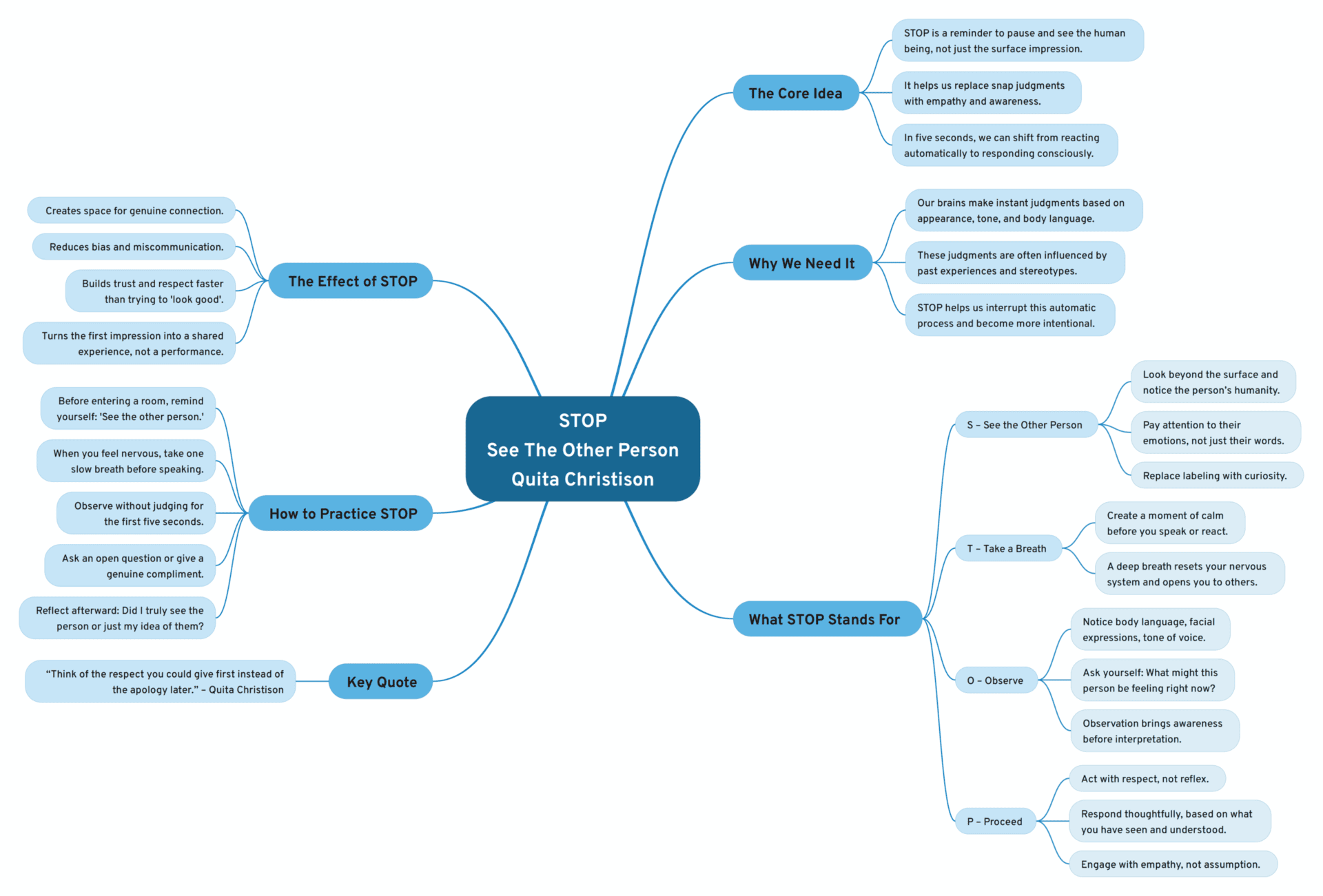
  • What does the acronym STOP mean?
  • What is the advantage of the STOP approach?
  • What does Quita ask us to do when we meet a new person?

Quita Christison

The new 5 Second Rule

“Think of the respect you could give first instead of the apology later.”

POLL

Cast your vote in the poll.

Coming Soon
Does first impression matter?
Total Votes : 14
w

DISCUSSION

Coming Home After the Company Reception

Read or role play this dialogue. 

Alita: That was quite a reception! I didn’t expect so many new people. My head is still spinning from all the names and faces.

Pete: Same here. At first, I felt completely out of place. But then I remembered the STOP idea — See The Other Person.

Alita: Oh yes! I tried to use it too. Instead of worrying how I looked, I focused on really seeing the person in front of me.

Pete: That’s what helped me start a real conversation. I stopped thinking about making a perfect impression and just listened. One guy from IT was shy at first, but once I noticed his badge said “photography club,” we clicked right away.

Alita: That’s such a great example. I used to think first impressions were all about control — what I wear, how I smile. But tonight I realised it’s more about presence than performance.

Pete: Exactly. When we truly see others, they feel it. And that changes everything.

Alita: I agree. It’s almost like pressing pause on our inner critic for five seconds, and giving space for the other person to be seen.

Pete: Right. And it’s amazing how a small shift in focus can make us feel more relaxed and authentic too.

Alita: So true. Next time we have an event like this, I’ll remind myself: “STOP — See The Other Person.”

Pete: Me too. Maybe that’s the real secret behind a good first impression.

OVER TO YOU

Discuss these questions.

BulletQuita says we often make snap judgments about people. Why do you think our brain does that so quickly?
BulletWhat does it mean to “See The Other Person”? How can this mindset change your first impression of someone?
BulletQuita suggests giving respect first instead of the apology later. Can you think of a situation where that advice would apply?
BulletWhen was the last time your first impression of someone turned out to be wrong? What made you change your mind?
BulletHow can you use the “STOP” idea in everyday situations — not just at receptions or meetings, but also at work, school, or home?

MIND-MAP

Use the mind-map below to have a more in-depth conversation about this topic.

STOP - See the Other Person

lesson glossary