Developing a Growth Mindset with Carol Dweck

Developing a Growth Mindset with Carol Dweck

Sorry, but lessons on The Blue Tree work only on a computer or a tablet.

Bardzo mi przykro, ale lekcje na platformie The Blue Tree działają jedynie na komputerze lub tablecie.

Do zobaczenia na większym ekranie 🙂

Zespół The Blue Tree

Developing a Growth Mindset with Carol Dweck
Learn more words

THE BLUE TREE

How to Learn

CEF B1

CEFR B1

Intermediate

warm up

Answer these questions. Listen to Alita’s answers and report back what she said.

How do you feel about doing something difficult?
TRANSCRIPT

Doing something difficult? Well, I think it’s like trying to climb a really steep hill. Sometimes I look up and think, “Wow, that’s going to be tough.” But I also get a bit excited, you know? Like, what if I actually make it to the top? That would be amazing. So, yeah, it’s hard, and sometimes I want to give up, but I keep telling myself to push a bit more. After all, reaching the top could feel awesome.

Remember the time at school when you failed a test or an exam. How did it feel? What did you do about it?
TRANSCRIPT

Oh, failing a test? That takes me back. I remember feeling pretty down about it, like I let myself down. It wasn’t just about the grades, you know? It was more like, “I could have done better if I’d tried harder.” So, what did I do? First, I probably spent a bit too much time feeling sorry for myself. But then, I got this idea to not let it beat me. I talked to my teacher, asked for advice on what to focus on, and then I hit the books again. Harder this time. I made a plan, tried to stick to it, and learned how to manage my time better. It was a bit of a wake-up call, really. Made me realize that if I want something, I’ve got to work for it.

Do you think people are born with a fixed intelligence or is intelligence something we can develop?
TRANSCRIPT

I reckon it’s a bit of both, you know? Sure, some people seem to be born with a knack for certain things. Like, some are really good with numbers or art right from the start. But I truly believe that we can all get better at things if we really put our minds to it. It’s like learning Italian for me. I wasn’t born speaking it, but with practice, I’m getting there. I think our brains are like muscles in a way. The more you use them, the stronger they get. So, yeah, we might start with certain talents, but there’s always room to grow and get smarter in different areas. It’s all about not giving up and keeping on learning.

part one

KEY LANGUAGE

Go through the flashcards below. Make sure you understand all the words and expressions.

VIDEO

Watch the first part of the video.

COMPREHENSION

Answer these questions. Refer to the information from the video.

  • What does Carol say about the word ‘yet’?
  • How is this word helping children learn better?
  • What did she ask children to do and how did some of them react?
  • What did these children understand?
  • What are the two ways of raising our children?
  • What do some business owners complain about?

part two

KEY LANGUAGE

Go through the flashcards below. Make sure you understand all the words and expressions.

VIDEO

Watch the second part of the video.

COMPREHENSION

Answer these questions. Refer to the information from the video.

  • What is the first thing we can do as parents to help our kids develop Growth Mindset?
  • What should we praise them for?
  • What shouldn’t we praise them for?
  • What is Brain Points about? How does it develop Growth Mindset?
  • What does research say about the phrase: “not yet”?
  • What does Carol teach children and how did it help those who learnt this lesson?

part three

KEY LANGUAGE

Go through the flashcards below. Make sure you understand all the words and expressions.

VIDEO

Watch the third part of the video.

COMPREHENSION

Answer these questions. Refer to the information from the video.

  • What do the examples Carol mentioned illustrate?
  • What did all the schools she talked about have in common?
  • How does Growth Mindset affect the meaning of effort and difficulty?
  • What did the 13 year old boy write in his letter to Carol Dweck?
  • What kind of environment does Carol urge us to create?

POLL

Cast your vote in the poll below. Compare your answer to the answers of other students.

Coming Soon
What do you think of the idea of Growth Mindset?
Total Votes : 4

lesson glossary

Check out the language from this lesson.

Growth Mindset by Carol Dweck

Be Professional! Never say this at work!

Be Professional! Never say this at work!

Be Professional! Never say this at work!
Learn more words

THE BLUE TREE

Business English

CEF B1

CEFR A2

Pre-Intermediate

warm up

Answer the questions below.

TRANSCRIPT

I have to speak English quite often at work, especially when we have meetings with international clients or colleagues from other countries. Sometimes it’s just a short conversation or a quick update, but other times I need to explain something more complicated. At first, it was a bit stressful, but now I’m getting used to it, and I even enjoy the challenge.

TRANSCRIPT

In my job, I do more writing than speaking. I send emails every day, write short reports, and sometimes prepare documents in English. Speaking happens less often, maybe once or twice a week during online meetings. I feel more confident when I write because I have more time to think, check the vocabulary, and correct mistakes before sending anything.

TRANSCRIPT

It depends on the situation. If it’s a one-on-one conversation, I usually feel okay. But when I have to speak in front of a group, especially with native speakers, I get nervous. I worry about my grammar or pronunciation. But at the same time, I know that making mistakes is part of learning, so I try not to be too hard on myself. Every time I speak, I feel like I improve a little.

part one

KEY LANGUAGE

Go through the flashcards below. Make sure you understand all the words and expressions.

VIDEO

Watch the first part of the video.

COMPREHENSION

Answer these questions. Refer to the information from the video.

  • How important is it to know what to say in a given situation in English?
  • What is the first scenario about?
  • Why shouldn’t we say: “I don’t know”?
  • What can we say instead? Open the toggle below to see the ideas from the video.
What to say when you don't know the answer
  • I’m not sure, but I can find out.
  • I’ll find out for you.
  • Let me come back to you on that.

part two

KEY LANGUAGE

Go through the flashcards below. Make sure you understand all the words and expressions.

VIDEO

Watch the second part of the video.

COMPREHENSION

Answer these questions. Refer to the information from the video.

  • What is wrong with “I’ll try”?
  • How should we answer a specific yes/no question?
  • What can you say in this situation?
  • What is the best thing to say when you don’t think you can manage the deadline?
What to say when somebody asks you to do something by a specific time
  • I can get it done by 2pm.
  • Sure! I can have it done by 2pm.
  • I don’t think I can manage it by 2, but I can have it done by 4!
  • Actually, I don’t think I can manage it by 2, but I can definitely have it done by 4.
  • I don’t think I can manage it by Thursday, but I can definitely have it done by Friday. Would that be OK?

part three

KEY LANGUAGE

Go through the flashcards below. Make sure you understand all the words and expressions.

VIDEO

Watch the third part of the video.

COMPREHENSION

Answer these questions. Refer to the information from the video.

  • What is the third situation about?
  • How do some people react in situations like these?
  • What two words can make things a little better?
  • What else can you say?
  • Why should we use ‘we’ instead of ‘I’?
What to say when somebody is angry about something
  • I understand.
  • I understand. Let’s see what we can do.
  • I’m sorry, I understand. Let’s see what we can do about this.
  • I understand that you came all this way and it’s not ready. Let’s see what we can do.

part four

KEY LANGUAGE

Go through the flashcards below. Make sure you understand all the words and expressions.

VIDEO

Watch the fourth part of the video.

COMPREHENSION

Answer these questions. Refer to the information from the video.

  • What is the fourth situation about?
  • What is the worst thing to say in such a situation? Why?
  • What can you say instead?
What to say when you keep somebody waiting
  • I’ll be with you in a moment.
  • Sorry to keep you waiting, I’ll be right there.
  • Sorry to keep you waiting, I’ll be there with you in just a moment.

part five

KEY LANGUAGE

Go through the flashcards below. Make sure you understand all the words and expressions.

VIDEO

Watch the fifth part of the video.

COMPREHENSION

Answer these questions. Refer to the information from the video.

  • What is the fifth situation about?
  • What shouldn’t you say?
  • What are the alternatives?
What to say when you didn't understand
  • I’m sorry, I missed that.
  • I’m sorry, I missed that. Could you say it again, please?
  • Sorry, would you mind just repeating that?
  • Sorry, would you mind just repeating that for me? I missed it.

LESSON GLOSSARY

Never say this at work

Design a Better Decision-Making Process

Design a Better Decision-Making Process

Design a Better Decision-Making Process
Learn more words

THE BLUE TREE

Business English

CEF B1

CEFR B1

Intermediate

warm up

Answer the questions beelow. Listen to model answers. Read the transcript.

TRANSCRIPT

I try to rely on data whenever possible, especially at work. However, I’ve noticed that intuition also plays a role, particularly when I don’t have complete information. Other people’s opinions matter too, but I don’t want to depend on them too much. Ideally, I try to combine logic with experience.

TRANSCRIPT

In my view, the process is more important than the result. Sometimes you can follow a solid process and still fail because of external factors. But if the process is weak, even a good result might just be luck. A clear process increases the chances of long-term success.

Why do people sometimes avoid making decisions, even when they have enough information?
TRANSCRIPT

People often avoid decisions because they are afraid of responsibility. Making a choice means accepting possible consequences. Even with enough information, uncertainty can feel uncomfortable. In many organizations, the fear of criticism slows everything down.

LISTENING

Listen to the recording and try to understand the main idea from the article.

reading

Read the article below.

Design a Better Decision-Making Process for Your Organization

Unfocused meetings. 1. Competing priorities. 2. Confusion over who gets to make the final call. These are often signs that your organization has poorly designed decision-making processes. Rather than treating the symptoms, you can 3. take on the system itself. Start by breaking down the types of decisions being made across your organization, then determine who should make which ones. Distribute decision rights 4. thoughtfully to ensure everyone is clear on the 5. boundaries of their departments and roles. Of course, no one makes decisions in a 6. vacuum, and we often have to 7. rely on others to 8. execute our choices. Make sure to connect anyone who’s impacted by the decision to 9. ensure effective coordination. You might need to identify 10. liaisons to other teams, create shared calendars, or develop online portals where meeting minutes are posted. Finally, be sure to build in 11. metrics to monitor how effective decisions are. Regularly assess what’s working and what’s not, and make changes accordingly.

This tip is adapted from “How Systems Support (or Undermine) Good Decision-Making,” by Ron Carucci

konkurujące, rywalizujące

zająć się

roztropnie, w przemyślany sposób

granice

próżnia, nicość

polegać na kimś

wykonywać, wprowadzać w życie

upewnić się, zagwarantować

wskaźnik, miernik

Comprehension

Answer the questions below. Refer to the article or your own experience. 

  • What are some of the symptoms of a poorly designed decision-making process?
  • What can be done to improve this process?
  • What does it mean that ‘no one makes decisions in a vacuum’?
  • Who are ‘liaisons’?
  • What are the two final steps of a smooth decision-making process?
  • What kind of metrics work for you and your decisions?

POLL

Cast your vote in the poll.

1️⃣ When making an important decision at work, what slows the process down the most?
2️⃣ What matters most in a well-designed decision-making process?
3️⃣ When you personally make a difficult decision, you usually:
2 votes

×

PRACTICE

What are the most common steps of a well-designed decision-making process? Select the right step from the drop-down list. 

Step 1 is to:

Step 2 is to:

Step 3 is to:

Step 4 is to:

Step 5 is to:

Step 6 is to:

w

DISCUSSION

DIALOGUE

Monday morning. Alita and Pete have just finished a long meeting. The team couldn’t agree on who should make the final decision about launching a new product feature. The discussion went in circles.

They grab coffee and continue talking.

Read (role-play) this dialogue. 

Alita:
That meeting was exhausting. We talked for an hour and still didn’t decide anything.

Pete:
I know. Everyone had an opinion, but no one knew who actually had the authority to make the final call.

Alita:
Exactly. At one point, I wasn’t even sure what the real problem was anymore.

Pete:
That’s what happens when the decision-making process isn’t clear. We focus on arguments instead of structure.

Alita:
So what do you think was missing?

Pete:
First of all, clear decision rights. Someone should have said, “This is my responsibility, but I want your input.” Instead, we all tried to decide together.

Alita:
But isn’t collaboration a good thing?

Pete:
Of course it is. But collaboration doesn’t mean everyone makes the decision. Sometimes too many voices slow everything down.

Alita:
True. And I also felt that people were afraid of taking responsibility.

Pete:
Yes. If you make the decision, you own the consequences. That’s uncomfortable.

Alita:
So what would you change?

Pete:
I’d define three things in advance:
Who decides.
Who gives input.
How we measure success.

Alita:
That sounds simple. But we rarely do it.

Pete:
Simple doesn’t mean easy. It requires discipline.

Alita:
Maybe we should suggest a clearer structure next time.

Pete:
Good idea. If we don’t design the process, the confusion designs it for us.

Alita:
I like that. We should write it down.

OVER TO YOU 

Discuss these questions. Find ways to use the language you were learning in this lesson.

BulletThink about a meeting where no decision was made. What usually goes wrong in situations like that?
BulletIn some teams, everyone shares opinions, but no one makes the final decision. Why can this create problems?
BulletMany employees are afraid of being responsible for important decisions. What might cause this fear?
BulletA decision may look good on paper but fail during implementation. Why does this happen?
BulletSometimes too many people are involved in one decision. How can this affect the speed and quality of the outcome?

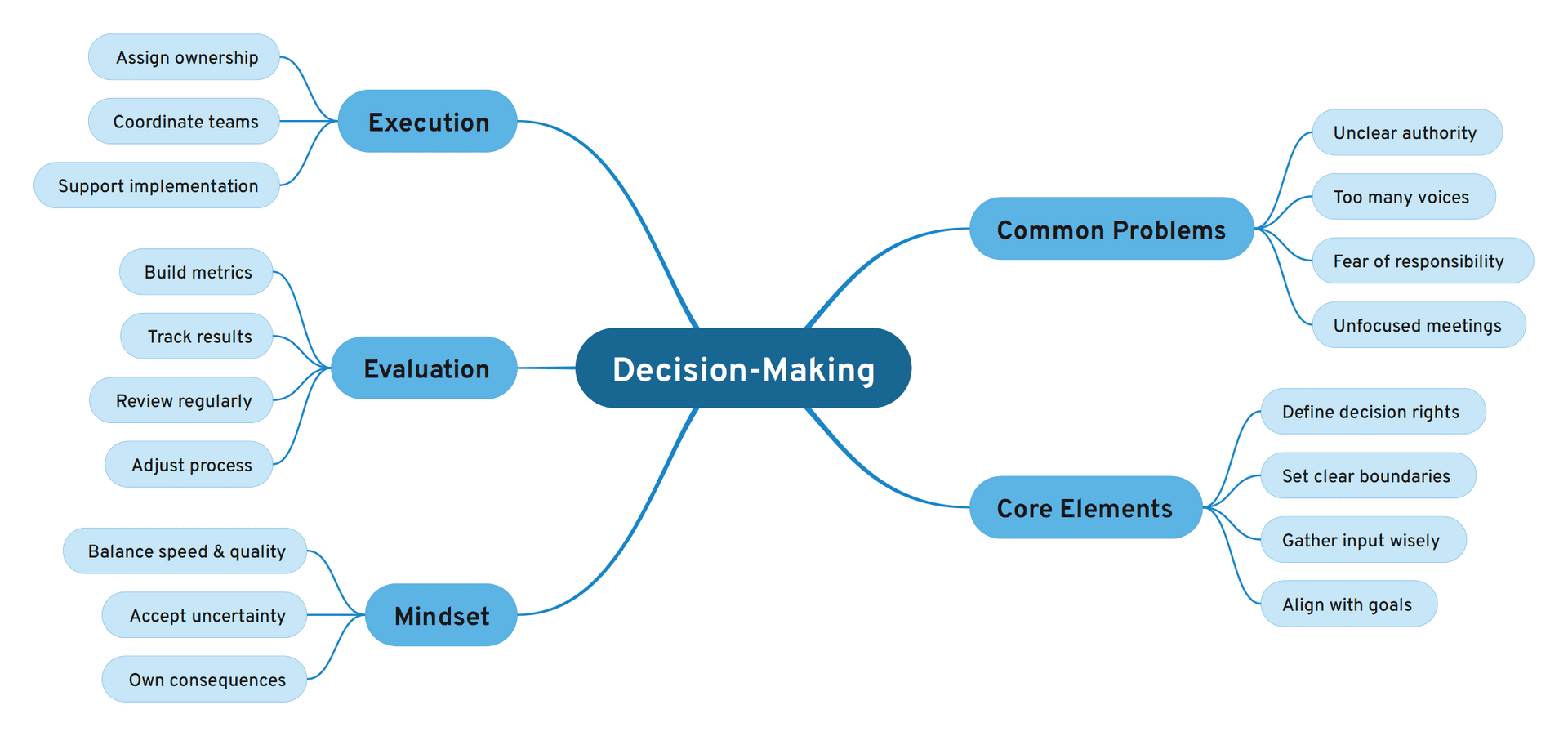
MIND-MAP

Study this mind-map to remember the ideas from this lesson better. 

COMMENTS

What is your system for making better decisions?

Share your opinions below.

Why we do what we do

Why we do what we do

Sorry, but lessons on The Blue Tree work only on a computer or a tablet.

Bardzo mi przykro, ale lekcje na platformie The Blue Tree działają jedynie na komputerze lub tablecie.

Do zobaczenia na większym ekranie 🙂

Zespół The Blue Tree

back to HOME > Personal Development  > Personal Productivity > Why we do what we do

Learn more words

THE BLUE TREE

Personal
Productivity

CEF B1

CEFR B2

Upper
Intermediate

warm up

Answer the questions below.

TRANSCRIPT

My strongest motivation is the desire to keep improving myself. Whether it’s learning something new or becoming better at my job, I love the feeling of making progress. It’s what pushes me to set goals and keep going, even when things get tough.

What can affect our motivation positively or negatively?
TRANSCRIPT

Motivation can be influenced by a lot of things. When I feel appreciated or see the positive impact of my work, my motivation gets a real boost. But when I’m overwhelmed or when it feels like my efforts aren’t being recognized, it can take a hit. Staying connected to my purpose helps me stay on track.

Do you prefer to do what you want or to be told what to do?
TRANSCRIPT

I definitely prefer to do what I want. I like having the freedom to make my own decisions and figure things out on my terms. I think it helps me stay more engaged and motivated when I have control over how I approach my work.

part one

KEY LANGUAGE

Go through the flashcards below. Make sure you understand all the words and expressions.

VIDEO

Watch the first part of the video.

COMPREHENSION

Answer these questions. Refer to the information from the video.

  • How long have they been working on the Theory of Self-Determination?
  • What is the primary distinction which Deci and Ryan introduced?
  • What does it mean to be autonomously motivated?
  • What does it mean to be controlled in your motivation?

part two

KEY LANGUAGE

Go through the flashcards below. Make sure you understand all the words and expressions.

VIDEO

Watch the second part of the video.

COMPREHENSION

Answer these questions. Refer to the information from the video.

  • What are the three basic psychological needs?
  • What is competence?
  • What is relatedness?
  • What is autonomy?
  • What does it mean to be intrinsically motivated?
  • What does it mean to be extrinsically motivated?
  • How can one promote better motivation in others?

POLL

Cast your vote in the poll.

What gives your motivation the strongest boost?
2 votes

×
w

DISCUSSION

Dialogue

Read or role-play a dialogue between two psychology students discussing the ideas from Edward Deci.

Anna:
So, what really stayed with me from the video was this idea that motivation isn’t about how much you have, but what kind it is. I’ve always thought that if I pushed myself harder, I’d get better results.

Marek:
Same here. I was raised on deadlines, grades, and pressure. It worked in the short term, but I was often exhausted. When Deci talked about controlled motivation, it honestly sounded like my entire school experience.

Anna:
Exactly. I recognized myself when he described doing things just to avoid guilt or disappointment. I used to study just so I wouldn’t feel bad about myself later. I was motivated, but it didn’t feel healthy.

Marek:
What surprised me most was how much better autonomous motivation works. Last year, I chose a research topic that genuinely interested me, not one that I thought would impress the lecturer. I worked longer hours, but I didn’t feel drained.

Anna:
That’s a great example of competence and autonomy working together. For me, relatedness was the missing piece. During my internship, my supervisor actually listened to my ideas. I felt respected, and suddenly I wanted to contribute more.

Marek:
Yes, that sense of belonging really changes things. It’s interesting how rewards can sometimes backfire. I used to think bonuses or grades were always motivating, but now I see how they can reduce internal motivation.

Anna:
I also liked the part about internalized extrinsic motivation. Not everything we do has to be fun. I don’t love statistics, but once I understood why it matters for research, I stopped resisting it so much.

Marek:
Same with my part-time job. I wouldn’t say I’m passionate about it, but I value what it gives me—independence and experience. That makes a huge difference in how I approach my work.

Anna:
Overall, the video made me rethink how motivation works in real life. Especially as future psychologists—we shouldn’t just ask how to motivate people, but how to support their basic needs.

Marek:
Absolutely. It’s not about pushing people harder. It’s about creating conditions where motivation can grow naturally.

OVER TO YOU

Discuss these questions.

BulletPeople are often motivated by pressure, grades, or rewards.
How can this help people, and how can it cause problems?
BulletMany people work better when they feel they have a choice.
Why does having a choice make motivation stronger?
BulletAccording to the theory, people need competence, autonomy, and connection.
Which of these is most often missing at school or at work, and what happens then?
BulletSome tasks are not enjoyable, but people still do them well.
How does knowing why a task is important change people’s attitude to it?
BulletSchools and companies often use rewards and punishment.
What other ways could they use to motivate people more effectively?

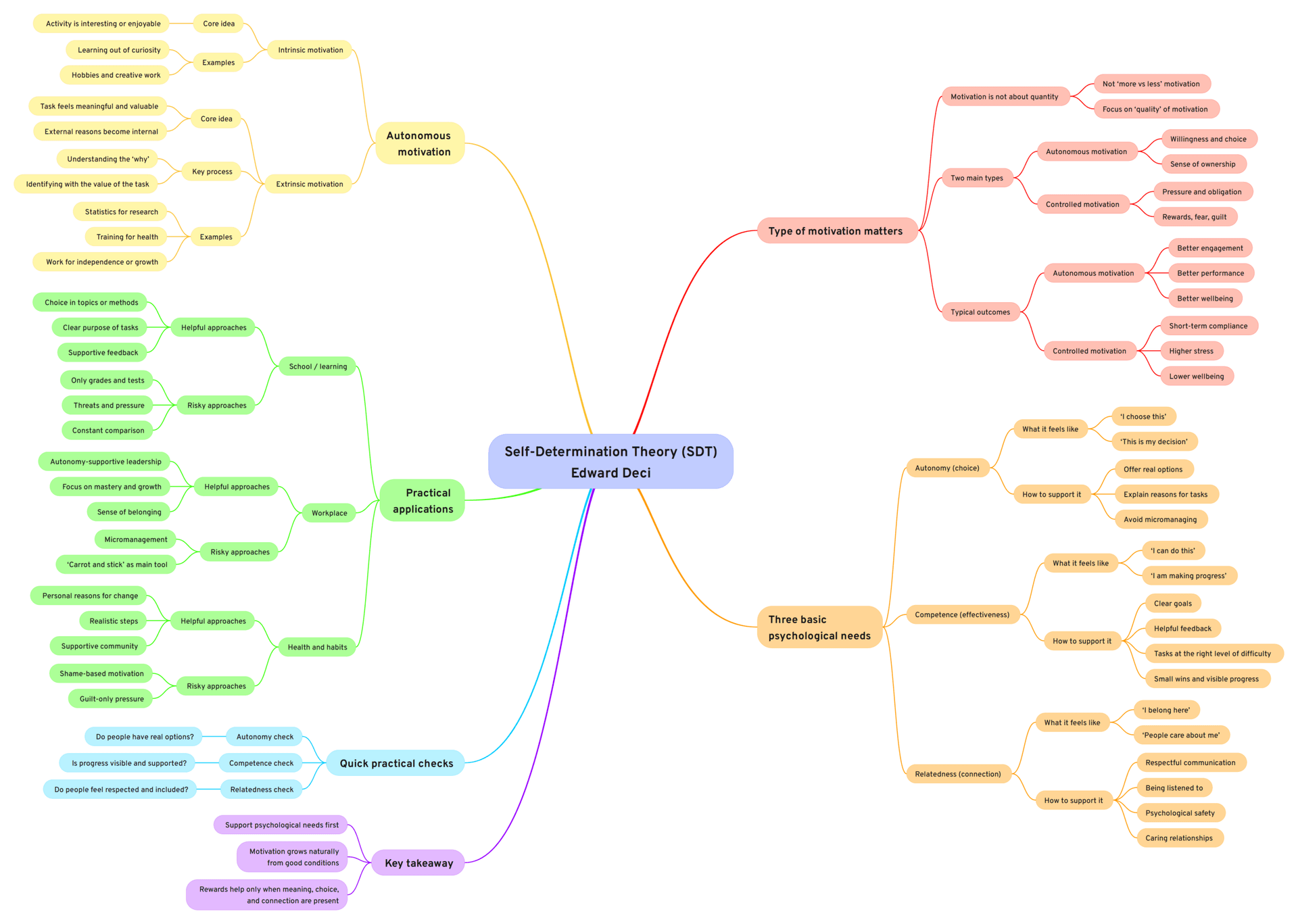
MIND-MAP

Use the mind-map below to have a more in-depth conversation about this topic.

Be respectful to your co-workers

lesson glossary

COMMENTS

What do you think of Edward Deci’s explanation of what motivates us to do things? Do you agree with him? What is your strongest drive?

Share your views and experience here.

Protect Your Non-Work Time

Protect Your Non-Work Time

Sorry, but lessons on The Blue Tree work only on a computer or a tablet.

Bardzo mi przykro, ale lekcje na platformie The Blue Tree działają jedynie na komputerze lub tablecie.

Do zobaczenia na większym ekranie 🙂

Zespół The Blue Tree

Protect Your Non-Work Time
Learn more words

THE BLUE TREE

Personal
Productivity

CEF B1

CEFR B1

Intermediate

warm up

Answer the questions below. Listen to some model answers and report back what you heard.

TRANSCRIPT

From a practical perspective, modern technology is probably the biggest reason. Smartphones constantly deliver emails and messages, so the workday never really ends. There’s also a psychological factor — people often feel that being available shows commitment. The problem with that idea is that the brain never gets proper recovery time. Without clear mental separation, work thoughts continue running in the background, even during dinner or family conversations.

What’s best when work and home overlap — strict separation or flexible boundaries?
TRANSCRIPT

In my experience, flexible boundaries usually work better than strict rules. Life rarely fits into neat categories, and sometimes important matters appear outside office hours. However, flexibility only works when people clearly decide when they are available and when they are not. Without that clarity, flexibility quickly turns into being always on duty. The key is being intentional rather than reactive about when work enters personal time.

TRANSCRIPT

The practical question is when the workday actually ends. I would suggest defining specific hours and treating them as fixed appointments, just like picking up my daughter Sally from her activities. It also helps to write a short end-of-day summary, so the mind can let go of unfinished tasks. Communicating these limits to colleagues is essential — otherwise people will assume that being available late is acceptable.

LISTENING

LISTENING FOR GIST

Listen to the article. What is the main message?

Summary

What’s the best summary for this listening?

What's the best summary of what you have just heard?

reading

READING

Read the article. Move your mouse over the underlined words to see Polish translations.

Protect Your Non-Work Time

Some jobs have very clear lines between when you’re “on” and when you’re “off.” But when you work in a role where the lines are 1. blurred — or potentially non-existent — it’s important to protect your non-work time.

If you feel like work is taking over most of your waking hours, start by clearly defining what “after hours” means for you. 2. Take into account the number of hours you’re expected to work each week, as well as personal 3. commitments like taking your kids to school, making a certain train, or attending an exercise class you really enjoy. When do you need to start and stop to put in the appropriate amount of work time?

Then, develop mental 4. clarity about what needs to get done and when you will do it. 5. Keep track of your tasks and plan them out. Make sure you block off time for an end-of-workday 6. wrap-up, where you review and make sure you did everything you needed to do for the day.

Lastly, communicate with your colleagues about how (or if) you want to be contacted during your off hours. Really guard your time. If you don’t, you won’t get the mental break that everyone needs.

zamaać, zamazywać, rozmazać

Wziąć pod uwagę

zobowiązanie

czystość, jasność, klarowność

być z czymś na bieżąco, kontrolować coś na bieżąco

podsumowanie

COMREHENSION

Now answer the questions below. Refer to the information from the article.

  • When is it especially important to protect your non-work time?
  • What should you take into account when you define your “after hours”?
  • What strategies can you use to protect your non-work time?
  • Do you have a personal system or strategy to keeping track of your tasks and duties?
  • Why do you think it is a good idea to tell your workmates how you want to be contacted after hours?
  • What does the expression “guard your time” imply?

POLL

Cast your vote in the poll.

1️⃣ When work emails arrive in the evening, what do you usually do?
2️⃣ What helps most in keeping work and personal life separate?
3️⃣ What's the biggest threat to non-work time today?
2 votes

×

DISCUSSION

DIALOGUE

Friday afternoon. Alita and Kat are having coffee after a long week.

Read or role-play this dialogue.

Alita: Kat, can I ask you something? How do you actually manage to disconnect from work in the evenings? I’ve been struggling with it lately.

Kat: That’s something I had to learn the hard way. When Sally was younger, I realised I couldn’t keep checking emails during family dinners. So I started setting a clear cut-off time — 6 p.m., no exceptions.

Alita: Just like that? Doesn’t it feel difficult when something urgent comes in?

Kat: In real life, most “urgent” things can actually wait until morning. The practical question is whether replying at 9 p.m. really changes the outcome. Usually, it doesn’t.

Alita: That makes a lot of sense. I never thought about it that way.

Kat: Another thing that helps me is a short end-of-day routine. Before I close my laptop, I write down three priorities for the next day. Then my brain knows the work is parked somewhere safe.

Alita: Oh, I like that. It sounds almost like closing a door behind you.

Kat: Exactly. And the third thing — I told my colleagues clearly how to reach me after hours. Only emergencies, only by phone. Emails can wait.

Alita: And they respect that?

Kat: Most of them, yes. People usually follow the limits you set, but only if you actually set them. If you stay available all the time, they assume you’re fine with it.

Alita: That’s really helpful. I think my main problem is that I never made those rules clear — not even to myself.

Kat: That’s where it always starts. Once you know your own limits, it becomes much easier to protect them.

DISCUSSION QUESTIONS

Discuss these questions. Refer to the ideas from this lesson and your own experience.

1Why do many people find it difficult to set clear limits between work and personal life?
2What’s best for long-term wellbeing — being constantly available or having strict non-work hours?
3Many people believe that replying to messages quickly shows commitment. Why might this attitude actually harm a career?
4Advise someone who feels guilty whenever they ignore work messages in the evening.
5How can a short end-of-day routine change the way people experience their free time?

MIND-MAP

Dive deeper into this topic with the help of this interactive MINDOMO mind-map.

COMMENTS

How important is to protect your non-work time? Have you found a way to balance work and life?

Share your views and experience here.