Giving suggestions and recommendations

Giving suggestions and recommendations

Sorry, but lessons on The Blue Tree work only on a computer or a tablet.

Bardzo mi przykro, ale lekcje na platformie The Blue Tree działają jedynie na komputerze lub tablecie.

Do zobaczenia na większym ekranie 🙂

Zespół The Blue Tree

Giving suggestions and recommendations
Learn more words

THE BLUE TREE

Everyday English

CEF B1

CEFR B1

Intermediate

warm up

Discuss these questions.

TRANSCRIPT

Oh, getting lost? Not my favourite, but it happens, right? Honestly, I’m a bit on the fence about asking for directions. I mean, yeah, I’ll ask if I really need to, but there’s just something about trying to figure it out on my own first. You know, like a mini adventure in the middle of London. But don’t get me wrong, if I’m really scratching my head, I’ll swallow my pride and ask someone. Most people are proper helpful, anyway.

TRANSCRIPT

Ah, being told what to do? Not really my cup of tea, to be honest. I get that sometimes people are just trying to be helpful, and I appreciate that, really. But, you know, I like to figure things out on my own, make my own decisions. It’s kinda important for me to feel like I’m in charge of my own life, you know? If someone’s advice comes from a good place, I’ll listen, maybe take it on board. But at the end of the day, I prefer to call my own shots.

TRANSCRIPT

Yeah, I like to think I’m pretty decent at giving advice and suggestions. You know, I’ve been around the block a few times, had my share of ups and downs. So, when friends come to me with something they’re going through, I feel good being able to share what I’ve learned, maybe help them see things from a different angle. I try to listen first, really understand where they’re coming from. Then, I’ll share my thoughts, but I always make it clear it’s just my perspective. At the end of the day, it’s their call. I just hope I can help them feel a bit more sorted about whatever it is they’re dealing with.

part one

Suggesting in speech

Study the ways of giving suggestions and recommendations.

Notice the form of verbs that follow ‘suggestion’ words.

1. I recommend … (doing)

General English: I recommend visiting the new art exhibition downtown; it’s really impressive.
Business English: I recommend scheduling the meeting for Friday afternoon when everyone is available.

2. I suggest … (doing)

General English: I suggest trying the Italian restaurant on Maple Street; their pasta is amazing.
Business English: I suggest reviewing the quarterly sales report in detail before making any major decisions.

3. If I were you, I would … (do)

General English: If I were you, I would take a few days off to rest and recharge.
Business English: If I were you, I would prioritize the most critical tasks first to ensure they are completed on time.

4. My advice would be to … (do)

General English: My advice would be to start your assignments early to avoid last-minute stress.
Business English: My advice would be to consult with the finance department before finalizing the budget.

5. Have you thought of … (doing)

General English: Have you thought of joining the local gym to stay fit and healthy?
Business English: Have you thought of using project management software to streamline our workflow?

6. Why don’t you … (do)

General English: Why don’t you take a walk in the park to clear your mind?
Business English: Why don’t you draft a preliminary proposal for the client to review?

7. How about … (somebody do)

General English: How about we watch a movie tonight?
Business English: How about we schedule a brainstorming session to generate new ideas?

8. It might be a good idea to … (do)

General English: It might be a good idea to save some money for unexpected expenses.
Business English: It might be a good idea to schedule a meeting with the team to discuss the project timeline.

8. You’d be better off if you … (did)

General English: You’d be better off if you focused on your studies instead of partying all the time.
Business English: You’d be better off if you addressed these issues directly with the client to avoid misunderstandings.

9. On no account … (inversion, ex. On no account should you do …)

General English: On no account should you leave your belongings unattended in a public place.
Business English: On no account should you share confidential information with unauthorized personnel.

10. You would do well … (to do)

General English: You would do well to listen to their advice and learn from their experience.
Business English: You would do well to prepare a detailed report before presenting your findings to the board.

11. Perhaps we could … (do)

General English: Perhaps we could invite some friends over for dinner this weekend.
Business English: Perhaps we could collaborate with the marketing team to develop a comprehensive campaign.

12. Shall we … (do)

General English: Shall we go for a coffee after work?
Business English: Shall we review the contract together to ensure we haven’t missed anything?

VERB PATTERNS

Play this Multidecker flashcard game. Decide what should be the verb pattern of the verbs and expressions on the cards.

part two

Suggesting in WRITING

Study the ways of giving suggestions and recommendations in business reports and emails.

Notice the form of verbs that follow ‘suggestion’ words.

SAMPLE EMAILS

email 1

Subject: Advice on Improving Client Retention Strategy

Dear Marta,

Thanks for sharing your draft plan to improve client retention. I’ve looked through your proposal, and I think you’re on the right track. I’d like to offer a few suggestions for further improvement:

  • You might want to consider segmenting your clients based on their value and engagement level. This could help us tailor our approach more effectively.

  • It might be a good idea to send personalized follow-up emails after each project is completed.

  • I suggest involving the sales team earlier in the onboarding process to build stronger initial relationships.

Let me know what you think. I’m happy to discuss this in more detail.

Best regards,
Tomasz

email 2

📧 Email 2 – Formal Tone (to a client or senior manager)

Subject: Strategic Input on Your Expansion Plan

Dear Mr. Kowalski,

Thank you for sharing your outline regarding the potential expansion into the Baltic region. I have reviewed your proposal and would like to offer several recommendations for your consideration:

  • You may wish to conduct a comprehensive risk assessment focused on local regulatory frameworks. This would ensure full compliance before any commitments are made.

  • It would be advisable to initiate preliminary discussions with local partners to gauge market interest and potential synergies.

  • Might I suggest arranging a workshop with our regional specialists to explore logistical challenges and customer behavior trends?

Please don’t hesitate to reach out if you’d like to schedule a follow-up meeting to discuss any of these points in more detail.

Kind regards,
Anna Nowak
Business Strategy Consultant

email 3

📧 Email 3 – Informal/Neutral Tone (between colleagues)

Subject: Quick Thoughts on the Marketing Campaign

Hey Kasia,

Just had a look at your draft for the new campaign — great work! It’s shaping up nicely. I do have a few suggestions that might help fine-tune things:

  • Why don’t we run a short A/B test first to see which message performs better?

  • Have you thought of reaching out to the social media team? They might have fresh data on recent engagement trends.

  • You could also try simplifying the call to action — right now it’s a bit wordy, and a snappier version might get more clicks.

Let me know what you think. Happy to chat later this week if you want to brainstorm!

Cheers,
Ola

SAMPLE REPORTS

REPORT 1

📊 Example Report – Making Recommendations to Management

Title: Recommendations for Enhancing Internal Communication

To: Senior Management
From: Internal Communications Consultant
Date: April 9, 2025
Subject: Internal Communication Strategy – Recommendations


Executive Summary:

This report outlines several recommendations to improve internal communication within our organization. These suggestions are based on employee feedback collected during the Q1 engagement survey.


Recommendations:

  1. I recommend implementing a bi-weekly internal newsletter, summarizing key updates, upcoming events, and team highlights. This would increase transparency and foster a stronger sense of inclusion.

  2. My advice would be to create a digital “suggestion box”, allowing employees to submit ideas or concerns anonymously.

  3. You would do well to introduce regular all-hands meetings where leadership shares updates and answers employee questions live.

  4. It might be a good idea to assign communication champions in each department to ensure important messages are delivered consistently.


Conclusion:

Adopting these measures can enhance transparency, improve morale, and increase alignment across teams. I’m available to support the implementation process if needed.

REPORT 2

📊 Report Fragment 2 – Formal Style

Section Title: Recommendations for Optimizing Remote Work Policy

Based on our findings, the following actions are recommended to enhance the effectiveness of the remote work policy:

  • It is recommended that management introduce a structured feedback system, allowing employees to regularly report on their remote work experiences and challenges.

  • We advise establishing clear performance metrics tailored specifically to remote roles to ensure accountability and fairness.

  • Consider providing additional training on digital collaboration tools, as survey results indicate uneven usage across departments.

Implementing these measures could lead to increased productivity, clearer communication, and improved employee satisfaction.

REPORT 3

📊 Report Fragment 3 – Less Formal but Professional

Section Title: Suggestions for Improving Team Onboarding

After reviewing recent onboarding feedback, a few practical ideas came up that might help improve the process:

  • You might want to think about assigning a buddy to each new hire, at least for their first month. It would help them settle in faster and feel more supported.

  • It could also be helpful to shorten the initial training sessions and spread them out over the first two weeks — people often feel overwhelmed with too much information at once.

  • Another suggestion is to include a short welcome video from the CEO, which could add a personal touch and make new employees feel more connected to the company’s values.

These simple changes could make the onboarding experience smoother and more engaging for new team members.

‘SUGGESTING’ QUIZ

Do this quiz to learn and memorize the verb pattern with ‘suggesting’words.

1) I recommend ...
2) If I were you, I would ...
3) How about ...
4) You could ...
5) It might be a good idea to ...
6) You’d be better off if you ...

7) I suggest ...
8) Why don’t you ...
9) Perhaps we could ...
10) My advice would be to ...


Well done! You're almost there!

11) You would do well ...
12) On no account ...

FREE PRACTICE

IF I WERE YOU

What advice would you give to your friend in these ten situations?

I come from a family of doctors. Everyone expects me to be a doctor too. I don’t want to become a doctor. I want to be a teacher. 

I am sharing my office with a guy who has a terrible allergy. He keeps using all my tissues and never brings his own. 

I have been invited to a job interview. It will take place in some fancy restaurant. I don’t have the right clothes for the occasion and I’m hard-up at the moment.

The clerk at the convenience store gave me too much change last night. I have discovered it this morning. 

I let a friend use my flat while I was gone on holiday. When I returned the flat was a mess. 

I am putting on weight. It begins to bug me. What should I do to lose some weight?

I have been working for the same company for almost ten years. My salary hasn’t changed much since my first day at this firm. What should I do? Stay at this job, ask for a raise or just move?

My boyfriend loves watching horror movies. I hate such kind of films, honestly. We often argue what to do on a Friday evening. Any advice?

It takes me more than two hours to get to and from work every day. I feel that I am wasting all that time.

One of my colleagues keeps swearing at work. I think this is highly inappropriate, but I don’t know if I should do anything about it.

ADVICE IN BUSINESS WRITING

Write an email or a fragment of a report using the prompts below. 

You are the marketing coordinator at a mid-sized technology company.

Your colleague, Katarzyna, is preparing her first solo presentation for a major client meeting next week. She sent you a draft of her slides and asked for your opinion.

You have reviewed the presentation and think it has potential, but there are a few areas that could be improved, especially the structure, clarity of visuals, and use of key messages. You want to encourage her, but also offer clear and constructive advice.


Your Task:

Write an email to Katarzyna (100–150 words), giving her advice on how to improve her presentation. Use polite and professional language. Include at least three different ways of giving advice or making suggestions.

✉️ Email Writing Scenario 2 – Staff Conflict Resolution

You are a team leader in the HR department.

One of your colleagues, Michał, is having ongoing communication issues with another team member. He’s frustrated and recently sent you a message asking for advice on how to handle the situation professionally. You know both individuals well and believe the conflict is mainly due to misunderstandings and unclear task responsibilities.


Your Task:

Write an email (100–150 words) to Michał offering your advice on how he can address the situation constructively. Be supportive, diplomatic, and suggest at least three possible actions he could take. Use different expressions for giving advice.

✉️ Email Writing Scenario 3 – Time Management Problems

You are a senior consultant in a busy consulting firm.

Your junior colleague, Aneta, recently started managing her first client project and is struggling with time management. She has missed two internal deadlines and asked you for tips on how to stay on track. You want to give her practical and encouraging advice to help her succeed.


Your Task:

Write an email (100–150 words) to Aneta with clear, practical suggestions to help her manage her time more effectively. Be supportive and professional. Use a variety of phrases to express recommendations and advice.

📊 Report Writing Scenario 1 – Improving Customer Satisfaction

You work as a customer experience analyst at a retail company.

You have been asked to prepare a short internal report for the Operations Manager based on the results of a recent customer satisfaction survey. The survey revealed issues with delivery delays, unhelpful customer service, and lack of follow-up communication.


Your Task:

Write the Recommendations section of the report (120–180 words). Include at least three specific recommendations for improving customer satisfaction. Use formal, business-like language and a range of phrases for giving advice and making suggestions.

📊 Report Writing Scenario 2 – Reducing Office Costs

You are part of the finance team in a medium-sized law firm.

Management has asked you to prepare a short report suggesting how the company can reduce day-to-day office expenses without affecting employee productivity. Areas to consider include printing, energy use, travel, and subscriptions.


Your Task:

Write a report fragment (120–180 words) including practical recommendations for cost reduction. Use formal and diplomatic language and include at least three different expressions for giving advice or making suggestions.

📊 Report Writing Scenario 3 – Enhancing Team Collaboration

You are a project manager at a tech startup.

Following several delays in recent projects, your CEO asked you to write a short report on how to improve collaboration among cross-functional teams. Your observations show that poor communication, unclear roles, and lack of shared tools are major problems.


Your Task:

Write the Recommendations section of the report (120–180 words). Offer three or more concrete suggestions to enhance collaboration. Use a professional tone and varied structures for giving advice.

DOWNLOAD

Download the mind-map below. Note that this mind-map includes expressions for accepting, accepting reluctanty, and rejecting a suggestion.

PRODUCT CATEGORY - Mind maps

download a mind-map

Learning is more effective when you use mind-maps!

Grit: the power of passion and perseverance

Grit: the power of passion and perseverance

Sorry, but lessons on The Blue Tree work only on a computer or a tablet.

Bardzo mi przykro, ale lekcje na platformie The Blue Tree działają jedynie na komputerze lub tablecie.

Do zobaczenia na większym ekranie 🙂

Zespół The Blue Tree

Grit: the power of passion and perseverance
Learn more words

THE BLUE TREE

How to Learn

CEF B1

CEFR B2

Upper
Intermediate

Practise speaking by describing this image.

key language

Read this extract from an English dictionary about the word ‘grit’. What does it mean?

warm up

Answer the questions below. Listen to sample answers. Report back what you heard.

Think of something you’ve always wanted to learn — maybe skiing, riding a bike, or coding a website Did you ever think of quitting?
TRANSCRIPT

I remember when I was learning to ride a bike as a kid. It wasn’t easy! I fell so many times, and there were moments when I thought, ‘Maybe I’ll never get it.’ But I kept trying because I really wanted that sense of freedom. I didn’t quit, and eventually, I got the hang of it. That feeling of accomplishment made all the falls worth it.

You want to learn something new. You have a choice. You can choose to be talented or to have 100% grit. What would you choose and why?
TRANSCRIPT

If I had the choice between being naturally talented and having 100% grit, I’d pick grit every time. Talent can give you a head start, but grit pushes you through the hard times. I believe that perseverance gets you further in life, especially when things get tough. Grit keeps you moving forward when talent alone might give up.

How important is it to be passionate about something you want to be good at? Is it possible to make oneself passionate about a topic?
TRANSCRIPT

Passion is incredibly important when you want to be good at something. It drives you to keep learning and improving, even when things get difficult. I think it’s possible to develop passion, especially if you see progress and find meaning in what you’re doing. Sometimes, the more you invest in something, the more passionate you become about it.

part one

KEY LANGUAGE

Go through the flashcards below. Make sure you understand all the words and expressions.

VIDEO

Watch the first part of the video.

COMPREHENSION

Answer these questions. Refer to the information from the video.

  • What do we learn about Angela’s career?
  • What did she find surprising about her work at school?
  • Why did she quit her teaching job?
  • What question did she want to answer through her research?
  • What do you think is the answer she has found?

part two

KEY LANGUAGE

Go through the flashcards below. Make sure you understand all the words and expressions.

VIDEO

Watch the second part of the video.

COMPREHENSION

Answer these questions. Refer to the information from the video.

  • How does Angela define grit?
  • What effect does grit have?
  • Does science know how to build grit?
  • What is the relationship between grit and talent?
  • What does Angela think we need to do to better understand how grit works?
w

DISCUSSION

DIALOGUE

Alita, and Pete are discussing the topic of grit. Read their conversation. 

Scene: A cozy cafe, afternoon light filtering through the windows. Alita and Pete sit across from each other, steaming mugs of coffee in front of them.

Alita: You know, Pete, I’ve been thinking about that book you mentioned – “Grit” by Angela Duckworth. I just can’t wrap my head around the idea that talent isn’t a significant factor in success. I mean, look around – we see prodigies and naturally talented people excelling everywhere!

Pete: I get where you’re coming from, Alita. It’s a common notion that talent plays a significant role in success. But Duckworth’s research suggests otherwise. She’s not saying talent doesn’t matter; she’s emphasizing that it’s not the only or even the most critical factor.

Alita: But surely someone with natural talent in, say, music would have an edge over someone who doesn’t, right?

Pete: Initially, yes. Talent can provide a head start. But Duckworth found that in the long run, those with grit – passion and perseverance for long-term goals – outperformed their talented counterparts. It’s because they stick with things, work hard, and don’t give up, even when the going gets tough.

Alita: So you’re saying someone with less talent but more grit would eventually surpass the talented one?

Pete: Exactly. Think of it this way: talent is like having a fast car, but grit is the fuel that keeps it going. A fast car without fuel won’t get you far. Duckworth found that when you combine talent with grit, that’s when you see some truly explosive results. But if you had to choose one, grit would take you further.

Alita: But what about people who are passionate about something but don’t necessarily have the talent for it? Should they just give up?

Pete: Not at all. That’s the beauty of Duckworth’s findings. She believes that with enough grit, passion, and perseverance, you can develop and refine your skills over time. Talent might make the initial stages easier, but grit determines how far you’ll go and how much you’ll grow.

Alita: I guess I never thought of it that way. It’s a bit empowering to think that sheer determination can outweigh innate ability.

Pete: Absolutely! It’s a testament to the human spirit. Success isn’t just about the cards you’re dealt but how you play them. And as Duckworth emphasizes, grit can be developed and nurtured, no matter where you start.

Alita: You’ve given me a lot to think about, Pete. Maybe I should give that book a read after all.

Pete: I think you’ll find it enlightening. It’s a game-changer in how we perceive success and potential.

They sip their coffee, lost in thought, letting the concepts of grit and perseverance linger in the air.

DISCUSSION QUESTIONS

Now, discuss these questions. Refer to the things you learnt in this lesson and your own experience.

  • Can you recall a time when you had to rely on your determination and persistence (grit) rather than your natural talent? How did it make you feel and what was the outcome?

  • Do you believe that anyone can develop grit? Why or why not? Share any personal experiences or observations you might have.

  • How do you think schools and teachers can help students develop more grit? Are there specific activities or approaches you think would be effective?

  • Have you ever been inspired by someone who showed tremendous grit in the face of challenges? Share their story and what you learned from it.

POLL

Cast your vote in the poll below.

Coming Soon
Which of these factors is the strongest predictor of success in your opinion?
Total Votes : 9

lesson glossary

Revise the language from the lesson using this practical glossary.

Grit

COMMENTS

Share your views and experience here.

Trends and Changes

Trends and Changes

Trends and Changes
Learn more words

THE BLUE TREE

Business English

CEF B1

CEFR B2

Upper
Intermediate

warm up

Study this graph and then listen to and read the text that follows. Do you know what all the blue expressions mean?

The chart shows the US stock market (Dow Jones index) for last year and the first quarter of this year. As can be seen from the chart, last year started on a positive note. The market rose until late February when it almost reached the 11,000 level. But interest rates were rising, and investors decided to take profits. There was a sharp fall during the month of March and the Dow bottomed out at just over 10,000. At that point investors started buying again – strong economic numbers and global liquidity (central banks printing money) offered support to the market. Over the summer the Dow was flat, trading in a range from 10,300 to 10,700. The market was unable to break out of this range, even though company profits were increasing. What was the reason? It was almost entirely due to the price of oil, which had climbed dramatically from 42 dollars a barrel at the start of the year to 68 dollars in August. This price rise was caused by the hurricane season in the Gulf of Mexico and increasing tension in the Middle East.

In mid-October, the markets started to rally strongly and went from 10,200 to 10,900 over just four weeks. This sudden jump was as a result of comments made by a member of the Federal Reserve, who indicated that interest rates would soon stop rising. This is positive for business as the cost of borrowing also stops going up. From November to January the market remained more or less unchanged, failing to break through the February highs.

Over the last few months, the market has advanced again. The economic backdrop remains healthy: company profits are good, consumer spending is up, and interest rates are close to reaching a peak. The only dark cloud is the price of oil, which has risen back to the $70 level and looks certain to go up further. The next hurricane season is approaching and production worldwide cannot be significantly expanded.

part one

UPWARD MOVEMENT – PEAKS

Study the words and expressions that describe an upward movement or change.

Downward movement – troughs

Study the words and expressions for downward movement and changes.

Horizontal movement

How about words and expressions that describe no movement? Study these flashcards and make sure you know all of these expressions.

part two

LANGUAGE OF TRENDS

Play this flashcard game. There are four categories:

➡️ upward,

➡️ downward,

➡️ horizontal,

and new one:

➡️ reason and cause. 

Make note of all the new vocabulary. 

WHAT’S THE TREND

Do the test below. Decide if the sentences describe an upward, horizontal or downward trend. 


Decide if the sentences describe an upward, horizontal or downward trend. 

1.

The economy is at last beginning to recover.

2.

Traffic reaches its peak between 8 and 9 in the morning.

3.

Sales have levelled off after a period of rapid growth.

4.

It's good to see a rally in shares on the stock market after such a weak start in January.

5.

Profits slumped by over 50%.


Keep up the good work! 

6.

House prices keep rising and falling but they should eventually even out.

7.

Share prices surged on the news of the merger.

8.

The company reported a small decline in its profits.

9.

I hope my French will improve when I go to France.

10.

The economic boom sent property prices skyrocketing.

11.

They had hit a 52-week low of $18.25 last Friday.


Well done! You're almost there!

12.

Share prices plummeted to an all-time low.

13.

The workforce has been slashed by half.

14.

The recession is finally beginning to show signs of bottoming out.

SALES REPORTS

Study these four graphs below and then do the activity that follows.

FIND THE FUNNY SIDE

Complete the joke by matching each noun or noun phrase on the left to a verb or verb phrase on the right.

part three

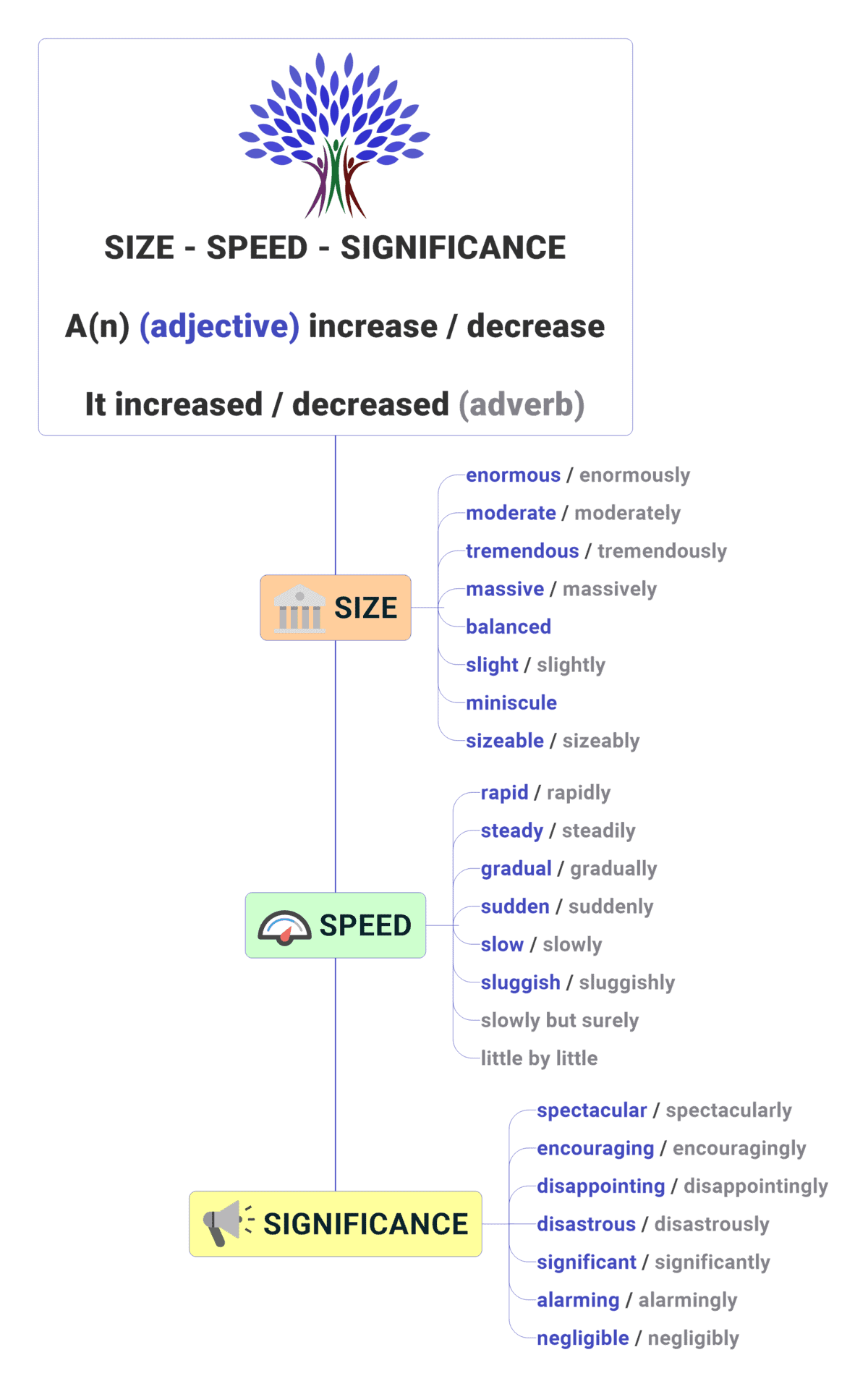
It is practical to qualify the trend with words or expressions from three categories:

  • size
  • speed
  • significance

Study the mind map and learn the adjectives and adverbs for qualifying trends.
PRACTICE 5

MD logo

Play this Multidecker game and decide if the words on the cards belong to the size, speed or significance category.

Finally, how would you complete the sentences below with these adjectives and adverbs for qualifying trends?

  1. In the last ten years there was a(n) ………………………… in my remuneration.
  2. Over the last decade my health has seen a(n) ………………………………
  3. Over the years, there has been a(n) ……………………………………… of my overall happiness.
  4. My country is experiencing a(n) …………………………. in prosperity.
  5. My overall outlook on life has seen a ……………………… over the years.

COMMENTING ON STATISTICS

When you are introducing trends, data or statistics in your presentations or reports, it is helpful to remember about three key steps:

1. HIGHLIGHT – draw your audience’s attention to your data

2. COMMENT – show your audience what this data mean to you

3. INTERPRET – explain the significance of these trends and statistics

Do the exercises below to learn some useful language for each of these steps.

You might need to comment on a trend by saying if it is good or bad news.

Practise some language of breaking good and bad news.

FINAL PRACTICE

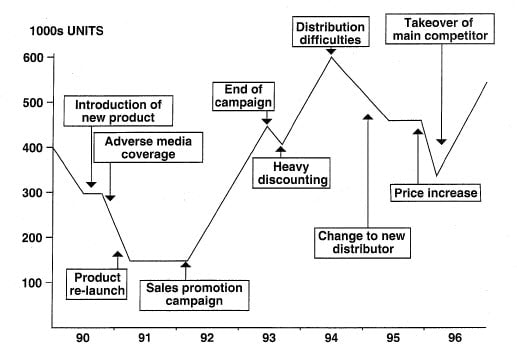
How would you comment on this graph?
DOWNLOAD
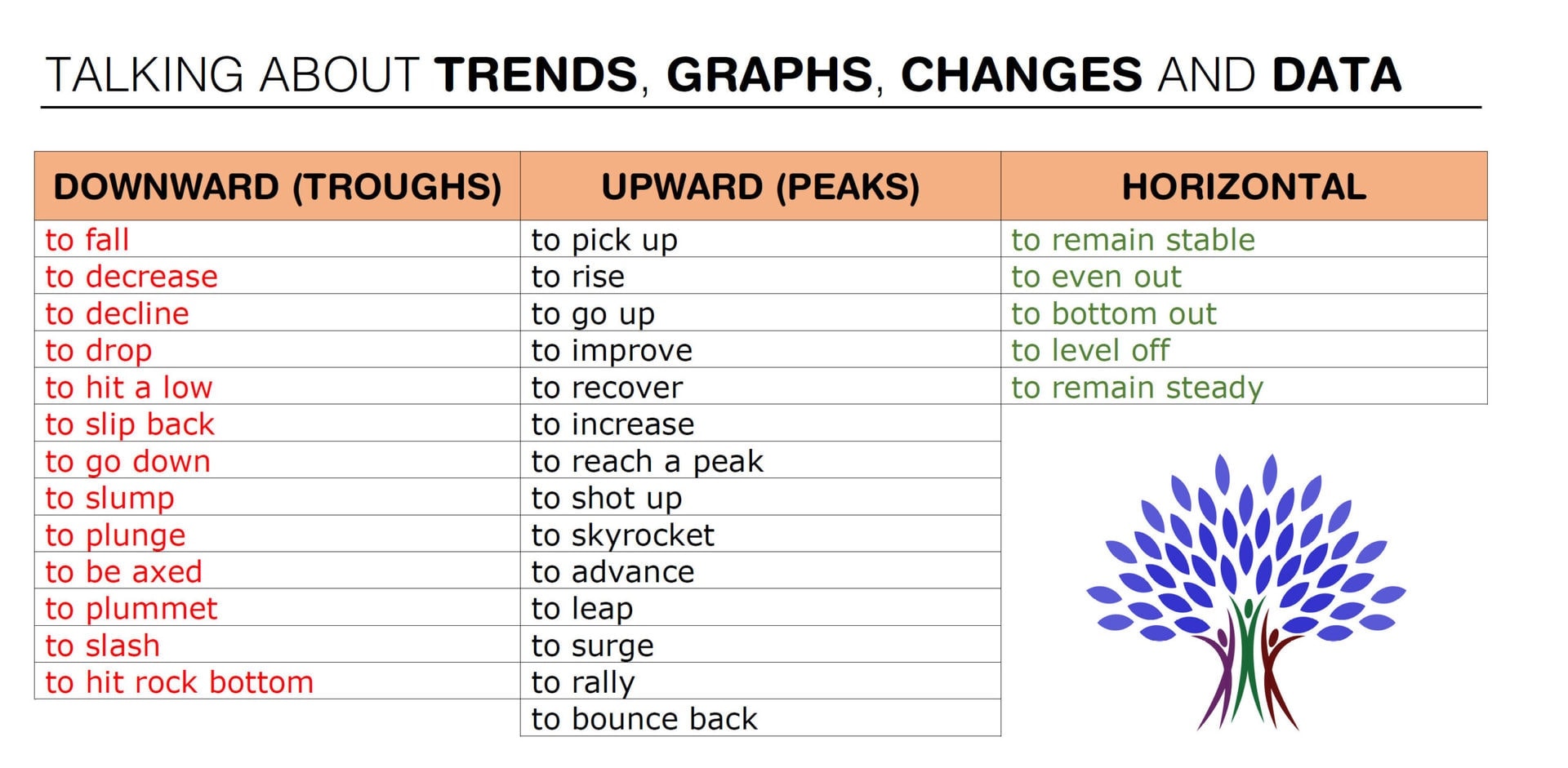
download a table

Learning is more effective when you use tables and charts!

Secrets of Learning Languages with Lydia Machova

Secrets of Learning Languages with Lydia Machova

Sorry, but lessons on The Blue Tree work only on a computer or a tablet.

Bardzo mi przykro, ale lekcje na platformie The Blue Tree działają jedynie na komputerze lub tablecie.

Do zobaczenia na większym ekranie 🙂

Zespół The Blue Tree

back to HOME > Personal Development  > How to learn > Secrets of learning languages

Learn more words

THE BLUE TREE

How to Learn

CEF B1

CEFR B1

Intermediate

warm up

Answer these questions. Listen to a model answer (if it is available) and see if there’s anything you would like to add to your own opinion.

TRANSCRIPT

I speak two languages fluently—English and Spanish. I’ve always appreciated how being bilingual allows me to communicate with a wider range of people and experience different cultures more deeply. It’s also been a big help in both personal and professional situations. I’d love to add another language to my list, maybe something completely different like Italian or Japanese!

TRANSCRIPT

I do like learning languages! It can be tough at first, but once you start to get the hang of it, it becomes a lot more fun. I love how it feels like solving a puzzle, and you can see your progress over time. Plus, learning a new language opens up so many new experiences—whether it’s through travel, meeting new people, or just understanding a different culture better. It’s challenging but really rewarding.

What are the advantages of knowing many languages?
TRANSCRIPT

Knowing many languages gives you a lot of advantages. First, it can improve your job opportunities since many businesses operate globally now. It also helps you connect with people from different backgrounds, which is invaluable both personally and professionally. Plus, it keeps your brain sharp—learning languages has been shown to improve memory and cognitive skills. It’s like having a superpower that opens doors everywhere.

The Blue Tree - Podręcznik do nauki angielskiego online

part one

KEY LANGUAGE

Study these flashcards. Make sure you understand all the items.

Secrets Of Learning Languages 1
0 / 0
0 / 0

VIDEO

Watch the first part of the video.

COMPREHENSION

Answer these questions. Refer to the information from the video.

10:05What does Lýdia love doing?She loves learning foreign languages.
20:15How often does she like to learn a new language?She likes to learn a new language every two years.
30:22How many languages is she currently working on?She is currently working on her eighth one.
40:50What do people always ask her when they find out?They ask her how she does it and what her secret is.

part two

KEY LANGUAGE

Go through the flashcards below. Make sure you understand all the words and expressions.

Secrets Of Learning Languages 2
0 / 0
0 / 0

VIDEO

Watch the second part of the video.

COMPREHENSION

Answer these questions. Refer to the information from the video.

11:15What are polyglots?Polyglots are people who speak a lot of languages.
21:30What did she want to find out from them?She wanted to find out how polyglots learn languages so much faster than other people.
31:50What is Benny’s method for learning a new language?His method is to start speaking from day one.
42:05Why doesn’t Benny mind making mistakes?Because making mistakes and getting feedback is how he learns.

part tHREE

KEY LANGUAGE

Go through the flashcards below. Make sure you understand all the words and expressions.

Secrets Of Learning Languages 3
0 / 0
0 / 0

VIDEO

Watch the second part of the video.

COMPREHENSION

Answer these questions. Refer to the information from the video.

12:23What was Lucas’s method of learning Russian?He added a hundred random Russian speakers on Skype and copied their messages to each other, making two strangers have a conversation.
22:28What allowed Lucas to start writing himself?He had so many of these copied conversations that he figured out how a Russian conversation usually starts.
32:33What does Lydia think about Lucas’s method?She thinks it is an "ingenious method".

part four

KEY LANGUAGE

Go through the flashcards below. Make sure you understand all the words and expressions.

Secrets Of Learning Languages 4
0 / 0
0 / 0

VIDEO

Watch the second part of the video.

COMPREHENSION

Answer these questions. Refer to the information from the video.

12:46What are some of the ways polyglots learn new languages?Some start by imitating sounds, others learn the 500 most frequent words, and some start by reading about the grammar.
22:56Did Lydia learn that there is one way of learning languages?No, she learned that everybody seems to have a unique way they learn a language.
33:16What do polyglots have in common?The one thing they all have in common is that they simply found ways to enjoy the language-learning process.
43:21How did polyglots talk about the process of learning languages?They were talking about language learning as if it was great fun.

part five

KEY LANGUAGE

Go through the flashcards below. Make sure you understand all the words and expressions.

Secrets Of Learning Languages 5
0 / 0
0 / 0

VIDEO

Watch the second part of the video.

COMPREHENSION

Answer these questions. Refer to the information from the video.

13:57How did Lydia learn Spanish?She learned Spanish by reading the "Harry Potter" books.
24:01What did polyglots find about methods of learning languages?They found that while everyone uses different methods, they always make sure it is something they personally enjoy.
34:07How much did she understand from Harry Potter at the beginning?She didn’t understand almost anything at the beginning.
44:14Why did she continue reading the book?She kept reading because she loved the book.
54:23Why did she decide to learn German by watching "Friends"?She decided to watch it because it is her favorite sitcom.
64:36What happened after the third season of watching "Friends" in German?The dialogue finally started to make sense.
75:33What are some methods of learning languages Lydia recommends?She recommends typing words in an app, finding interesting content on YouTube or in podcasts, and applying the method of self-talk.
85:45What is the first secret of learning languages?The first secret is finding enjoyment in the process of learning languages.

part six

KEY LANGUAGE

Go through the flashcards below. Make sure you understand all the words and expressions.

Secrets Of Learning Languages 6
0 / 0
0 / 0

VIDEO

Watch the second part of the video.

COMPREHENSION

Answer these questions. Refer to the information from the video.

15:55What is the second secret according to Lydia?You need to use effective methods.
26:11What is the benefit of using spaced repetition?It allows you to keep words long term.
36:30Where can we find information about effective methods of learning languages?You can check out polyglots’ YouTube channels and websites and get inspiration from them.

part sEVEN

KEY LANGUAGE

Go through the flashcards below. Make sure you understand all the words and expressions.

Secrets Of Learning Languages 7
0 / 0
0 / 0

VIDEO

Watch the second part of the video.

COMPREHENSION

Answer these questions. Refer to the information from the video.

16:39What is the third secret?The third secret is to create a system in your learning.
26:47How can we create more time for learning a new language?We can create that time if we just plan a bit ahead, such as waking up 15 minutes earlier to revise vocabulary.
37:03What are some ideas how to find time for learning a new language?You can find time by doing things without planning, such as listening to podcasts on your way to work or while doing household chores.
47:16What is important as regards having a system?The important thing is to create a plan in the learning, such as deciding to practice speaking every Tuesday and Thursday.
57:30What is the benefit of having a system for learning a new language?If you create a system in your learning, you don’t need to find that extra time because it will become a part of your everyday life.

part EIGHT

KEY LANGUAGE

Go through the flashcards below. Make sure you understand all the words and expressions.

Secrets Of Learning Languages 8
0 / 0
0 / 0

VIDEO

Watch the second part of the video.

COMPREHENSION

Answer these questions. Refer to the information from the video.

17:35What is the forth secret of learning a language?The fourth secret is patience.
27:46What is possible after learning a new language for two months?You can make a "visible improvement" if you learn in small chunks every day.
37:50What is the strongest motivator?There is nothing that motivates us more than our own success.
48:01How did Lydia feel when she undertood a joke in German version of "Friends"?She was very happy and remembers that moment vividly.
58:20Why does she learn a new language every two years?Because she gets addicted to that feeling of joy and success.

part NINE

KEY LANGUAGE

Go through the flashcards below. Make sure you understand all the words and expressions.

Secrets Of Learning Languages 9
0 / 0
0 / 0

VIDEO

Watch the second part of the video.

COMPREHENSION

Answer these questions. Refer to the information from the video.

18:44What may some people assume about polyglots?They may assume that polyglots are just language geniuses who have a special talent.
28:57Was benny a good at languages when he was at school?No, he studied Irish for 11 years and German for five years but still couldn’t speak them.
39:15How many languages does Benny speak?He can now easily have a conversation in over 10 languages.
49:22How good was Lucas at English at school?He tried to learn English at school for 10 years and completely failed.
59:45How long did it take Lucas to learn 11 languages?It took him about 10 years to learn 11 new languages.
69:57As a language mentor, what does Lydia help people with?She helps people take their language learning into their own hands and find methods they enjoy.
710:20When do Lydia’s clients find the magic language talent?They suddenly find it once they start enjoying the process, applying effective methods, and creating a system.

POLL

Cast your vote in the poll below.

1️⃣ When you learn a new language, what motivates you the most?
2️⃣ 2. What is your biggest challenge when learning a language?
3️⃣ 3. Which approach to language learning sounds closest to yours?
1 vote

×

DISCUSSION

Different ways of learning languages

Agata and Dawid are talking about learning languages. They are discussing Lydia’s ideas and sharing their own experience in learning a foreign language. 

Read (role-play) their dialogue. Whose story is closer to yours?

Agata: Hi David! Did you watch the TED Talk by Lydia Machova?

David: Yes, I did! I really liked it. She has a lot of energy and good ideas. What did you think?

Agata: I liked it too. I think the most important thing she said is that learning languages can be fun. I sometimes forget that.

David: Me too. I always think I have to study grammar and vocabulary lists. But she said we can learn with things we enjoy—like watching series or reading books.

Agata: Yes! I started watching a Spanish telenovela last week. I don’t understand everything, but I can guess a lot from the situation.

David: That’s great. I use music. I listen to English and Spanish songs and try to learn the lyrics. It helps me remember new words.

Agata: Lydia also said we need a system. Do you have one?

David: Kind of. I try to do something every day. Just 20 minutes. Sometimes I use an app. Sometimes I talk to my language partner online.

Agata: That’s smart. I still need to find my system. I study a lot one day, and then nothing for three days. Not good…

David: Don’t worry. She also said we should be patient. If we keep going, we will improve.

Agata: Yes, and I think I need to be more patient with myself. Maybe I will try her idea of “language coaching”—just helping myself stay motivated.

David: That’s a good idea. Let’s keep each other motivated too!

Agata: Deal! Let’s talk next week in Spanish?

David: ¡Sí, claro! Hasta pronto, Agata!

Agata: Hasta pronto, David!

OVER TO YOU

Answer these questions. Refer to your own experience and what you learnt in this lesson.

BulletWhat is your favorite way to learn a new language? Why do you like it?
BulletDo you have a system for learning languages? If yes, what is it? If not, would you like to create one?
BulletCan you think of a time when you felt proud of your progress in learning a language? What happened?
BulletDo you agree that enjoying the process is the most important part of language learning? Why or why not?
BulletWhat would you say to someone who wants to give up learning a new language?

DOWNLOAD

Download a mind-map with ideas of methods for learning languages.

What methods would you add to it?

download a mind-map

Learning is more effective when you use mind-maps!

Weekly Learning Plan is a practical template for self-disciplined students who want to track their learning.

It contains a lot of ideas of what you could do to improve your English.

WEEKLY LEARNING PLAN

Use this template to plan your week of learning!

lesson glossary

Secrets of learning languages

COMMENTS

What is your experience with learning languages? How did you learn English? Which methods or systems have you tested and can recommend?

Share your views and experience here.

How to Disagree Productively

How to Disagree Productively

Sorry, but lessons on The Blue Tree work only on a computer or a tablet.

Bardzo mi przykro, ale lekcje na platformie The Blue Tree działają jedynie na komputerze lub tablecie.

Do zobaczenia na większym ekranie 🙂

Zespół The Blue Tree

How to Disagree Productively
Learn more words

THE BLUE TREE

Better
Communicator

CEF B1

CEFR B2

Upper
Intermediate

warm up

Answer the questions below. Then listen to the model answers and think about how you could improve yours.

TRANSCRIPT

Conflict makes me feel a bit uncomfortable, to be honest. I prefer when things run smoothly and everyone is on the same page, but I also understand that conflict is sometimes necessary to make progress. If handled well, it can actually lead to better solutions. I just try to stay calm and focus on the facts rather than getting caught up in emotions.

TRANSCRIPT

Disagreements definitely have pros and cons. On the positive side, they can bring out different perspectives and lead to more creative solutions. When people challenge each other, it often results in better ideas. On the downside, if the disagreement turns personal or becomes too heated, it can damage relationships and make it harder to work together. That’s why it’s important to keep it professional and focused on the issue at hand.

What advice would you give to somebody who argues a lot?
TRANSCRIPT

My advice for someone who argues a lot would be to pick their battles carefully. Not every disagreement is worth having, especially if it’s over something small. I’d also recommend practicing active listening. Instead of always trying to prove a point, take time to understand where the other person is coming from. Sometimes, just showing that you’re open to different ideas can help resolve conflicts more smoothly.

LISTENING

LISTENING FOR GIST

Listen to the article. What is the main message?

Alita is listening to a podcast and making notes

Summary

What’s the best summary for this listening?

What's the best summary of what you have just heard?

reading

KEY VOCABULARY

Study the vocabulary in this quizlet. All these words will appear in the following article.

4 Rules Of Disagreement
0 / 0
0 / 0

READING

Read the article. Answer the questions as you read.

4 Rules to Help Your Team Disagree Productively

It’s no secret that conflict can be uncomfortable. When diverse thoughts, perspectives, and ideas clash, it often stirs emotions, escalates tensions, and distracts from the original goal. However, conflict isn’t necessarily detrimental. On the contrary, it can be a powerful tool for team growth and innovation, given we manage it well. For a manager, part of the job is guiding their team to learn how to disagree in a manner that’s productive, fostering robust debates rather than destructive arguments. Here are some foundational rules for encouraging constructive disagreements that keep discussions professional and focused on the topic at hand:

Q1. Why is conflict uncomfortable?

Q2. What do managers need to learn about disagreements?

1. Remember you’re all on the same team.

It’s crucial to reinforce the collective mentality. The aim of the conversation shouldn’t be about validating
an individual’s point to win the argument, but rather, the objective should be problem-solving. The entire team needs to understand that the goal is to collaboratively arrive at the best possible solution to the problem at hand. This rule ensures that the competition remains healthy and doesn’t veer off into personal territory or ego battles. To sustain this mindset, it might be beneficial to remind your team before heated discussions that every participant has a common goal: the team’s success.

Q3. What should be the objective behind an argument?

Q4. What does this rule ensure?

2. Stick to facts.

Empowering your team members to substantiate their points with clear, logical reasoning can significantly
enhance the quality of debates. Encourage everyone to back their ideas with sound, evidence-based arguments, and discourage rhetorical gimmicks and “volume over value” tactics. As a leader, promoting a fact-based culture not only strengthens the logic behind each argument, but also reduces the likelihood of misunderstandings and fosters a respect for truthful, well-reasoned perspectives.

Q5. What should people back their ideas with?

Q6. What are the benefits of fostering a fact-based culture?

3. Don’t make it personal.

In the heat of a passionate discussion, it’s all too easy for things to become personal. Team members should
refrain from name-calling, personal attacks, or disparaging questions such as “How could you believe that?”. This approach is unproductive and harms team cohesion. Instead, the focus should be on the idea or argument, not the person presenting it. Promote an environment where everyone understands that a critique of an idea is not a personal attack. Remember, the intention is to create a safe space for differing opinions to be aired and evaluated, not to disparage individuals.

Q7. What should team-members refrain from when arguing?

Q8. What should everyone understand about arguing?

4. Be intellectually humble.

Intellectual humility plays a significant role in maintaining the productivity of disagreements. By respecting everyone’s viewpoints, the team can create an environment that fosters learning and collaboration. Intellectual humility also involves being open to changing your mind when confronted with a more compelling argument or evidence. This rule doesn’t imply that team members should abandon their convictions, but rather that they should be willing to adapt their understanding in the face of compelling new insights.

Q9. What is intellectual humility?

Q10. What doesn’t it imply?

In summary, managers can facilitate productive disagreement within their teams by promoting a collective mindset, encouraging fact-based arguments, maintaining a focus on the ideas rather than the individuals, and fostering intellectual humility. By adhering to these rules, teams can turn potential conflict points into opportunities for creativity, innovation, and problem-solving, which in turn can lead to the team’s overall success.

Q11. How can teams benefit from adhering to these rules?

Adapted from “How to Debate Ideas Productively at Work,” by Shane Snow

zróżnicowany, różnorodny

wzbudzać, wywoływać

eskalować, nasilać się

szkodliwy, niekorzystny

wręcz przeciwnie

sprzyjać, rozwijać

solidny, mocny

wzmacniać, umacniać

potwierdzać, uzasadniać

zbaczać z tematu

uzasadniać, potwierdzać dowodami

poprawiać, zwiększać

chwyt, sztuczka

powstrzymać się od

uwłaczający, lekceważący

spójność, jedność

wyrazić opinię

pokorny, skromny

przekonujący, nieodparty

przekonanie

POLL

Cast your vote in the poll below.

1️⃣ When you disagree with a colleague, what usually comes first?
2️⃣ What makes a workplace disagreement productive?
3️⃣ How comfortable are you with changing your mind during a discussion?
0 votes

×

PRACTICE

ARGUMENT AT WORK

Kat and Alita are having an argument at work. Kat has a grudge for Alita for not delivering her work on time. Alita has some good reason for the delay. At first, the argument seems to be spinning out of control, but later Alita manages to calm Kat down and eventually girls come to an amicable solution for this situation.

Role play this dialogue.

Kat: Alita, I’ve got a bone to pick with you. You promised to have the report ready by Tuesday, and it’s now Thursday!

Alita: I understand your frustration, Kat. I’m really sorry—

Kat: Sorry isn’t going to cut it, Alita. This delay has thrown off my entire schedule!

Alita: I can see how it’s causing problems, Kat, and I didn’t mean to disrupt your schedule. You know I usually meet my deadlines.

Kat: Yes, but “usually” doesn’t help me right now!

Alita: You’re right, Kat. I can’t change the past, but I can explain. I had an emergency at home and had to take a few days off. It was a tough call, but family had to come first.

Kat: I can understand that, Alita. But why didn’t you communicate this with me? I could have planned better!

Alita: I should have communicated it more clearly. I thought I could still manage the workload, but I underestimated the situation. It was a mistake on my part.

Kat: Communication is key, Alita. We’re a team, remember? We need to have each other’s backs.

Alita: I couldn’t agree more, Kat. And I appreciate your understanding. I propose a solution, if you’re open to it?

Kat: Go ahead.

Alita: I’ll prioritize finishing the report by tomorrow morning, first thing. I’ll also work on a back-up plan with you for such situations in the future. How does that sound?

Kat: That sounds reasonable, Alita. And yes, let’s talk about that back-up plan. Let’s ensure this doesn’t happen again.

Alita: Absolutely, Kat. And again, I apologize for the inconvenience. I really value our teamwork and I don’t want to jeopardize it.

Kat: Apology accepted, Alita. Let’s move forward and focus on making sure we’re better prepared next time.

Prepare a similar dialogue.

It should start with some kind of conflict, but finish in a friendly way. Use the tips from the lesson.

w

DISCUSSION

Discussion

Discuss these questions.

BulletWhy do many people find workplace disagreements uncomfortable?
BulletWhat separates a productive debate from a destructive one?
BulletHow can managers create a safe space for differing opinions?
BulletWhat’s best when emotions start to take over: pausing the conversation or pushing through to a solution?
BulletAdvise someone who tends to take every disagreement personally.

MIND-MAP

Use the mind-map below to have a more in-depth conversation about this topic. 

Use the mind map and speak for 60 seconds about today’s topic. Try to use 2–3 expressions from the lesson.

COMMENTS

Should there be more formal approach to how people agree or disagree? Perhaps companies should include this in their training plan for all staff, what do you think?

Share your views and experience here.