Learning is uncomfortable

Learning is uncomfortable

Sorry, but lessons on The Blue Tree work only on a computer or a tablet.

Bardzo mi przykro, ale lekcje na platformie The Blue Tree działają jedynie na komputerze lub tablecie.

Do zobaczenia na większym ekranie 🙂

Zespół The Blue Tree

back to HOME > Personal Development  > How to learn > Learning is uncomfortable

Learn more words

THE BLUE TREE

How to Learn

CEF B1

CEFR B1

Intermediate

warm up

Answer the questions below. Then listen to the audio answers and report back on what you’ve heard.

TRANSCRIPT

Recently, I’ve been learning how to cook new dishes! I always loved baking, but cooking meals was something I never really focused on. It’s been fun trying out new recipes and experimenting with different flavors, although I’ve definitely had a few failed attempts! But that’s part of the process, and I’m enjoying it.

TRANSCRIPT

To be honest, I wasn’t a huge fan of learning at school. I didn’t dislike it, but sometimes it felt like I was just memorizing things without really understanding why they were important. Now, I appreciate learning a lot more, especially when I can apply what I’m learning to real-life situations. It’s more meaningful when you know it’s going to help you later.

How do you feel when you need to learn something new?
TRANSCRIPT

When I need to learn something new, I feel a bit anxious, but also excited. It’s like starting a journey where I know I’ll struggle at first, but if I stick with it, I’ll eventually get better. The initial awkwardness can be frustrating, but I try to remind myself that everyone feels that way when they’re starting out. The key is not to let that stop you.

LISTENING

First, listen to the recording without looking at the text. Can you grasp what the main idea of this article is?

reading

LEARNING IS UNCOMFORTABLE

Being a beginner at something can feel 1. awkward and 2. embarrassing, especially if you’re used to being an expert. But those feelings are the 3. inescapable growth pains that come from developing and improving. To get used to the discomfort, know that it’s brave to be a beginner. Exposing your weaknesses and trying new things 4. takes courage. You can make the challenge a bit easier by looking for learning situations where 5. the stakes are low — maybe a class where you’re not expected to be an expert or you don’t know anyone else. If it helps, tell fellow participants that you may mess up whatever you’re about to 6. attempt. Your willingness to take risks may inspire others to do the same. And whatever you do, don’t stop learning. Keep pushing yourself, especially in the areas where you are 7. accomplished, so you can get even better. If you are willing to feel embarrassment and shame, and even to fail, there’s no end to what you can do.

wymaga odwagi

stawka (np. w grze hazardowej)

podejście, próba

znakomity, utalentowany

This tip is adapted from Learning Is Supposed to Feel Uncomfortable,” by Peter Bregman

COMPREHENSION

Answer the questions below. Throw some newly learned words and phrases into your answers.

  • How does it feel to be a beginner at something?
  • What does it take to be a successful beginner at something?
  • How to limit the inescapable feeling of uneasiness related to learning something new?
  • How can being brave and open affect fellow participants in the learning process?
  • Which areas you should particularly keep pushing yourself?
  • How important is one’s willingness to feel embarrassed?

POLL

Cast your vote in the poll.

Coming Soon
Do you agree with the premise that learning needs to feel uncomfortable?
Total Votes : 4

COMMENTS

How do you feel about learning new things? Do you enjoy learning new things and skills or do you consider it hard and unpleasant necessity? What was the most uncomfortable learning experience for you?

Share your experience and views here.

Take Extreme Ownership

Take Extreme Ownership

Sorry, but lessons on The Blue Tree work only on a computer or a tablet.

Bardzo mi przykro, ale lekcje na platformie The Blue Tree działają jedynie na komputerze lub tablecie.

Do zobaczenia na większym ekranie 🙂

Zespół The Blue Tree

Take Extreme Ownership
Learn more words

THE BLUE TREE

Personal
Productivity

CEF B1

CEFR B2

Upper
Intermediate

warm up

Answer the questions below. Listen to the sample answers.

TRANSCRIPT

The pros of a war are hard to define, but historically, some argue it has led to technological advancements or the resolution of conflicts. However, the cons are overwhelming—loss of life, destruction of communities, and long-term psychological impacts. War should always be the absolute last resort, as the damage it causes often outweighs any potential benefits.

Why is it so difficult to admit having made a mistake?
TRANSCRIPT

It’s difficult to admit making a mistake because it makes us feel vulnerable and exposes our imperfections. We’re often worried about how others will perceive us, and there’s a fear of judgment or losing credibility. But I think the ability to own up to mistakes shows strength and maturity. Once we get past the fear, admitting a mistake can actually build trust with others.

What do you think it means to take extreme ownership?
TRANSCRIPT

To me, taking extreme ownership means accepting full responsibility for everything in your control, even if things go wrong. It’s about not blaming others or external factors but instead focusing on what you can do to fix the situation. It’s a leadership mindset—leading by example, owning your actions, and setting a standard of accountability that encourages others to do the same.

part one

KEY LANGUAGE

Go through the flashcards below. Make sure you understand all the words and expressions.

VIDEO

Watch the first part of the video.

COMPREHENSION

Answer these questions. Refer to the information from the video.

  • How does Jocko describe war?
  • What can war teach us?
  • What happened in the spring of 2006?
  • Can you imagine how Jocko must have felt at that time?

part two

KEY LANGUAGE

Go through the flashcards below. Make sure you understand all the words and expressions.

VIDEO

Watch the second part of the video.

COMPREHENSION

Answer these questions. Refer to the information from the video.

  • What did Jocko expect to happen next?
  • What did he put in his debrief?
  • Who is Jocko talking about when he says that there is only one person to blame?

part three

KEY LANGUAGE

Go through the flashcards below. Make sure you understand all the words and expressions.

VIDEO

Watch the third part of the video.

COMPREHENSION

Answer these questions. Refer to the information from the video.

  • Why did Jocko take the blame for what had happened?
  • How did he feel about taking the blame?
  • How did his bosses and his men react to his decision?
  • What does it mean to take extreme ownership?

POLL

Cast your vote in the poll.

Coming Soon
Do you agree with Jocko that we should take extreme ownership?
Total Votes : 6
w

DISCUSSION

Pete & Sven Discuss Responsibility

Pete and Sven are talking about a colleague who shirks  responsibilities. 

Read or role-play their dialogue.

Pete: You know what really gets to me, Sven? Tom keeps blaming others for every mistake at work. It’s never his fault — always someone else’s.

Sven: Yeah, I’ve noticed that too. He’s good at avoiding responsibility. It reminds me of what Jocko Willink said about Extreme Ownership.

Pete: Oh, right — that idea that leaders should take full responsibility, even when things go wrong because of their team.

Sven: Exactly. Jocko said there’s no one else to blame. If something fails, it’s your fault because you didn’t plan well enough, didn’t communicate clearly, or didn’t supervise properly.

Pete: It’s a tough mindset to adopt, though. Most people want to protect their ego. Admitting fault feels like weakness.

Sven: True, but Jocko argues the opposite — that taking ownership builds trust and respect. It actually makes you stronger as a leader.

Pete: Maybe if Tom started thinking like that, he’d earn more respect around here. Instead, people just avoid working with him.

Sven: Yeah. Responsibility is contagious. When one person steps up, others usually follow. When one shirks it — the whole team suffers.

Pete: So, what’s our move? Should we tell him directly?

Sven: Maybe not lecture him, but we can lead by example. Take ownership ourselves — show him how it’s done.

OVER TO YOU

Discuss these questions.

BulletHave you ever worked with someone who avoided taking responsibility? How did it affect the team’s results or atmosphere?
BulletWhy do you think so many people find it difficult to admit their mistakes?
BulletIn what ways can taking ownership actually make a person stronger rather than weaker?
BulletDo you think leaders should always take full responsibility, even when their team members clearly make mistakes? Why or why not?
BulletHow can you personally apply the idea of Extreme Ownership in your everyday work or studies?

MIND-MAP

Use the mind-map below to have a more in-depth conversation about this topic.

Be respectful to your co-workers

lesson glossary

COMMENTS

What do you think of Jocko’s concept of ‘extreme ownership’?

The Harvard Principles of Negotiation

The Harvard Principles of Negotiation

Sorry, but lessons on The Blue Tree work only on a computer or a tablet.

Bardzo mi przykro, ale lekcje na platformie The Blue Tree działają jedynie na komputerze lub tablecie.

Do zobaczenia na większym ekranie 🙂

Zespół The Blue Tree

The Harvard Principles of Negotiation
Learn more words

THE BLUE TREE

Better
Communicator

CEF B1

CEFR B2

Upper
Intermediate

warm up

Answer the questions below. Then listen to the model answers and think about how you could improve yours.

How often do you negotiate things in your professional life?
TRANSCRIPT

I negotiate quite often in my professional life, whether it’s about deadlines, project goals, or even salaries. I think negotiation is a part of everyday business interactions, but sometimes it’s subtle. It’s not always about the big deals—sometimes it’s about finding a middle ground on smaller decisions too. I’ve learned that staying calm and focusing on what’s important to both sides helps me a lot.

Do you have your favourite tactics that help you achieve the best outcome?
TRANSCRIPT

When I negotiate, I always make sure to prepare in advance. I try to understand the other party’s needs as much as possible so that I can present solutions that benefit both of us. One tactic that works well for me is to stay flexible. Instead of sticking to one rigid idea, I propose multiple options. That way, I can pivot and still move towards the best outcome even if my initial offer isn’t accepted.

What are the different options a negotiation can end with?
TRANSCRIPT

Negotiations can end in a few different ways—either both sides reach an agreement, one side walks away, or sometimes, both sides may decide to revisit the negotiation at a later time. There’s also a chance that the agreement reached isn’t ideal for both parties, which could lead to more discussions down the line. The goal, of course, is to end with a win-win solution, where both parties feel satisfied with the outcome.

part one

KEY LANGUAGE

Go through the flashcards below. Make sure you understand all the words and expressions.

VIDEO

Watch the first part of the video.

COMPREHENSION

Answer these questions. Refer to the information from the video.

  • Why did Harvard people choose to call them principles and not rules?
  • What’s the advantage of using principles for negotiations?
  • Can you guess what these principles are?

part two

KEY LANGUAGE

Go through the flashcards below. Make sure you understand all the words and expressions.

VIDEO

Watch the second part of the video.

COMPREHENSION

Answer these questions. Refer to the information from the video.

  • ⌚ 1:23 What are the five possible strategies or outcomes of a negotiation?
  • ⌚ 1:50 What tendency can we have when we negotiate with somebody we like?
  • ⌚ 2:05 What tendency can we have when we negotiate with somebody we dislike?
  • ⌚ 2:32 What should we separate according to the first principle?
  • ⌚ 2:52 What does it mean in real life?
  • ⌚ 3:02 What does it mean that ‘the other party is your partner’?

part three

VIDEO

Watch the third part of the video

COMPREHENSION

Answer these questions. Refer to the information from the video.

  • ⌚ 3:57 What is the pupkin example about and how was it solved?
  • ⌚ 4:10 What should we focus in accordance with the second principle?
  • ⌚ 4:35 When is the third principle particularly useful?
  • ⌚ 4:57 What did the Harvard people find about the speed people negotiate?
  • ⌚ 5:13 What should we develop according to the third principle?
  • ⌚ 6:13 Which example illustrates this need for developing the criteria for success?
  • ⌚ 6:33 What is the benefit of working with criteria?

part four

VIDEO

Watch the fourth part of the video

COMPREHENSION

Answer these questions. Refer to the information from the video.

  • ⌚ 7:24 What did the researcher find that people like?
  • ⌚ 7:34 What should we offer to the other party during a negotiation?
  • ⌚ 7:59 What is the advantage of offering different options?
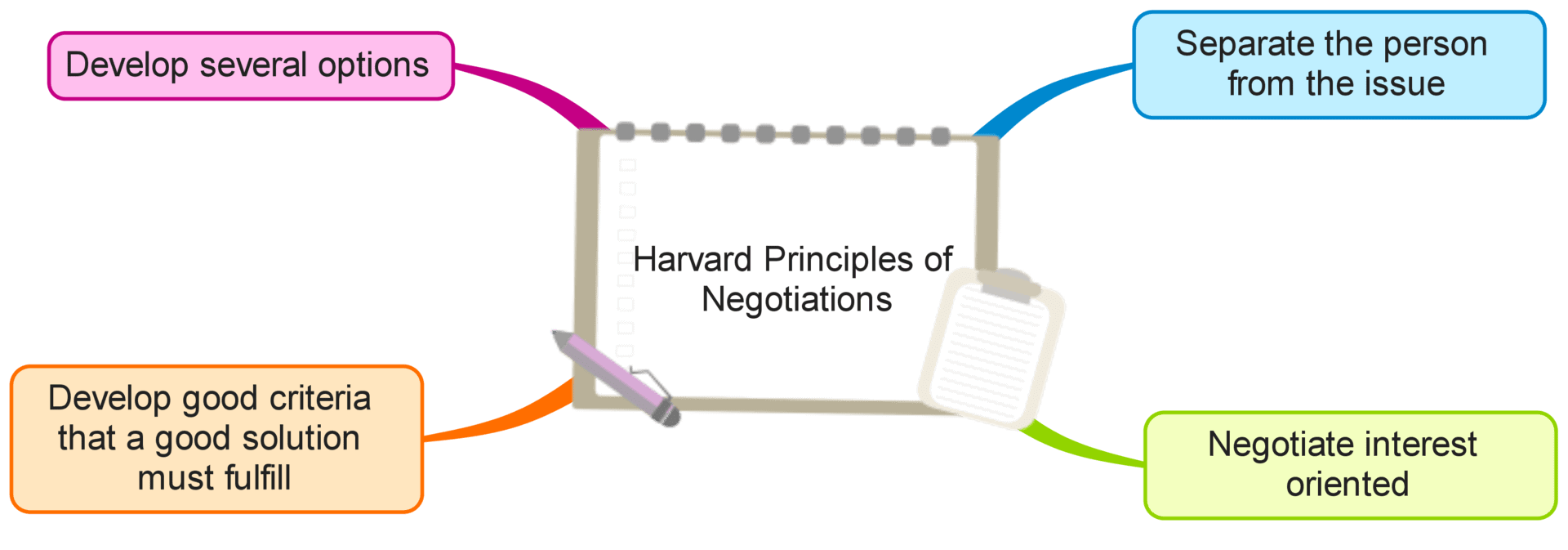
  • ⌚ 8:19 What are the Four Principle of Negotiations of Harvard Model?
  • ⌚ 8:29 What is benefit of apllying these principles in a negotiation?
POLL

Cast your vote in the poll.

Coming Soon
Which of these principles for negotiations are the most difficult to implement?
Total Votes : 7

lesson glossary

Harvard Principles of Negitiations

After a vacation

After a vacation

back to HOME > Learning EnglishBusiness English > After a vacation

Learn more words

THE BLUE TREE

Business English

CEF B1

CEFR B1

Intermediate

warm up

Answer the questions below.

  • Which holiday do you prefer, the summer or the winter?
  • How long is your typical holiday break?
  • What usually happens at work before you go on holiday and just after you return?

WHAT DO YOU THINK

key language

Go through all the words and phrases in this Quizlet set. Make sure you understand these words well.

LISTENING

Listen to a short article about strategies for returning to work after a holiday. What are some of the tips and advice presented in it?

Alita is listening to a podcast and making notes

reading

Complete the article you have just listened to with the missing words. Listen again, if you make more than 5 mistakes.

POLL

Read these pieces of advice and decide how practical they are. Think of some more tips and post them in the comments section.

Coming Soon
Use your first 30 minutes in the office to look through what’s on your to-do list and make a plan for it.
Total Votes : 46
Coming Soon
Keep in mind that what’s most urgent now may not be what was most urgent before your time away.
Total Votes : 43
Coming Soon
Check in with key people to discuss what you missed and what needs your attention.
Total Votes : 43
Coming Soon
Thank anyone who covered for you, and ask them what they need from you now.
Total Votes : 43
Coming Soon
If you have to read all the emails that came in while you were away, start by scanning your inbox for key names - your boss’s or a big client’s - and read those first.
Total Votes : 40
Coming Soon
And as you resume work, don’t let the vacation glow fade. Take moments to remember the best experiences of your time away, and use them to tap into the joy or calm your need to stay energized.
Total Votes : 32

Adapted from “How to Minimize Stress Before, During, and After Your Vacation,” by Tristan Elizabeth Gribbin

Here are some more tips and tricks for your first hours and days at the office after a vacation.
Coming Soon
Spend the first few minutes on deleting any irrelevant or spam emails. Only then should you start reading the rest.
Total Votes : 37
Coming Soon
Don't choose the busiest day at the office for your return. Pick a day that is usually a bit lighter in workload. For instance, if Monday is usually the most hectic day at work, avoid resuming work that day.
Total Votes : 38
Coming Soon
Try to take it easy on your first day. Don't schedule any important calls or meetings. Make sure you do not need to make any tough decisions on that first day after a vacation.
Total Votes : 38
Coming Soon
Why don't you keep in touch with the office while you are on holiday. You might read emails at least. It shouldn't take too long, provided you have access to the Internet.
Total Votes : 34
Coming Soon
Before you go on holiday, put some time-holders into your calendar in the first days after your return to make sure you have enough time for things which require your immediate attention.
Total Votes : 24
w

DISCUSSION

Read this dialogue. Pay special attention to the bold parts.
Alita and Pete in the elevator

Alita: (Sighs) Hey Pete, it’s good to be back, but I feel overwhelmed with all the work that has piled up during my holiday. I don’t even know where to start.

Pete: Welcome back, Alita! I totally get how you’re feeling. Don’t worry; we can tackle this together. First things first, let’s use the next 30 minutes to go through your to-do list and make a plan to handle it effectively.

Alita: That sounds like a good idea. I guess I need to re-prioritize since the urgent tasks might have changed while I was away.

Pete: Exactly! Things might have shifted in your absence, so it’s crucial to identify what requires immediate attention now. Also, it’s essential to check in with key people, like your team members or managers, to discuss what you missed and what tasks need your immediate attention.

Alita: You’re right. I should touch base with them to get up to speed. Oh, and I need to thank the colleagues who covered for me while I was on vacation. They did a great job, and I’m grateful for their support.

Pete: That’s a thoughtful idea, Alita. Expressing your gratitude will go a long way. Plus, it’s a good opportunity to ask them if there’s anything they need from you now that you’re back.

Alita: Excellent point. I’ll make sure to do that. But, oh boy, my inbox is overflowing with emails. It’s going to take ages to read them all!

Pete: Don’t worry, Alita. Instead of going through every email one by one, start by scanning your inbox for key names, like your boss’s or significant clients. Read those first to get a sense of any pressing matters that need your immediate attention.

Alita: Ah, that’s a time-saving approach. I’ll do that right away. Hopefully, it will help me catch up faster.

Pete: I’m sure it will. Remember, take it one step at a time, and don’t hesitate to ask for help if you need it. We’re all here to support each other.

Alita: Thanks, Pete. I appreciate your advice and support. I feel more confident now that I have a plan to tackle this mountain of work!

Pete: You’re welcome, Alita! You’ve got this! Just take it one task at a time, and you’ll be back on track in no time. If you need any assistance, don’t hesitate to ask. Good luck!

Alita: Thanks again, Pete. I’ll do my best to get back into the swing of things. Let’s get to work!

LANGUAGE NOTES

Focus on the bold fragments of the conversation. Answer the language questions below.

  • What is the correct pronunciation of “pile, pill, pale, peel“?
  • What does the expression “be back on track in no time” mean?
  • What does it mean that Alita’s inbox is overflowing?
  • What does it mean that ‘something will go a long way‘?
  • Which word is the synonym of the word “urgent“?
  • What are the synonyms of the phrase “first things first“?
  • Which expression means to get in touch or contact somebody?
  • Which word is the synonym of the word “considerate“?
  • Which phrase is the synonym of “gradually“?
  • What is the meaning of “get” in the phrase “I totally get how you’re feeling“?
  • What does Pete mean when he says: “You’ve got this!“?
  • Which expression can be replaced with “work in my usual pace“?

Now, discuss the questions below.

Alita is learning something on a computer
  • How do you usually feel about returning to work after a holiday? Is it challenging for you to get back into the work routine, or do you find it easy to transition back?

  • How do you manage the overwhelming workload that often accumulates during your absence? Do you have any strategies or tips to share with others?

  • Have you ever experienced a shift in priorities upon returning to work after a holiday? How do you handle reprioritizing tasks to address urgent matters?

  • When you return to work after a holiday, do you prefer to take some time for yourself to ease back into the routine, or do you jump right into tasks and emails?

  • How do you ensure effective communication with your team members and colleagues after your time away? Do you have any methods for catching up on important updates and discussions?

  • What are some practical ways you show appreciation to colleagues who cover for you during your vacation? How important do you think it is to thank them for their support?

  • Have you ever encountered any specific challenges or unique situations when returning to work after a holiday? How did you overcome them, and what did you learn from those experiences?

COMMENTS

Do you have any other tips or advice on how to avoid the post-holiday burnout?

Expressing Opinions

Expressing Opinions

Sorry, but lessons on The Blue Tree work only on a computer or a tablet.

Bardzo mi przykro, ale lekcje na platformie The Blue Tree działają jedynie na komputerze lub tablecie.

Do zobaczenia na większym ekranie 🙂

Zespół The Blue Tree

Expressing Opinions
Learn more words

THE BLUE TREE

Everyday English

CEF B1

CEFR B1

Intermediate

Practise speaking by describing this image

warm up

Answer the questions below. Listen to some model answers. Read the transcript or report what you heard.

TRANSCRIPT

Changing my opinions definitely feels easier on some topics than others. I find it quite natural to update my views on things like film recommendations or travel destinations — they’re low stakes. But when it comes to values or beliefs I’ve held for years, the process feels much slower and more uncomfortable. I think that’s normal. Real change in perspective usually needs a meaningful experience or a genuinely compelling argument to get started.

What influences your opinions the most: personal experience, word-of-mouth, or something else?
TRANSCRIPT

For me, personal experience is by far the strongest influence. When I’ve actually lived through something — managing a project, dealing with a difficult situation at work — my view of it is much harder to shake than if I’d simply read about it. That said, I’ve noticed that trusted people in my life can gradually shift my thinking too, especially when their experience clearly differs from mine.

TRANSCRIPT

I think part of the reason is that we’re constantly surrounded by confident voices — on social media, in the news, in everyday conversation — that present opinions as settled truths. When something is repeated often enough and with enough certainty, it starts to feel factual. There’s also a deeper issue: distinguishing opinion from fact requires a certain amount of critical thinking, and that skill isn’t really something most people are taught systematically.

POLL

Complete this survey by expressing your opinion.

There are always three options:

➡️ when you agree

➡️ when you are not sure

➡️ when you disagree.

Pay special attention to the language used to express these three functions.

1. All modern architecture is absolutely awful.

A. I couldn’t agree more.
B. I’m afraid I can’t agree with that idea.
C. I agree up to a point.

2. Smoking should be banned from all public places.

A. I quite agree.
B. I couldn’t agree less.
C. I think that’s going a bit too far.

3. Computers cause unemployment.

A. That’s exactly how I feel.
B. Nonsense. That’s not true at all.
C. You could be right, but…

4. Everyone knows that sweets are bad for your teeth, so they should be taxed much more heavily.

A. Yes, you have a point there.
B. I can’t accept that.
C. I don’t think it’s as simple as that.

5. Doctors earn far too much money.

A. I’d go along with that.
B. I’m afraid I disagree completely.
C. Possibly, but…

6. It’s a waste of money trying to explore space.

A. Exactly. I couldn’t have put it better myself.
B. In my opinion, that’s out of the question.
C. I agree to some extent.

7. Going and lying on a beach all day is not a real holiday.

A. Basically, I think it’s right.
B. It’s total rubbish!
C. It’s a bit one-sided.

8. We should work or study six days a week.

A. I entirely agree with you.
B. I am afraid that’s not how I see it.
C. On the other hand…

STUDY SECTION

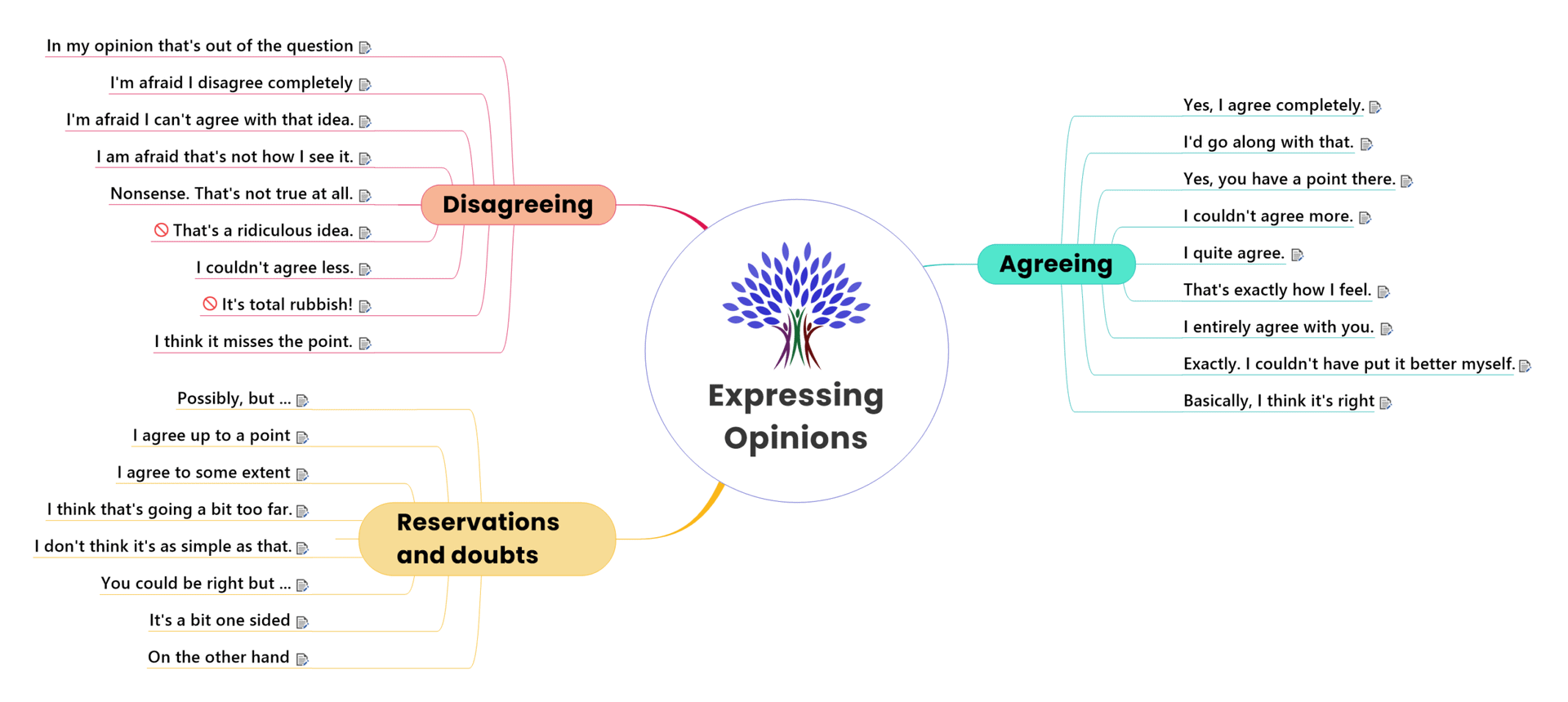
HOW TO AGREE

Learn how to agree. Listen to and read the expressions below.

HOW TO EXPRESS RESERVATIONS AND DOUBTS

Learn these phrases. Listen to them and read them aloud. 

HOW TO EXPRESS DISAGREEMENT

Now study the language for diagreeing with somebody.

MIND-MAP

Use this mind-map to study these expressions.

PRACTICE

FLASHCARDS

Play this flashcard game. Move the expression of opinion to the correct category.

DELIBERATE PRACTICE

It’s time for some Deliberate Practice! Fill in the sentences in these short dialogues with exactly the same words as presented above.

Score more than 80% and get a beautiful certificate. Remember to download it, as you can win prizes for it. 🎁

1.

A: It's foolish to give money to beggars.
B: I’m afraid that’s not I see it.

2.

A: Men are worse gossips than women.
B: I couldn’t more.

3.

A: Women are only interested in getting married.
B: I think that’s a bit too far.

4.

A: Animals should not be kept in zoos.
B: I’m I disagree completely.

5.

A: Politics is the most prestigious job.
B: I agree to some .

6.

A: The customer is always right.
B: Nonsense. That’s not at all.

7.

A: Money can't buy happiness.
B: I don’t think it’s as as that.


Well done! You're almost there!

8.

A: All Europe should speak one language, preferably English.
B: I think it misses the completely.

9.

A: The Internet is the best invention ever.
B: I don’t have an , really.

10.

A: People who drink and drive should lose their licence for life.
B: Exactly, I couldn’t have put it myself.

PRODUCTION

WHAT’S YOUR OPINION ON …

Deal the cards below and express your opinion using the language from this lesson.

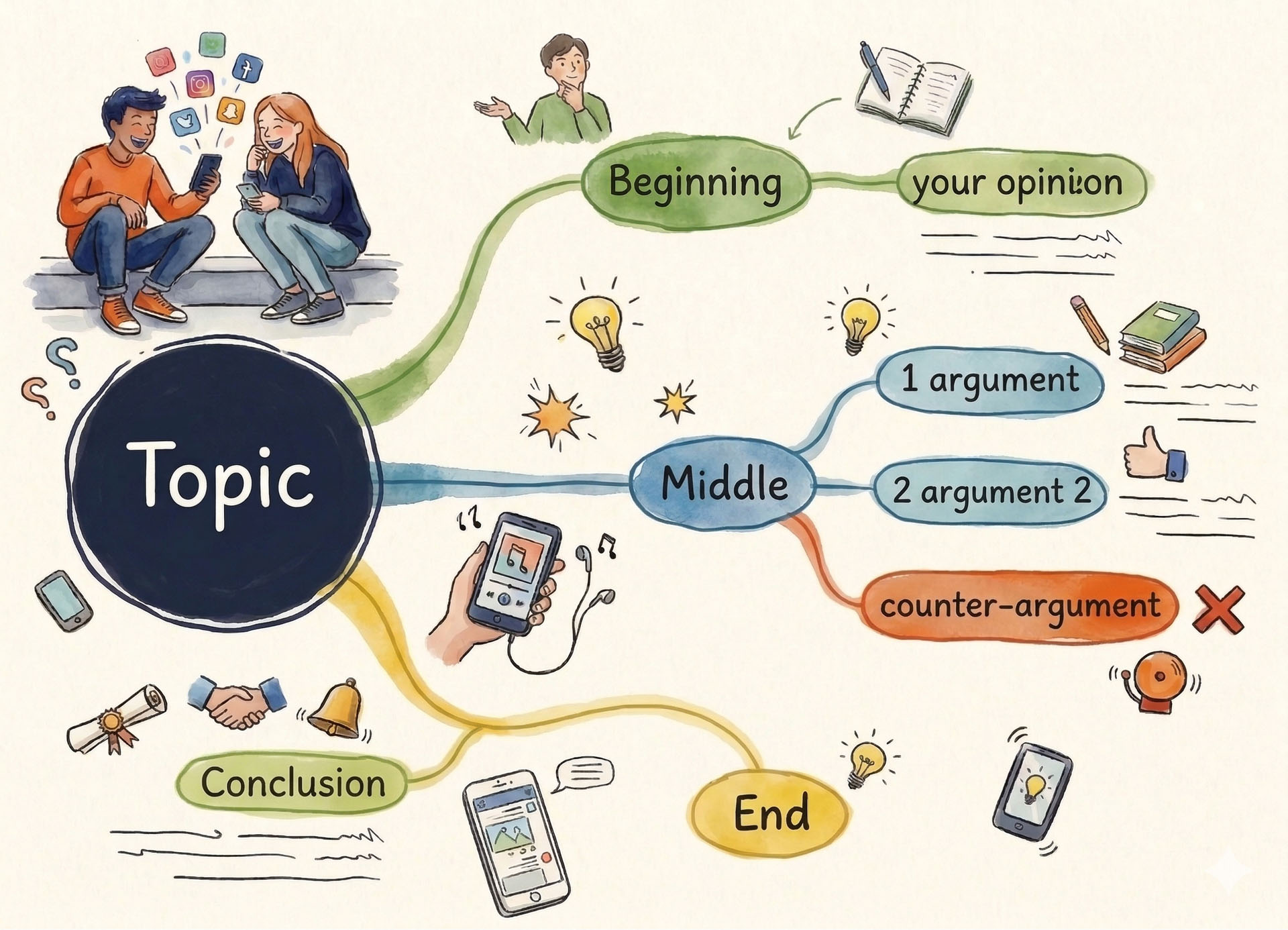
STRUCTURED OPINION

Use the template below to present your opinion on a sample topic from the cards.

COMMENTS

Post your answers to these questions here.