Talking about weather – questions tags

Talking about weather – questions tags

Sorry, but lessons on The Blue Tree work only on a computer or a tablet.

Bardzo mi przykro, ale lekcje na platformie The Blue Tree działają jedynie na komputerze lub tablecie.

Do zobaczenia na większym ekranie 🙂

Zespół The Blue Tree

Talking about weather – questions tags
Learn more words

THE BLUE TREE

Learn Words

CEF B1

CEFR B1

Intermediate

warm up

Answer the questions below.

TRANSCRIPT

Yes, they really do. I think it’s a popular topic because it’s safe and everyone has something to say about it. For example, when we meet in the morning at the office, someone usually says, “It’s freezing today, isn’t it?” or “What a beautiful day, isn’t it?” It’s an easy way to start a conversation or to fill a silence. And in Poland, where the weather changes so often, there’s always something to comment on!

TRANSCRIPT

My favourite kind of weather is sunny but not too hot—something like 22 or 23 degrees with a bit of a breeze. I really enjoy this type of weather because I can go for a walk, ride my bike, or just sit outside with a coffee. I don’t like when it’s very humid or windy. For me, perfect weather means feeling comfortable and relaxed, without sweating or freezing. It makes the day more enjoyable, doesn’t it?

TRANSCRIPT

Yes, I usually do check the weather forecast before booking a holiday. If I’m going to the seaside or planning to spend a lot of time outdoors, I want to make sure it won’t rain all the time. Of course, weather forecasts are not always 100% correct, but they help me decide what clothes to pack and what kind of activities I can plan. If the weather looks really bad, I sometimes choose a different destination or change the dates. It’s better to be safe than sorry, isn’t it?

part one

question tags

Weather is a very safe topic to start a conversation with. There is one strategy that makes such conversations sound very natural and native-like – it’s the use of Question Tags. 

Study the notes about question tags below. 

‘Question tags’ (also called ‘tag questions’) are the small questions that often come at the ends of sentences in speech, and sometimes in informal writing.

  • The film wasn’t very good, was it?

Negatives are usually contracted. Full forms are possible in formal speech.

  • That’s the doorbell, isn’t it?
  • You take sugar in tea, don’t you?
  • They promised to repay us within six months, did they not? (formal)

Question tags can be used to check whether something is true, or to ask for agreement.

Question tags are used after affirmative and negative sentences, but not after questions.

  • You’re the new secretary, aren’t you?
  • You’re not the new secretary, are you?

(but not Are you the new secretary, aren’t you?)

To check information or ask for agreement, we most often put negative tags after affirmative sentences, and non-negative tags after negative sentences.

In speech, we can show the exact meaning of a question tag by the intonation. If the tag is a real question – if we really want to know something and are not sure of the answer – we use a rising intonation: the voice goes up.

If the tag is not a real question – if we are sure of the answer – we use a falling intonation: the voice goes down.

In writing, the exact meaning of a question tag is normally clear from the context.

lucy explains question tags

Watch Lucy explain how to use Question Tags. Pay attention to how she explains the differences in intonation and special cases. 

part two

Complete these five dialogues with the correct question tag. 

Get more than 70% and you will receive a beautiful certificate. 

Dialogue one

A: Good morning! It’s another lovely day, ?
B: It certainly is. It wasn’t as warm as this yesterday, ?
A: No it wasn’t. It poured cats and dogs yesterday evening, ?
B: Yes, it did. The sunshine, though, makes you feel very good, ?
A: You are absolutely right.

Dialogue two

A: Gosh. It’s absolutely scorching, ?
B: Yeah. The heat is simply unbearable, ?
A: That’s true. I hate when it gets so sultry, ?
B: Yeah, I do. Your shirt just sticks to your body, ?
A: If only the wind blew, the air wouldn’t be so stale, ?
B: I’m afraid the forecast says it will only get hotter, ?
A: I’m afraid it does.

Dialogue three

A: Good morning! It’s rather chilly today, ?
B: Yeah, And the sky is overcast. It hasn’t been as cold as this for ages, ?
A: That’s true. We’ve had some lovely weather recently, ?
B: Mm. Ah, well. Mustn’t complain, ?

Dialogue four

A: It looks as if we are going to have a shower from that cloud, ?
B: Actually, I hope it does rain. We could do with a little drizzle, ?
A: Yeah. I believe you’re right. Last few days were really sweltering, ?
B: They certainly were. The lawn is begging for some water, ?
A: True. It gets pretty expensive to water the grass in the summer, ?
B: It does. That’s why I’m looking forward to some rain, actually.

Dialogue five

A: Look, the sky is clearing up, ?
B: Yeah, it definitely looks like it. The clouds are dissipating, ?
A: Yes, they are. I hope it dries before we go out of the office, ?
B: Yeah, I do. I only have flip-flops today. The forecast didn’t say it might rain, ?
A: No, they said there will be sunny intervals, ?
B: Oh well, one shouldn’t believe these weathermen so gullibly.

The dialogues above contained some interesting words and expressions about the weather. 

Play this Quizlet game and learn the meaning of these expressions. 

w

DISCUSSION

project update

Read (role-play) this dialogue. 

Some friends are discussing the weather after coming to work on Monday.

Monday Morning at Work 

Anna:
Morning, everyone! Lovely weather over the weekend, wasn’t it?

Tomek:
Oh yes, just perfect… if you enjoy grey skies and nonstop rain!

Magda:
I know! It always rains on the weekend in Poland, doesn’t it?

Anna:
It really does. The moment Friday evening comes, the clouds show up, don’t they?

Tomek:
Exactly! I planned to go cycling, but I stayed home watching TV all day. Not very active, was it?

Magda:
No, it wasn’t. I tried to take a walk on Sunday, but I gave up after five minutes. The wind was awful, wasn’t it?

Anna:
At least it’s sunny now… just when we’re stuck in the office. Typical!

Tomek:
That’s the rule here: good weather from Monday to Friday, and rain on Saturday and Sunday. It’s a bit unfair, isn’t it?

Magda:
Maybe we should start having weekends on Wednesdays. That would solve the problem, wouldn’t it?

Anna:
Great idea! But the weather would probably change too, just to annoy us.

Tomek:
Well, at least we can talk about the weather—it never gets boring, does it?

(They all laugh.)

OVER TO YOU 

Discuss these questions. Find ways to use the language you were learning in this lesson.

BulletWhat kind of weather makes you feel the happiest, and why?
BulletDo you prefer hot summer days or cold winter days? What are the advantages and disadvantages of each?
BulletHow does the weather affect your daily routine or your energy levels?
BulletIf you could live in any climate in the world, what would it be like? Why?
BulletDo you enjoy extreme weather like storms or snow? Why or why not?
Uses of Present Simple and Present Continuous Tenses

Uses of Present Simple and Present Continuous Tenses

Learn more words

THE BLUE TREE

Tests & Quizzes

CEF B1

CEFR A2

Pre-Intermediate

Practise speaking by describing this picture

TEST YOUR ENGLISH

The key to mastering the English tenses lies in understanding what we use them for. 

Do the tests below and check how well you know what we use the Present Simple and Present Continuous tenses for. 

If you get more than 70 % of correct answers you will receive a beautiful certificate. 

part one

Decide if uses a) to k) are usually associated with the Present Simple or Present Continuous tenses.

a) facts and permanent situations
b) actions and events in progress
c) arrangements for the future
d) verbs of thinking and feeling
e) habits and routines
f) temporary situations
g) fixed timetables
h) current trends and changes


Well done! You're almost there!

i) talking about homes and jobs
j) sport commentaries
k) talking about things we do not expect to change


Time to check your answers. Click on CHECK YOUR ANSWERS button below.

part two

Now assign the correct use of Present Simple and Present Continuous to the examples below. 

1)

She's talking on another line right now, can I ask her to call you back?

2)

We offer a networking solution that is customised, reliable and secure.

3)

We release figures for total sales and net earnings every quarter.

4)

I'm arriving in Munich at 10.30.

5)

The plane arrives in Munich at 10.30.

6)

I'm working in our customer services department this month.

7)

Internet fraud and cybercrime is increasing all over the world.

8)

OK, I understand what the problem is now.

9)

I wear glasses.

10)

Susan works as a nurse in the local hospital.

11)

Krzychowiak passes to Lewandowski scores the goal! What a match!?

12)

The price of crypto currencies is rapidly declining.

13)

I'm meeting the sales team later today. Would you like to come too?

14)

I don't understand this contract. Can you help me?

15)

Food goes off if you don't keep it in the fridge.

16)

I hardly ever need to speak English in my work.

17)

His plane lands in twenty minutes. We should hurry up if we don't want him to wait for us.


Well done! You're almost there!

18)

Świątek hits a brilliant forehand and wins her next tournament.

19)

They live in the suburbs, if my memory serves me right.

20)

This week I'm taking a bus to work. My car is being serviced.

DOWNLOAD

Well done! Have you managed to get the certificates for both of the tasks? I certainly do hope so!

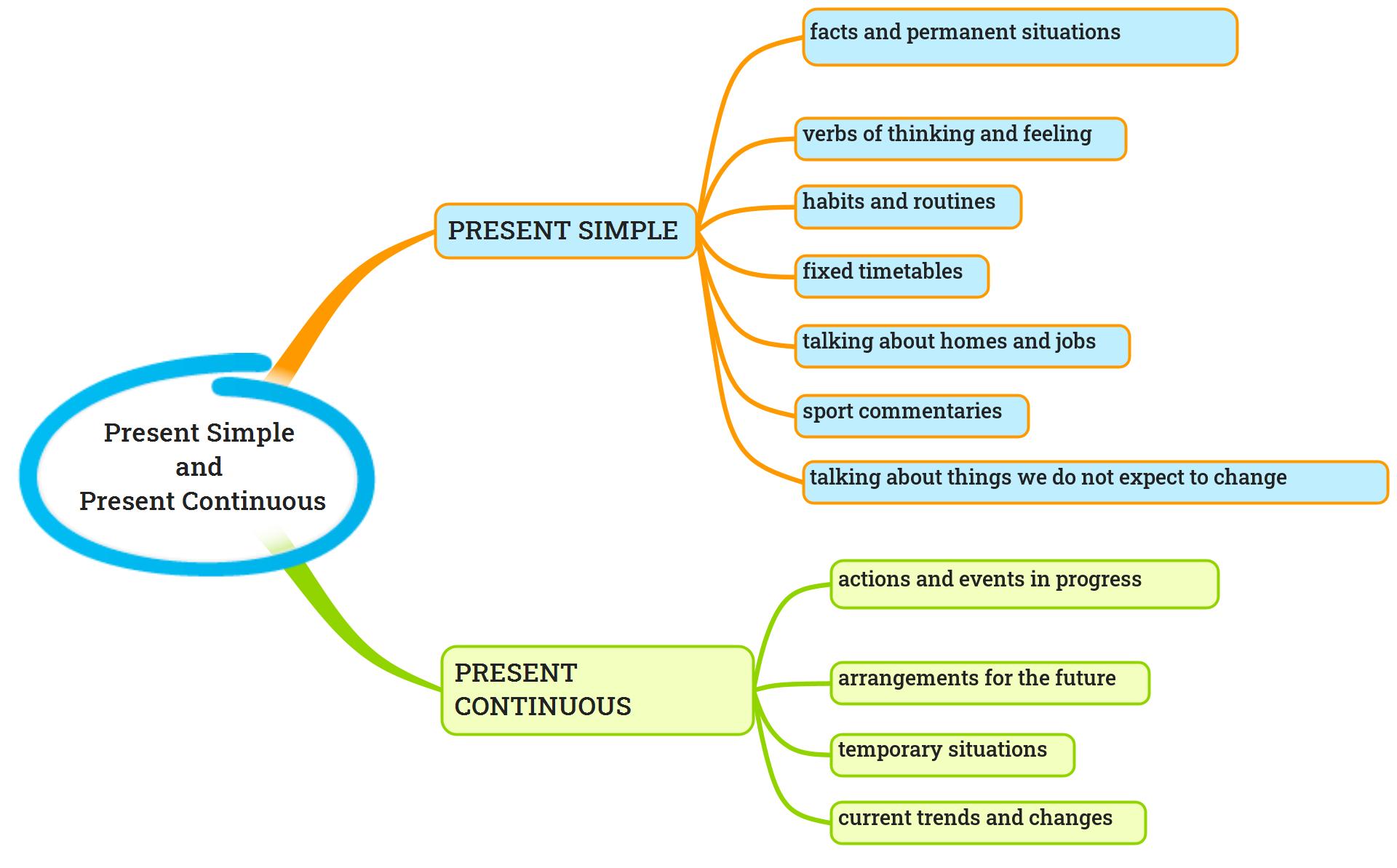
Here’s a little reward for your hard work and effort! It’s a mind-map with the uses of Present Simple and Present Continuous. 

Present Simple and Present Continuous
The Story of Ada Lovelace: The World’s First Computer Programmer

The Story of Ada Lovelace: The World’s First Computer Programmer

Sorry, but lessons on The Blue Tree work only on a computer or a tablet.

Bardzo mi przykro, ale lekcje na platformie The Blue Tree działają jedynie na komputerze lub tablecie.

Do zobaczenia na większym ekranie 🙂

Zespół The Blue Tree

The Story of Ada Lovelace: The World’s First Computer Programmer
Learn more words

THE BLUE TREE

Science Stuff

CEF B1

CEFR B1

Intermediate

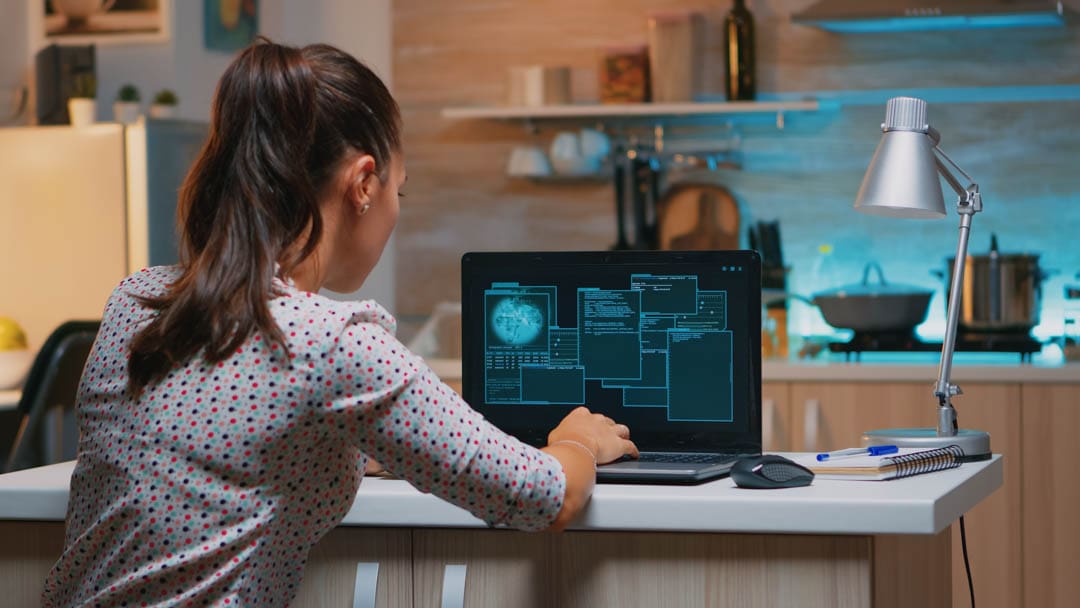
Practise speaking by describing this image

warm up

Answer the questions below. Then listen to the model answers and think about how you could improve yours.

How good are you with computers? Do you like using a computer?
TRANSCRIPT

I’d say I’m pretty comfortable with computers! I like using them, especially for creative work like graphic design or writing. They’re such versatile tools, and I love how you can do so many things from just one device. Plus, it’s fun to explore new programs and learn little tech tricks!

How important are computers in your work/life?
TRANSCRIPT

Computers are essential in my work and life. Nearly everything I do is either on a computer or heavily reliant on them—from managing projects to keeping in touch with colleagues and clients. They streamline so many tasks and make complex work much more manageable. I really can’t imagine working without them.

What do you think the future holds as regards computer development?
TRANSCRIPT

I think we’re going to see computers continue to become even more integrated into our daily lives. With advancements in AI, quantum computing, and machine learning, it’s likely that computers will be able to assist us in ways we can’t fully predict yet. They might get more intuitive, almost like having a personal assistant that understands our needs and habits. It’s exciting but also a bit humbling to think about where technology could lead us!

part one

key language

watch the video

COMPREHENSION

  • ⌚ 0:10 Who was Ada Lovelace?
  • ⌚ 0:18 What was she the first person to recognize?
  • ⌚ 0:31 What is she famous for?
  • ⌚ 0:55 What do we know about Ada’s early childhood?
  • ⌚ 1:16 Who did she get in touch with when she was in her twenties?
  • ⌚ 1:20 How did she use these contacts?

Andrew Cross

Crosse was an early pioneer and experimenter in the use of electricity.

Charles Babbage

A mathematician, philosopher, inventor and mechanical engineer, Babbage originated the concept of a digital programmable computer.

Sir David Brewster

He was a British scientist, inventor, author, and academic administrator. In science he is principally remembered for his experimental work in physical optics, mostly concerned with the study of the polarization of light

Charles Weston

He was an Australian horticulturist and was responsible for the afforestation of Canberra.

Micheal Faraday

He was an English scientist who contributed to the study of electromagnetism and electrochemistry. His main discoveries include the principles underlying electromagnetic induction, diamagnetism and electrolysis.

part two

key language

watch the video

COMPREHENSION

  • ⌚ 1:24 How did Ada describe her approach to science?
  • ⌚ 1:31 Who was her good friend and fellow mathematician?
  • ⌚ 1:36 What was Ada particularly interested in?
  • ⌚ 1:51 Why are Ada’s notes on Babbage’s article important?
  • ⌚ 2:01 What happened to Ada in 1852?
  • ⌚ 2:10 What is Ada’s contribution in the development of modern computers?
  • ⌚ 2:25 What questions was she asking in relation to the analytical engine? Is this question valid today?
w

DISCUSSION

DIALOGUE

Alita and Pete meet at a café after reading about Ada Lovelace. They discuss her remarkable achievements and reflect on how her story still inspires us today.

Alita: Hey Pete! I just finished reading the story of Ada Lovelace. What a woman! Did you know she was the daughter of a countess and the poet Lord Byron?

Pete: Yeah, I read that too! And even though her life was cut short, she really made an impact. She’s often regarded as the world’s first computer programmer!

Alita: Exactly! And what amazed me most was how she supplemented Babbage’s work. He had the idea, but she saw the bigger picture. Her notes were so elaborate—she really understood the capability of the machine.

Pete: Right? She even imagined the machine doing more than just numbers—like music! That’s not mere calculation, that’s vision. And to think some people at the time saw her ideas as insanity…

Alita: I know! Maybe it’s because she was a woman. In her time, women weren’t seen as legitimate scientists or mathematicians.

Pete: True. But she deftly managed to get her work noticed. She was a keen student, always learning and thinking ahead.

Alita: And I liked how her work was so collaborative. She didn’t just work alone—she built on others’ ideas and helped carry out a new vision of computing.

Pete: Yeah, even if it wasn’t fully understood at the time, her work is now perceived as genius.

Alita: We should talk about her more, especially in schools. She’s a great example of someone who broke barriers.

Pete: Agreed. I think her story teaches us that big ideas need courage—and sometimes, time—to be appreciated.

Alita: So, next time we talk about tech pioneers, let’s make sure Ada’s name is always on the list.

Pete: Absolutely. She wasn’t just ahead of her time—she helped shape ours.

OVER TO YOU

Discuss these questions. Refer to the topic of the lesson and your own experience.

BulletHave you ever been a keen student of something?
BulletWhat kind of achievements do you think should be regarded as important in today’s world?
BulletHave you ever carried out a difficult task or project successfully?
BulletWhat’s your opinion about working in a collaborative way versus working alone?
BulletDo you think it’s sometimes okay to cut short your plans or goals?

POLL

Cast your vote in the poll.

How important are computers in our lives these days?

×

lesson glossary

COMMENTS

How important are computers in today’s world? How do you see the development of the computer sciences? What are the pros and cons of computers and the Internet?

Share your views and opinions below. 

What’s the missing word – part 2

What’s the missing word – part 2

Sorry, but lessons on The Blue Tree work only on a computer or a tablet.

Bardzo mi przykro, ale lekcje na platformie The Blue Tree działają jedynie na komputerze lub tablecie.

Do zobaczenia na większym ekranie 🙂

Zespół The Blue Tree

What’s the missing word – part 2
Learn more words

THE BLUE TREE

Learn Words

CEF B1

CEFR B1

Intermediate

WHAT YOU WILL LEARN

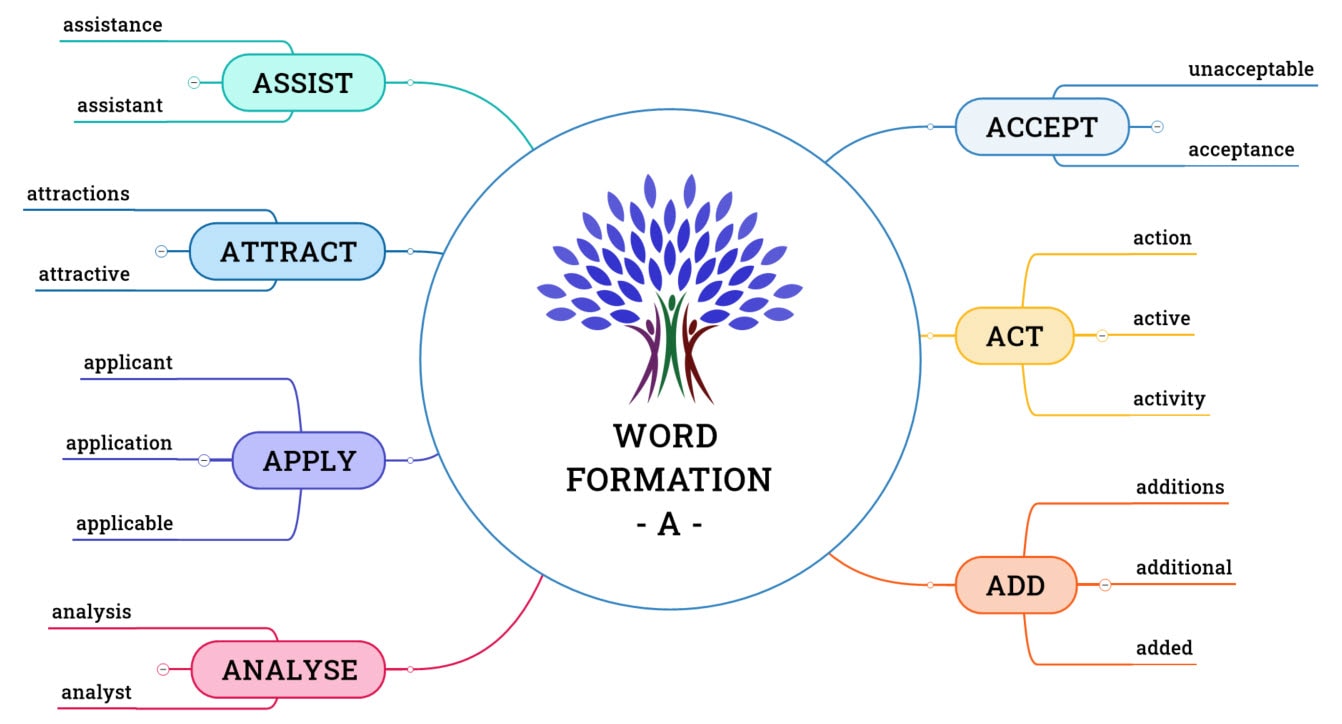
This lesson practises some word-formation of words beginning with “A”. Most of the examples are connected with work and business. 

This lesson contains:

  • A study section
  • Some practice exercises
  • Questions for discussion

And, of course, there is Your Dictionary, where you can add new and interesting words.

Remember to add this lesson to your Learning History.

Practise speaking by describing this image

warm up

Answer the questions below.

  • How are you learning new words in English?
  • What’s the advantage of learning how to form new words from a root word?
  • How important is it for you to speak English accurately, without mistakes?

PRACTICE

Complete the sentences below with the correct form of the root word.

You need to have at least 18 correct answers to get a beautiful certificate. 🙂

UPS! Ta sekcja jest dostępna tylko dla moich uczniów. Zapraszam na wyjątkowe lekcje angielskiego online lub na Mokotowie w Warszawie. Napisz do mnie na hi@thebluetree i umów się na darmową lekcję próbną.
w

DISCUSSION

Answer these questions. Use the language practised from this lesson.

  • Do you believe companies should officially accept working from home?
  • Do you prefer to spend your free time actively or just to chill out?
  • What additional benefits should companies offer along the salary?
  • What advice would you have for job applicants?
  • How do you feel about the government offering material assistance to citizens?
  • What makes a good commercial attractive to customers?
In a Rut. Try These Simple Approaches to Re-Energize Yourself

In a Rut. Try These Simple Approaches to Re-Energize Yourself

Sorry, but lessons on The Blue Tree work only on a computer or a tablet.

Bardzo mi przykro, ale lekcje na platformie The Blue Tree działają jedynie na komputerze lub tablecie.

Do zobaczenia na większym ekranie 🙂

Zespół The Blue Tree

In a Rut. Try These Simple Approaches to Re-Energize Yourself
Learn more words

THE BLUE TREE

Personal
Productivity

CEF B1

CEFR B1

Intermediate

Practise speaking by describing this image

warm up

Answer the questions below.

TRANSCRIPT

Absolutely! I think it’s really important to do work that you enjoy, or at least find meaning in. When I’m working on something creative or something that challenges me in a good way, I feel so much more energized. It’s tough to stay motivated if you’re not passionate about what you’re doing.

How can recognition help us to enjoy our work more?
TRANSCRIPT

Recognition can make a big difference. When people acknowledge your efforts, it boosts your morale and makes you feel like your work matters. I’ve seen how a simple thank you or feedback from a colleague can make the work feel more rewarding. It doesn’t have to be a big gesture—just knowing you’re making a positive impact is motivating.

Is it a good idea to have a clear purpose for doing your job?
TRANSCRIPT

Yes, having a clear purpose for doing your job is really important. It helps keep you focused, especially during challenging times. Personally, I like to remind myself why I started a project or how it fits into my bigger goals. It’s like having a compass—it guides your energy and decisions in the right direction, so you don’t get lost in the day-to-day stress.

part one

AT A GLANCE

Listen to a short version of the article that you will read later. Answer the questions that follow.

TRUE OR FALSE

Do the task below.

Are these sentences true or false according to to the listening?

1. The text says that when you feel stuck at work, you should try to work harder and longer.
2. One suggestion is to write down your purpose and keep it where you can see it.
A “to-don’t” list helps you identify activities that take away your energy.

part two

FULL ARTICLE

Now read the full article and do the tasks that follow.

In a Rut at Work? Try These Simple Ways to Feel Re-Energized

We all have moments at work when everything feels heavy. You sit at your desk, look at your tasks, and think: “I just don’t have the energy today.” That’s completely normal.

Instead of trying to power through and force yourself to work harder, try something different: manage your energy, not your time. Small changes can make a big difference.

Here are three simple ideas that many people use to feel more motivated and positive at work.

1. Write Your Purpose on a Post-it 📝

Take a small piece of paper and write down why you do your job.

This can be:

  • your big purpose – why you chose this career

  • or a small purpose – why this one task or project matters right now

Put the note somewhere you can see it every day: on your desk, computer screen, or notebook.

“I wrote ‘I help people feel confident in meetings’ on a post-it and stuck it to my screen. On bad days, it reminds me that my work has meaning,” says Anna, a project coordinator.

When work feels stressful or tiring, this simple reminder can help you reconnect with what really matters.

2. Create a “Wall of Encouragement” 🌟

Collect things that make you feel good:

  • kind emails from colleagues or clients

  • positive feedback

  • awards or certificates

  • funny pictures or memes

You can put them on the wall near your desk or save them in a digital folder.

“When I feel tired or unappreciated, I open my ‘good moments’ folder. It reminds me that my work is noticed,” says Marek, an IT specialist.

Looking at these messages can give you a quick emotional boost and help you feel valued.

3. Make a “To-Don’t” List 🚫

Instead of only writing a to-do list, try writing a to-don’t list.

Ask yourself:

  • What activities drain my energy?

  • Which habits don’t help me anymore?

  • What tasks could be automated or given to someone else?

These might be:

  • unnecessary meetings

  • checking emails too often

  • tasks that are boring and repetitive

“I realized I was saying yes to everything. My to-don’t list helped me stop doing things that weren’t important,” says Kasia, a team leader.

Removing just one energy-draining habit can make your day feel much lighter.

Final Thought

You don’t always need more time. Very often, you just need more energy.

Small actions—like a post-it note, a kind message, or a better boundary—can help you feel more focused, motivated, and calm at work.

Sometimes, working smarter starts with being kinder to yourself 💙

COMPREHENSION

Answer these questions on the basis of the article.

  • What do people often fall into at work, according to the article?

  • What two kinds of purpose can someone write on a post-it note?

  • Why is it helpful to keep your purpose visible at your desk, especially on difficult days?

  • What kinds of things can be included in a “wall of encouragement”?

  • Why is it important to identify activities, habits, or people that drain your energy?

  • What actions should you take after making a “to-don’t” list?

POLL

Cast your vote in the poll.

Which tip about hot re-energize yourself at work do you think is the most relevant for you?

×
w

DISCUSSION

DIALOGUE

Read or role-play this dialogue.

Alita:
You know, I really liked the idea of writing your purpose on a post-it. When work gets stressful, I sometimes forget why I’m doing what I’m doing in the first place.

Pete:
Yeah, I get that. I’m more skeptical, though. I used to think a post-it wouldn’t change much. But when I wrote a short sentence about helping my team work better, it actually helped me refocus on bad days.

Alita:
Exactly. It’s not about motivation in a big, dramatic way. It’s more like a quiet reminder. I also liked the idea of a wall of encouragement. I tend to focus too much on what goes wrong.

Pete:
Same here. I saved a few positive emails from clients, and when I read them again, I realize that my work is appreciated more than I think. It really changes my mood.

Alita:
What about the to-don’t list? That one felt very practical to me.

Pete:
Honestly, that’s my favourite idea. I noticed that too many meetings were draining my energy. Once I started saying no to some of them, my days felt much lighter.

Alita:
I agree. We usually add more and more to our to-do lists, but we rarely stop and ask what we should stop doing.

Pete:
Exactly. For me, managing energy is about small decisions, not big changes. And these ideas are simple enough to actually use.

OVER TO YOU

Discuss these questions.

BulletWhat usually drains your energy the most at work or in everyday life, and how do you normally deal with it?
BulletWhen you feel tired or unmotivated, what helps you recover your energy faster: rest, a change of activity, or a sense of purpose? Why?
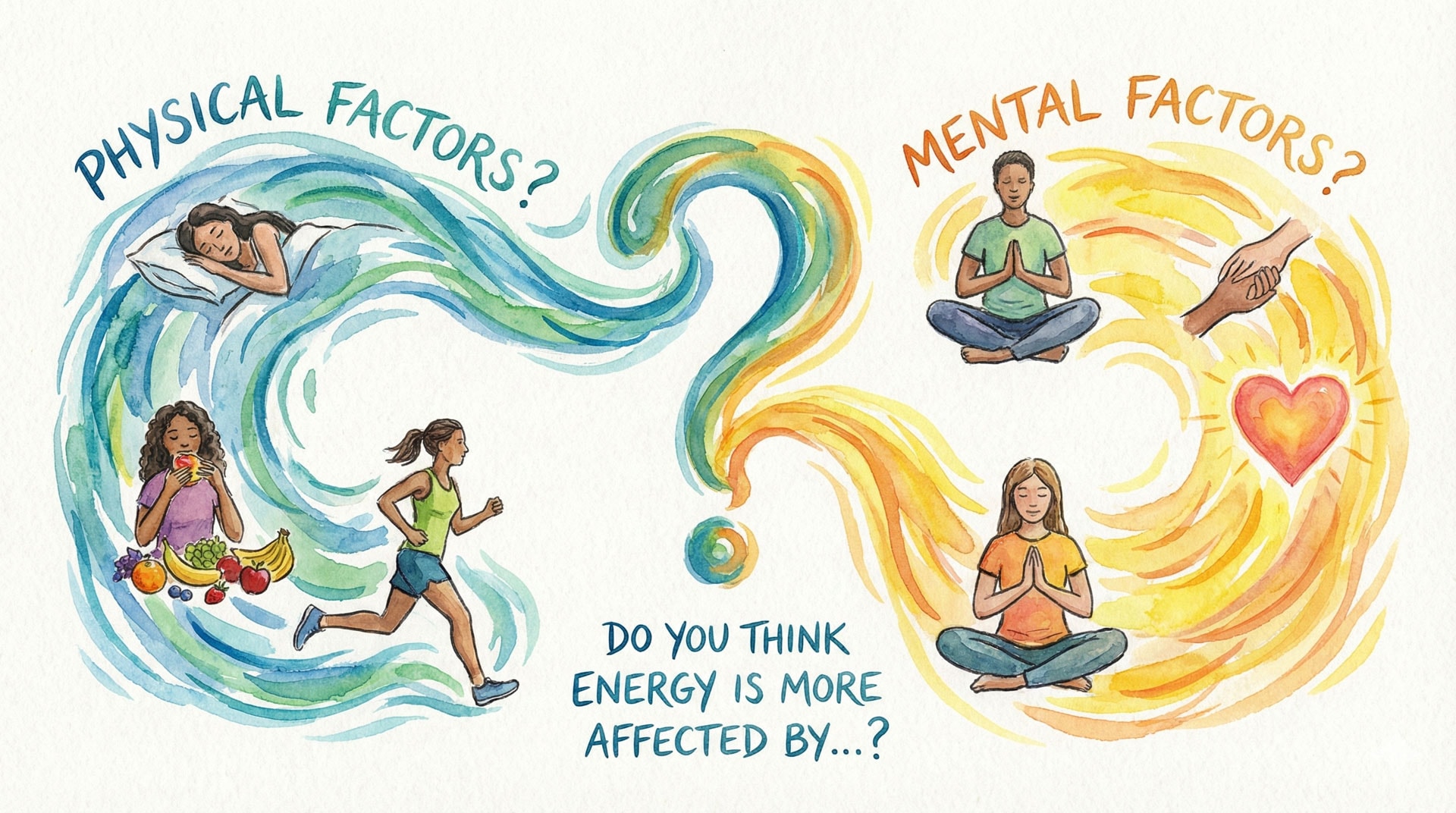
BulletDo you think energy is more affected by physical factors (sleep, food, movement) or mental factors (stress, meaning, relationships)? Explain your opinion.
BulletCan being busy sometimes feel energizing instead of exhausting? In what situations does that happen for you?
BulletIf you had to give one piece of advice to a colleague who feels burned out, what would it be and why?

COMMENTS

How do you re-energize yourself when you are feeling down at work? Would you like to give any of these ideas a try?

Share your views and experience here.