
A-Z Challenge – Phrasal Verbs

A-Z Challenge – Phrasal Verbs

Sorry, but lessons on The Blue Tree work only on a computer or a tablet.

Bardzo mi przykro, ale lekcje na platformie The Blue Tree działają jedynie na komputerze lub tablecie.

Do zobaczenia na większym ekranie 🙂

Zespół The Blue Tree

A-Z Challenge – Phrasal Verbs
Learn more words

THE BLUE TREE

Learn Words

CEF B1

CEFR B1

Intermediate

WHAT YOU WILL LEARN

This lesson will teach you 26 practical phrasal verbs. You will have a chance to practise them in some fun ways.

This lesson contains:

  • Some warmup questions
  • A-Z Challenge
  • Fill in the gaps activity
  • Questions for discussion
  • Downloadable glossary

Which phrasal verbs will you add to Your Dictionary?

Remember, also, to add this lesson to your Learning History.

Practise speaking by describing this image

warm up

Answer the questions below.

  • If you could take up any hobby, no matter the cost, what would you choose?
  • Have you ever had to reach out to anybody for help or support?
  • Do you think that petrol cars will eventually yield to electric ones?

A-Z CHALLENGE

Do the A-Z Phrasal Challenge. Let’s see how many of these phrasal verbs are new for you, shall we?

PRACTICE

Complete the sentences in this exercise with EXACTLY the same phrasal verbs as in the examples from the A-Z Challenge.

If you score more than 70%, you will receive a beautiful certificate.

1.

You should his advice. He knows what he is talking about.

2.

If you'll a moment, I'll just find your trip details.

3.

I had seven siblings. It was difficult for my parents to so many children.

4.

I'll have to a computer this week. It is being serviced, because it was very slow.

5.

She doesn't like to , so she cooks a lot.

6.

My sister is my best friend. I wouldn't have anything against it if he wasn't so much older than her.

7.

You will never it! How could you be so cruel to us? I'll make sure you'll pay for what you have done.

8.

I want to to some deserted island and start a life as a hermit.

9.

Why did you leaving early? Didn't you like the party?

10.

She the list of things she had to do. She frowned when she realized how long this list was.

11.

Annaleigh is running. She goes jogging every day, regardless of the weather outside.

12.

Let's this Sunday! We deserve it, don't we? We worked really hard all week.

13.

I don't want to the next big thing Samsung puts to market. I want to be the first to lay my hands on it.

14.

We have the list to four candidates, although I am leaning toward giving the job to Mrs.Lane. She is very well connected.

15.

More than 100 students the student exchange program every year. Most of them decide to go abroad and taste living in a different country.

16.

I wish I'd gone to see my grandmother before she .

17.

There is now no chance that things will this year. We should brace ourselves for some hard times ahead.

18.

If you have any questions or concerns, please to us at this email address.

19.

After a long day at the office, she finally in an armchair to watch her favourite series on Netflix.

20.

I am not going to much of your time. I just want you to hear about my latest idea how to save the company some money.

21.

This app your battery. You should delete it.

22.

Since he lost his job, he's only in front of the TV all day.

23.

We have already this business. There was no chance it would be a success.

24.

Canals the railways for transporting goods. Now everything is transported on freight trains rather than on rivers.

25.

Why don't we the January figures? I'd like to discuss it further, if I may.

w

DISCUSSION

Answer these questions. Use the language practised from this lesson.

  • Which part of your job takes up the most of your time?
  • Do you feel comfortable reaching out to others for help?
  • Do you enjoy vegging out in front of a TV?
  • Have you ever had to write off any money you had lent to anybody?
  • When will the pandemic quiet down, in your opinion?
  • Will the owners of social media sites yield to pressure from the regulators?
  • How do you prepare your shopping list?

LESSON GLOSSARY

COMMENTS

Can you think of some other examples that illustrate these idioms?

Post your answers to these questions here.

Briefing the big boss

Briefing the big boss

Sorry, but lessons on The Blue Tree work only on a computer or a tablet.

Bardzo mi przykro, ale lekcje na platformie The Blue Tree działają jedynie na komputerze lub tablecie.

Do zobaczenia na większym ekranie 🙂

Zespół The Blue Tree

Briefing the big boss
Learn more words

THE BLUE TREE

Better
Communicator

CEF B1

CEFR B1

Intermediate

Practise speaking by describing this image

warm up

Answer the questions below. Then listen to the sample answers and report back on what you’ve heard.

How approachable are the managers in your company?
TRANSCRIPT

The managers in my company are generally approachable, but I think it depends on the individual. Some are more open to casual conversations, while others prefer a formal setting. It’s important to understand their style before approaching them. Personally, I feel that if you come prepared and respectful, they’re usually willing to listen.

Have you ever heard about managing up? What do you think it is?
TRANSCRIPT

I’ve heard about managing up, and I think it’s about working well with your boss and ensuring that you’re making their job easier while also advocating for yourself. It involves understanding their priorities, how they like to communicate, and aligning your work to support their goals. It’s like managing the relationship with your manager to make sure both sides succeed.

How can subordinates increase their chances of being heard by their superiors?
TRANSCRIPT

To increase their chances of being heard by their superiors, subordinates should be clear, concise, and direct. Having a solution-oriented mindset also helps. It’s crucial to do your homework and understand what matters most to your manager, and then present ideas that align with those priorities. Timing and context are key, too—choosing the right moment to pitch an idea can make all the difference.

LISTENING

Listen to the audio. What is the main message of this HBR Management Tip?

reading

Read this article and answer the questions that follow.

Briefing the Big Boss

1. There’s no shortage of advice on how to 2. brief a senior leader: Keep it short, 3. front-load the message, and so on. But you can’t 4. undervalue the interpersonal dynamics in the room when you’re presenting
5. crucial information to the big boss. So before the meeting, identify the senior leader’s most trusted advisor. Consult with that person ahead of time so they’ll be able to 6. vouch for you and back up the information you’re presenting. Their support will help you earn the senior leader’s trust. Next, 7. familiarize yourself with your boss’s instructions. For example, what are their 8. nonverbal cues that 9. indicate that they want you to either say more or hurry up. You need to adapt your style in real time based on their reaction — so make sure you know what those signals are. Finally, find out how your boss engages with material. Are they someone who pushes back on points? Are they a quiet listener? Or do they ask a lot of questions? Being aware of these things ahead of time will make you more effective in communicating the right message under pressure.

This tip is adapted from “How to Brief a Senior Executive,” by Grant T. Harris

nie brakuje

przedstawić coś krótko

od razu przejść do rzeczy

niedocenić

istotne, bardzo ważne

ręczyć za kogoś, poprzeć kogoś

zapoznać się z czymś

niewerbalne sygnały

wskazać

COMPREHENSION

Answer the questions below. Try to throw some of the newly learned words into your answers.

  • What are some pieces of advice on how to brief a big boss?
  • What shouldn’t we undervalue?
  • Why is it a good idea to find someone who could vouch for us?
  • What should we familiarize ourselves with?
  • How does learning how our boss engages with a material help us?
  • Are there any other tips that can help us be more effective presenting under pressure?

Time for a short summary. Watch this video and read all the questions. Do you think it could be practical to take them into consideration when you are briefing the big boss?

POLL

Cast your vote in the poll.

Which piece of advice from the article do you find most practical?

×

COMMENTS

What advice would you give to a colleague who had to present in front of the Management Board for the first time?

How important is it for the success of a business that top management are approachable and easy to talk to?

Share your views and experience here.

Beginning Graphic Design: Fundamentals

Beginning Graphic Design: Fundamentals

Learn more words

THE BLUE TREE

English for Graphic Designers

BEGINNING GRAPHIC DESIGN FUNDAMENTALS

warm up

  • What is design?
  • Do you pay attention to how things are designed?
  • Is design a learnable skill?

part one

LEARN KEY LANGUAGE

WATCH THE VIDEO

ANSWER THE QUESTIONS

  • ⌚ 00:25 What are the five most basic elements of design?
  • ⌚ 00:46 What is the advantage of mastering fundamentals of design?
  • ⌚ 01:00 What are some of the types of lines?
  • ⌚ 01:26 What are some of the functions of a line in a text?
  • ⌚ 01:33 What are the four qualities of a line?

part two

LEARN KEY LANGUAGE

WATCH THE VIDEO

ANSWER THE QUESTIONS

  • ⌚ 01:56 What is the definition of a shape?
  • ⌚ 02:00 What are some examples of shapes?
  • ⌚ 02:09 What are the two categories of shapes?
  • ⌚ 02:18 How do shapes affect images?
  • ⌚ 02:35 What are some of the uses of shapes in a graphic design?
  • ⌚ 02:51 What is the difference between a shape and a form?
  • ⌚ 03:01 What does it mean that a form is implied?
  • ⌚ 03:01 What three strategies help create an illusion of depth?
  • ⌚ 03:20 What is the advantage of using 3D forms in graphic design?

part three

LEARN KEY LANGUAGE

WATCH THE VIDEO

ANSWER THE QUESTIONS

  • ⌚ 03:43 What is the definition of texture?
  • ⌚ 03:59 What does texture add to a design?
  • ⌚ 04:05 What are some of the qualities of texture?
  • ⌚ 04:20 Where can texture be found?
  • ⌚ 04:26 What should a designer remember about as regards the use of textures?

part four

LEARN KEY LANGUAGE

WATCH THE VIDEO

ANSWER THE QUESTIONS

  • ⌚ 04:36 How can balance be described?
  • ⌚ 04:44 What are some of the things that can affect balance?
  • ⌚ 04:49 Why mastering balance is difficult for beginners?
  • ⌚ 05:00 What are symmetrical designs?
  • ⌚ 05:11 How does balance work on an asymmetrical design?
  • ⌚ 05:31 What is the rule of thirds?
  • ⌚ 05:39 What does research say about the path human eye follows?

POLL

Which basic element of design is in your opinion the most impactful?

×

DOWNLOAD

download the mind-map

Learning is more effective when you use mind-maps!

GLOSSARY

COMMENTS

  • How important is design in the modern world?
  • Does design have impact if a product of a site are successful?
  • How important is it to learn the basics of design?
  • Do you know some examples of work that illustrates good use of these design elements?

Share your views and opinions below.

WILL Book Trailer

WILL Book Trailer

Sorry, but lessons on The Blue Tree work only on a computer or a tablet.

Bardzo mi przykro, ale lekcje na platformie The Blue Tree działają jedynie na komputerze lub tablecie.

Do zobaczenia na większym ekranie 🙂

Zespół The Blue Tree

WILL Book Trailer
Learn more words

THE BLUE TREE

Entertainment

CEF B1

CEFR B1

Intermediate

warm up

Answer the questions below. Then listen to the model answers and think about how you could improve yours.

TRANSCRIPT

My favorite actor would probably be Tom Hanks. I admire how versatile he is, transitioning effortlessly between serious roles and lighthearted comedies. His performances always feel authentic and relatable, which is why I think he resonates with so many people. His movies have such a lasting impact on me.

How much do you know about their personal lives?
TRANSCRIPT

I know a fair amount about their personal lives, but I try to focus more on their work. For instance, I enjoy learning about how actors prepare for their roles or what inspires them. But sometimes, details about their personal lives come up in interviews or articles, and it’s interesting to see how their experiences shape their acting.

TRANSCRIPT

I do enjoy reading biographies, especially about people who’ve had unique journeys or overcome great challenges. Biographies give such an intimate look into a person’s life and thoughts. They often inspire me to see how others have managed difficulties and used their experiences to grow and achieve greatness.

THE BLUE TREE - Learning English

key language

Remember the words from the flashcards.

watch the video

COMPREHENSION

Answer the questions below.

  • ⌚ 00:20 Why is being nervous a good thing?
  • ⌚ 00:33 How did Will feel about writing a book?
  • ⌚ 01:04 What will readers learn about Will from this book?
  • ⌚ 01:16 What does the book focus on?
  • ⌚ 01:28 How important was Will’s father for him?
  • ⌚ 01:53 Was it easy to write this book?
  • ⌚ 02:13 What did Will learn in the process?

POLL

Which film(s) with Will Smith do you like the most? Pick maximum three movies.

Which film(s) with Will Smith do you like the most? Pick maximium three movies.

×

lesson glossary

Four Thousand Weeks by Oliver Burkeman

Four Thousand Weeks by Oliver Burkeman

Sorry, but lessons on The Blue Tree work only on a computer or a tablet.

Bardzo mi przykro, ale lekcje na platformie The Blue Tree działają jedynie na komputerze lub tablecie.

Do zobaczenia na większym ekranie 🙂

Zespół The Blue Tree

Four Thousand Weeks by Oliver Burkeman
Learn more words

THE BLUE TREE

Personal
Productivity

CEF B1

CEFR C1

Advanced

Practise speaking by describing this image

warm up

Answer the questions below.

Are you feeling overwhelmed with work at times?
TRANSCRIPT

Yeah, I do feel overwhelmed with work sometimes, especially when there’s so much to get done and not enough time. It’s hard not to get caught up in trying to do everything, but I’m learning to focus on what’s most important and let go of the rest. I’m trying to be kinder to myself and accept that I can’t do it all.

How long is your bucket list? What are some of the items on it?
TRANSCRIPT

My bucket list isn’t too long, but it’s full of things that really matter to me. Some of the items include traveling to Japan, writing a book, and maybe even learning a new language. I’ve realized it’s more about quality than quantity—choosing a few meaningful goals and really focusing on them rather than spreading myself too thin.

Do you like being really good at what you take-up?
TRANSCRIPT

I do like being really good at what I take up, but I’ve also learned that perfection isn’t always necessary. Sometimes, it’s better to aim for ‘good enough’ so I can spend my time on what matters most. It’s about finding a balance between doing things well and not letting the pursuit of perfection hold me back.

part one

KEY LANGUAGE

Go through the flashcards below. Make sure you understand all the words and expressions.

VIDEO

Watch the first part of the video.

COMPREHENSION

Answer these questions. Refer to the information from the video.

  • ⌚ 00:16 How long is the average life?
  • ⌚ 00:49 Why do we take more responsibilites than we can handle?
  • ⌚ 01:06 What do pebbles and rocks illustrate?
  • ⌚ 01:18 What is Existential Overwhelm?
  • ⌚ 01:38 What is the Efficiency Trap?
  • ⌚ 01:57 How do people caught in Existential Overwhelm and The Efficiency Trap feel?

part two

KEY LANGUAGE

Go through the flashcards below. Make sure you understand all the words and expressions.

VIDEO

Watch the second part of the video.

COMPREHENSION

Answer these questions. Refer to the information from the video.

  • ⌚ 02:18 What did Warren Buffet’s pilot ask him about?
  • ⌚ 02:36 What did Mr Buffet tell him to do?
  • ⌚ 02:51 What does the modern world supply us with?
  • ⌚ 03:06 How does wanting to do many things lead to Existential Overwhelm?
  • ⌚ 03:59 How can we get rid of Existential Overwhelm?
  • ⌚ 04:34 What is the bonus benefit of having an Open and Closed lists?

part three

KEY LANGUAGE

Go through the flashcards below. Make sure you understand all the words and expressions.

VIDEO

Watch the third part of the video.

COMPREHENSION

Answer these questions. Refer to the information from the video.

  • ⌚ 05:31 What is strategic underachievement and how can we practise it?
  • ⌚ 05:56 What effect will being good enough have?
  • ⌚ 06:16 What do you think of Jon Acuff’s quote?

“When you decide in advance what things you are going to bomb, you remove the sting of shame.”

part four

KEY LANGUAGE

Go through the flashcards below. Make sure you understand all the words and expressions.

VIDEO

Watch the fourth part of the video.

COMPREHENSION

Answer these questions. Refer to the information from the video.

  • ⌚ 06:41 How can we enrigh the remaining weeks?
  • ⌚ 06:49 What assumptions should we make?
  • ⌚ 07:35 What is the advantage of adopting this mindset?

POLL

Cast your vote in the poll.

Which of the ideas from Four Thousand Weeks appeals to you the most?

×
w

DISCUSSION

Dialogue

Alita & Pete talk about Four Thousand Weeks by Oliver Burkeman. 

Read or role-play their dialogue.

Alita:
You know, I didn’t expect this book to hit me so much. My workmate Mario is really into Burkeman’s ideas. He even showed me his diary last week.

Pete:
His diary? That already sounds a bit extreme. What was so special about it?

Alita:
It wasn’t packed with tasks. Quite the opposite. He had an “open list” and a “closed list.” The closed one was surprisingly long—things he consciously decided not to do. It made his days look calmer, almost intentional.

Pete:
I don’t know… It sounds like giving up before you even try. Aren’t we supposed to be efficient and get more done?

Alita:
That’s exactly the trap Burkeman talks about. Mario said that the more efficient he used to be, the more work he attracted. Now he accepts he can’t do everything in his four thousand weeks, so he chooses more carefully. It felt… honest.

Pete:
Hmm. I admit I’m always chasing that feeling of being “on top of things,” and it never really comes. My to-do list just keeps growing.

Alita:
Same here. What really stayed with me was the idea of treating some moments as if they might be the last time. Mario wrote things like “last time walking my daughter to school.” That really stopped me.

Pete:
Okay… that’s actually powerful. Maybe embracing limits isn’t laziness after all. Maybe it’s a way of paying better attention.

Alita:
Exactly. It’s not about doing less for the sake of it—it’s about doing what matters, and accepting the trade-offs.

Pete:
Alright, you’ve convinced me more than I expected. I might not start a diary tomorrow, but I could start by deciding what not to worry about.

Alita:
That already sounds very Burkeman-like.

OVER TO YOU

Discuss these questions.

BulletHave you ever felt that the more efficient you became, the more work you had? Can you give an example from your job or daily life?
BulletHow do you usually decide what goes on your to-do list?
Would it be difficult for you to create a “closed list” of things you choose not to do?
BulletWhat do you think about the idea of “strategic underachievement”? Are there areas in your life where “good enough” would actually be better than perfect?
BulletHave you ever experienced a moment that felt special only after it had passed? How could “last time” thinking change the way you experience such moments?
BulletIf you truly accepted that your time is limited, what would you do differently next week? Is there one small change you could realistically make?

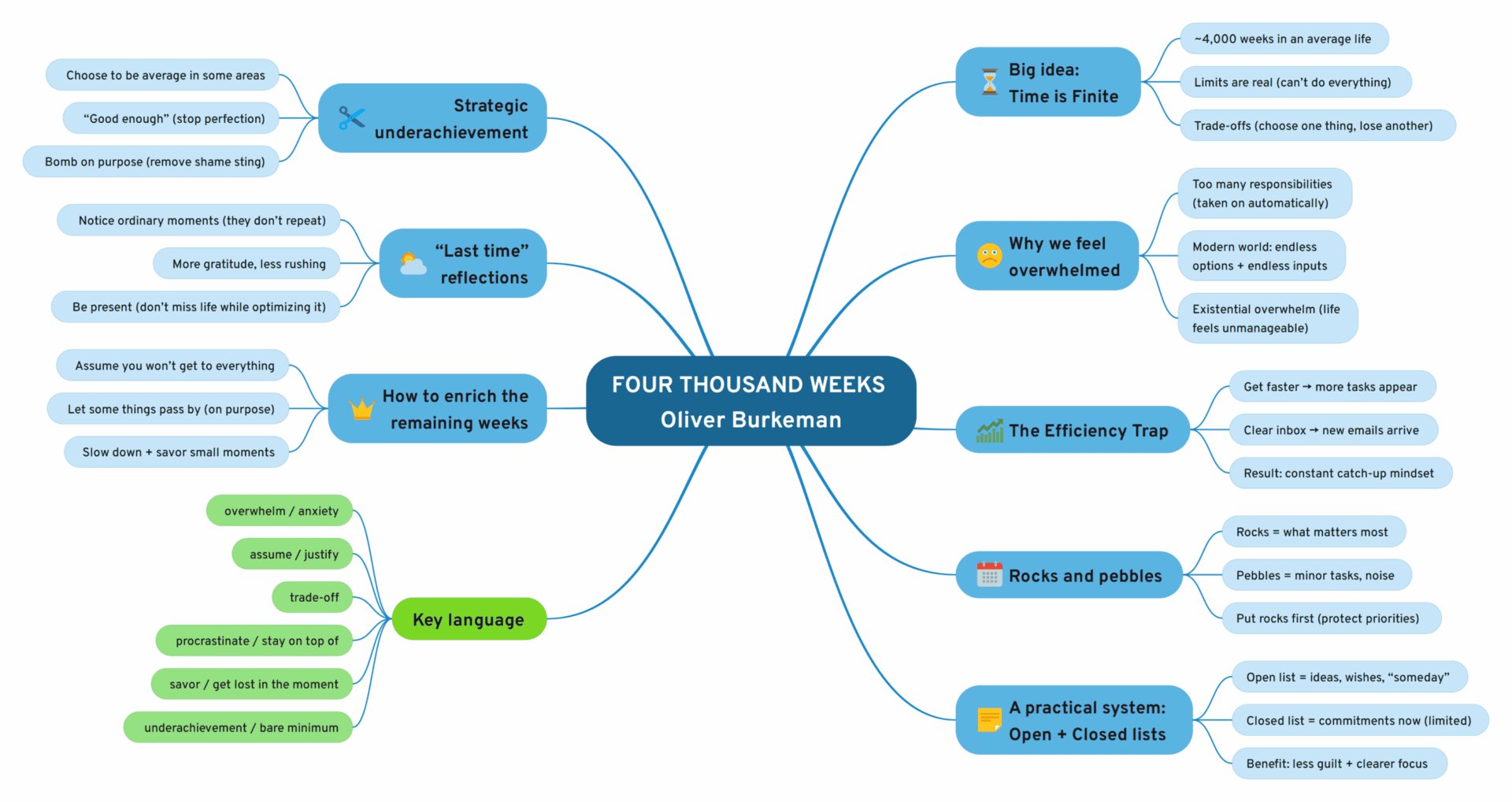
MIND-MAP

Use the mind-map below to have a more in-depth conversation about this topic.

4000 Weeks by Oliver Burkeman

lesson glossary

COMMENTS

What do you think of the ideas presented in this lesson?

Share your views and experience here.