Test your question tags – part 2

Test your question tags – part 2

Learn more words

THE BLUE TREE

Tests & Quizzes

CEF B1

CEFR B1

Intermediate

Sorry, but lessons on The Blue Tree work only on a computer or a tablet.

Bardzo mi przykro, ale lekcje na platformie The Blue Tree działają jedynie na komputerze lub tablecie.

Do zobaczenia na większym ekranie 🙂

Zespół The Blue Tree

Practise speaking by describing this picture

TEST

Complete each item with the correct question tag. 

If you get more than 15 correct answers, you will receive a beautiful certificate. 

1)

It's quite cold today, ? I should have worn a heavier coat.

2)

"You're attending the conference next month, ? It's a great networking opportunity."

3)

They moved to Canada last year, ? I wonder how they're adjusting to the climate.

4)

Our team met the project deadline, ? That calls for a celebration.

5)

This is the best pizza in town, ? I've never tasted anything like it."

6)

You're new to the marketing department, ? Welcome aboard!

7)

Oliver loves hiking, ? I saw his pictures from the mountain trip.

8)

We should finalize the report by Friday, ? The client is expecting it.

9)

I'm really late, ? The traffic was just terrible today.

10)

Let's brainstorm some new ideas for the campaign, ? Fresh perspectives are always helpful."

11)
That dog belongs to Mrs. Johnson, ? It's always in her garden.
12)
You didn't receive the email about the meeting change,
13)
Emily will join us for dinner tonight, ? She always enjoys Italian cuisine.
14)
This software makes our work much easier, ? It's been a great investment.
15)
We used to play soccer together as kids, ? Those were good times.
16)
You've met our new CEO, ? He started last week.
17)
You'll brief the team on the new policy, ? They need to be informed.


Well done! You're almost there!

18)
You hardly ever eat sweets, ? I always see you choosing healthy options.
19)
They've exceeded their sales targets this quarter, ? The results are impressive.
20)
We're ahead of schedule on the project, ? This will give us extra time for quality checks.

Moods are weather

Moods are weather

Moods are weather
Sorry, but lessons on The Blue Tree work only on a computer or a tablet.

Bardzo mi przykro, ale lekcje na platformie The Blue Tree działają jedynie na komputerze lub tablecie.

Do zobaczenia na większym ekranie 🙂

Zespół The Blue Tree

Learn more words

THE BLUE TREE

Everyday English

CEF B1

CEFR B1

Intermediate

Practise English by describing this image

warm up

Answer these questions. Then listen to Penelope give her answers. Report back what she said.

TRANSCRIPT

“Oh, absolutely! The weather really gets to me sometimes. Like, when it’s sunny and bright, I feel super cheerful and full of energy. But on those gray, rainy days, I can’t help but feel a bit down, you know? I just wish I could be more like, ‘Hey, it’s just weather!’ and not let it affect my mood that much. But yeah, sunny days are my happy days!”

What do you do when you are feeling a bit down?
TRANSCRIPT

“Well, when I’m feeling a bit down, I usually try to do something that cheers me up. Sometimes, it’s as simple as listening to my favorite music or watching a funny movie. Other times, I call a good friend to chat, or I go for a walk. I think getting some fresh air and a bit of exercise can really help lift my spirits. Oh, and I love baking too! There’s something about making cookies or a cake that just makes me happier.”

Think of some really happy moment in your life. What was happening and why did you feel that way?
TRANSCRIPT

“Oh, one really happy moment? There are quite a few, but let me think… Okay, got it! It was the day I got my dream job offer. I was at home, checking my emails, not expecting much. And there it was – the offer letter! I remember feeling this huge rush of excitement and I just started jumping around my living room. It was a job I really wanted, and I’d worked so hard for it. I felt so proud and, well, over the moon! It was like all my efforts had finally paid off. That day was just full of laughter and celebration with my friends and family. Definitely a memory I cherish!”

part one

KEY EXPRESSIONS

Play this Multidecker game about moods. How many of the expressions do you know already?

Check the meaning of any new langauge on the back side of the cards.

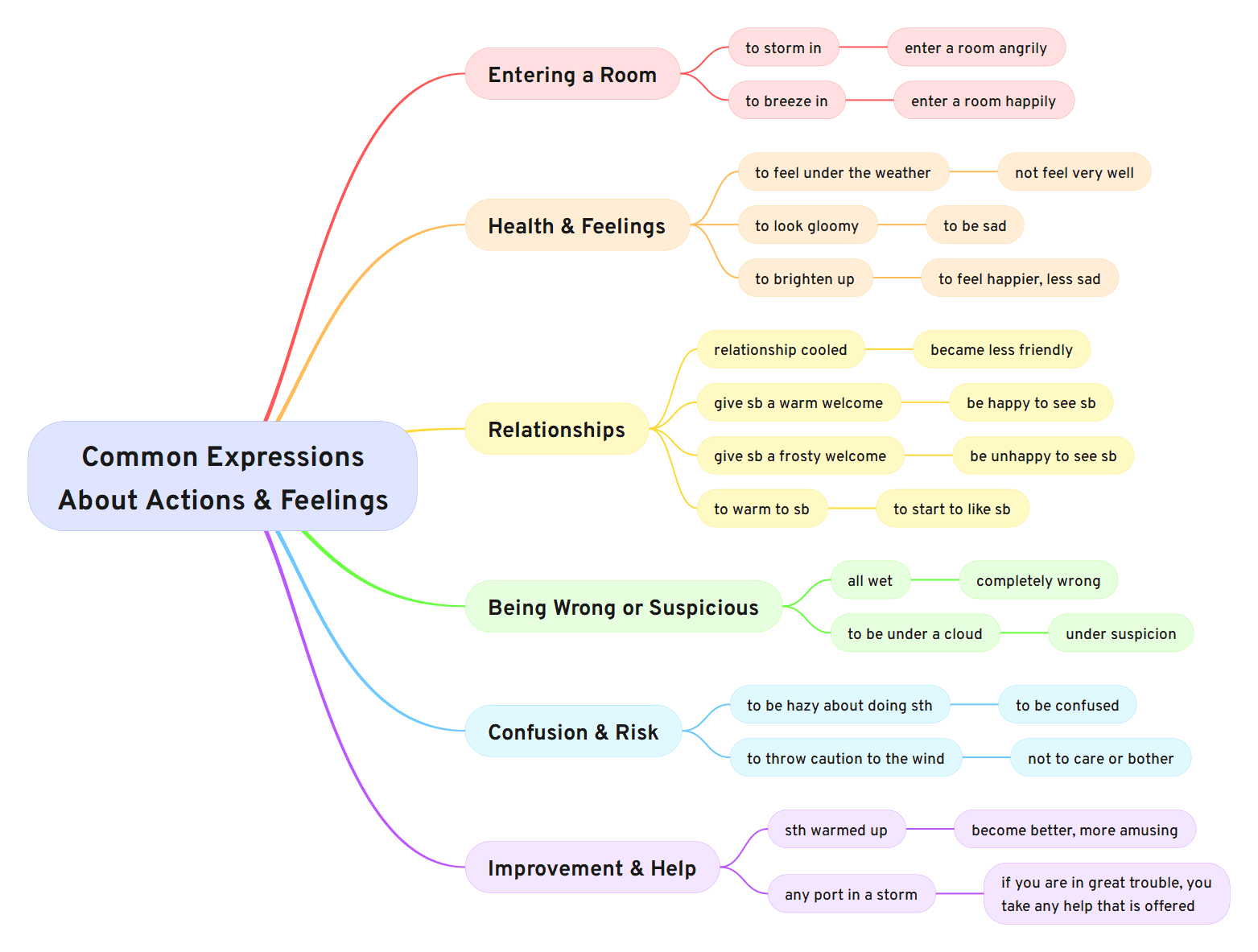
MIND-MAP

Study the mind-map below.

part two

RATE THE EXAMPLES

Now read and listen to these examples and decide how well they illustrate the meanings of the expressions from the flashcard game.

Give them 1 if you do not think it is a good example, and 10 if you think it is a perfect example.

1) to storm in = To enter a place suddenly and angrily or with a lot of energy.

"After hearing the news about the cancelled project, she stormed into the boss's office, demanding an explanation."

poor example
excellent example
2) to breeze into = To enter a place in a very confident, relaxed, and casual way.

"I breezed into the café where my friends were waiting. I was so excited to show them my new outfit!"

poor example
excellent example
3) Under the weather = Feeling a little sick or not well.

"She wasn't her usual energetic self at the meeting, mentioning she was feeling under the weather and might need to rest."

poor example
excellent example
4) to call off = To become less angry or upset with someone after a disagreement or argument.

"Ever since that argument over the dress, my relationship with Ellie has really cooled off. We hardly talk at the school now."

poor example
excellent example
5) to give somebody a warm welcome = To greet someone in a very friendly and kind way when they arrive.

"When I introduced Lily to my group, everyone gave her such a warm welcome. She felt right at home!"

poor example
excellent example

6) frosty welcome = To greet someone in a cold, unfriendly, or distant way.

"Despite her efforts to be friendly, the club members gave her a frosty welcome, making it clear she wasn't considered part of the group."

poor example
excellent example
7) to look gloomy = To appear sad, unhappy, or not hopeful.

"I looked so gloomy after I found out that my favourite boutique was closed. I had been planning that shopping trip for weeks."

poor example
excellent example
8) to be all wet = To be completely wrong about something.

"I thought the blue dress would be perfect for the party but I was all wet. It didn't fit the theme at all."

poor example
excellent example
9) under a cloud = To be suspected of doing something wrong or to be in trouble.

"Ever since the misunderstanding at the party, I've been under a cloud with some of my friends. They think I started the rumor."

poor example
excellent example
10) to warm up = To start a conversation in a friendly and relaxed way, making people feel comfortable.

"The conversation really warmed up when we started talking about the latest fashion trends."

poor example
excellent example
11) to warm to somebody = To begin to like someone more and feel comfortable around them.

"I wasn’t sure about Hannah at first, but after our shopping trip together, I really warmed to her."

poor example
excellent example
12) to be hazy about something = To be unclear or unsure about something.

"He was hazy about accepting the job offer in a new city, uncertain if the move would be the right decision for his family."

poor example
excellent example


Well done! You're almost there!

13) to throw caution into the wind = To take a risk and stop worrying about possible dangers or problems.

"Knowing the risks, she threw caution to the wind and invested all her savings in the new startup, hoping for a big payoff."

poor example
excellent example
14) to brighten up = To become happier or more cheerful; or for a place to become lighter and more pleasant.

"My mood totally brightened up when I found the perfect shoes to match my dress for the dance."

poor example
excellent example
15) Any port in a storm = When you’re in trouble, any help or solution—even if not ideal—is welcome.

"I usually avoid fast food, but I was starving after the long journey, so I grabbed a burger from the nearest place. Any port in a storm, right?"

poor example
excellent example

FILL IN THE GAPS

Play this game. Fill in the gaps in these sentences.

w

DISCUSSION

Why did she storm in like that?

Read a conversation between Alita and Kat. They are chatting about another colleague’s behaviour. Notice how they are using the language from this lesson.

Role play this dialogue.

Alita: Hey Kat, did you see how Emma stormed into the meeting today? It was like a whirlwind hit the room!

Kat: I know, right? Totally caught me off guard. She’s usually not the type to throw caution to the wind like that.

Alita: Exactly! I’m a bit hazy about what’s got her so riled up. Do you know anything?

Kat: Well, I heard from Dave that she’s feeling under the weather about the new project assignments. Apparently, she got a frosty welcome from the team in Budapest.

Alita: Oh, really? That’s tough. But still, any port in a storm, right? She needed that international experience for her promotion.

Kat: True. But I guess the whole situation has her under a cloud. She’s been so gloomy lately.

Alita: Yeah, and the way she breezed in yesterday, all smiles and laughs, you’d never have guessed she was having a rough time.

Kat: Moods change like the weather, don’t they? One day you’re sunny and bright, the next you’re all stormy.

Alita: Well, let’s hope she finds a way to weather this storm. She’s a great colleague, after all.

Kat: Agreed. Maybe we should invite her for lunch, show her some friendly faces around here?

Alita: That’s a great idea, Kat! Let’s do that. A little kindness can go a long way.

OVER TO YOU

Discuss these questions. Refer to your own experience and remember to use the language of moods you were learning in this lesson.

  • Can you recall a time when you had to ‘throw caution to the wind’ and make a spontaneous decision? How did it turn out?
  • Have you ever been ‘hazy’ about making a significant change in your life, like moving to a new city or changing careers? How did you resolve your uncertainty?
  • ‘Any port in a storm’ often means settling for less than ideal circumstances. Can you share an experience where you had to do this? Was it a positive or negative experience in the end?

COMMENTS

Submit your views and opinions below.

A simple formula for making a great pitch

A simple formula for making a great pitch

Sorry, but lessons on The Blue Tree work only on a computer or a tablet.

Bardzo mi przykro, ale lekcje na platformie The Blue Tree działają jedynie na komputerze lub tablecie.

Do zobaczenia na większym ekranie 🙂

Zespół The Blue Tree

Learn more words

THE BLUE TREE

Better
Communicator

CEF B1

CEFR B1

Intermediate

Practise speaking by describing this image

warm up

Answer the questions below. Then listen to Kirsten, a woman from the UK, give her answers. Report back what you heard.

What is the most difficult part of preparing and delivering presentations for you?
TRANSCRIPT

The most difficult part of preparing and delivering presentations was overcoming the initial fear of standing in front of an audience. It took a lot of practice to feel comfortable with all eyes on me. In the beginning, it was also challenging to find the right balance between providing enough information and keeping the presentation engaging. I had to learn to anticipate the questions people might have and address them in my presentation, while also keeping my nerves in check. Now, after quite a bit of experience, I’d say the hardest part is making sure I’m bringing something new and valuable to the table each time. I always want my presentations to be fresh and interesting, not just for my audience but for me as well.

What is the one piece of advice you received about presenting that you incorporated?
TRANSCRIPT

The best piece of advice I incorporated was to practice my presentations out loud and to do so in front of a mirror or even a small audience of friends or family. This helped me see how I come across, notice any distracting gestures or movements, and refine my delivery. It made a big difference in how confidently I presented the material. Additionally, it helped me time my presentations and make sure I was expressing my points clearly and effectively.

How important is the skill of presenting persuasively in your opinion?
TRANSCRIPT

In my opinion, the skill of presenting persuasively is incredibly important, especially in the corporate world. A well-delivered presentation can influence decisions, win over stakeholders, and drive important initiatives forward. It’s not just about the facts you present, but how you frame them—persuading your audience requires you to connect on a level that resonates with their values and interests. It’s a skill that can set you apart in your career and open up opportunities for leadership and advancement. In essence, it’s as crucial as any technical skill, if not more so, because it’s about leading people, not just managing tasks.

key language

Go through these words and expressions.

Check out if you know what they mean and how to pronounce them. 

LISTENING

Listen to a presentation on how to prepare a great speech. Focus on the main ideas.

Alita is listening to a podcast and making notes

reading

Read the text below.

The Art of Pitching:
A Skill Everyone Needs in Today’s Business World

In the contemporary landscape of business, you don’t need to be a salesperson or marketer to convince others about your ideas. Every professional, from an engineer to a financial analyst, will at some point need to ‘sell’ a concept, a project, or a strategy. By mastering the art of the pitch, you can ensure your ideas don’t just get heard but also adopted. Here’s an extended four-step approach to crafting a persuasive pitch, supported by real-world examples from the business realm.

1. “What if you could…”: Illustrating a Vision

Illustration: Think about the introduction of the iPhone in 2007. Steve Jobs didn’t just present a new phone. He painted a picture, asking the audience to imagine a device that combined an iPod, a phone, and an Internet communication device.

In Practice: It’s all about highlighting possibilities. If you’re an IT consultant, instead of merely proposing a new software solution, you could ask, “What if your team could streamline all their processes in one integrated platform, reducing manual effort by 50%?”

2. “So that…”: Making a Connection

Every idea should resonate with its audience by addressing a specific need or desire.

Illustration: When SpaceX proposed the idea of reusable rockets, they connected it with a clear goal: reducing the cost of space travel so that life could be multi-planetary.

In Practice: If you’re in finance and suggesting a new investment, you could say, “By diversifying into this emerging market, we’re positioning ourselves to capture untapped revenue sources so that we can ensure sustained growth over the next decade.”

3. “For example…”: Grounding the Vision

Abstract ideas can be hard to grasp. Concrete examples or use cases help bridge the gap between vision and reality.

Illustration: AirBnB didn’t just propose a new way of finding accommodations. They showcased stories of real hosts and travelers, illustrating how their platform fostered unique experiences and connections.

In Practice: A project manager might say, “Consider Company X. By implementing a similar strategy, they not only increased their customer retention by 20% but also saw a significant boost in their overall brand loyalty.”

4. “And that’s not all…”: Projecting Forward

After establishing the immediate benefits, it’s vital to demonstrate the long-term potential.

Illustration: Amazon, in its early days, was more than an online bookstore. Jeff Bezos spoke about its potential to be the world’s most customer-centric company, branching out into countless product categories.

In Practice: A marketing strategist might argue, “Once we’ve tapped into this demographic, there’s potential to expand our offerings and partner with complementary brands, turning one-time customers into brand ambassadors.”

In conclusion, everyone in today’s fast-paced business world needs to be a bit of a salesperson, regardless of their title. By refining your ability to present and pitch ideas effectively, you don’t just communicate — you captivate and convince. Remember, it’s not about pushing an idea aggressively, but drawing your audience into a vision that benefits them.

zasady

niezawodność, bycie godnym zaufania

ulepszone, poprawione

brać odpowiedzialność za swoje czyny

pilny

równie

być z czegoś dumnym

przedstawić (pomysł, ideę)

pewność, niezawodność, rzetelność

COMPREHENSION

Answer the questions below using the information from the article. 

  • Why is the skillof presenting important not only for sales people?
  • Why was Steve Jobs presentation about the iPhone so effective?
  • What does it mean to ‘highlight possibilities’?
  • How does “so that” make a connection?
  • What’s the problem with abstract ideas?
  • How can this shortcoming be overcome?
  • What are the two benefits of mastering the art of the pitch?
w

DISCUSSION

Discussing public speaking

Read a conversation between Alita and Pete. They are discussing some questions pertaining to public speaking. You will discuss them afterwards.

Alita: Pete, when you think about striking the right balance between emotion and logic in pitches, how do you approach it?

Pete: That’s a great point, Alita. I believe it’s all about understanding the needs of the audience. Sometimes, you need to appeal to their emotional side, especially when the subject matter can have a personal impact. For instance, when pitching a new health product, showing its personal benefits can resonate emotionally. However, for a technical audience, presenting data and logical arguments might be more effective.

Alita: Absolutely, Pete. And speaking of tailoring pitches, have you ever had to significantly adjust a pitch based on who you were presenting to?

Pete: Oh, definitely. Once, I was pitching a product to a group of investors. The initial presentation was filled with technical jargon, but halfway through, I noticed their disinterest. I quickly pivoted, focusing on the potential returns and market size. The change in approach made a world of difference.

Alita: It’s so crucial to be adaptive. On a slightly different note, how do you handle skepticism? Especially when it’s evident the audience is resistant?

Pete: Dealing with skepticism is challenging. For me, it’s about being transparent and open to questions. Do you remember when Airbnb first started? Many were skeptical about the idea of strangers staying in their homes. But their pitch focusing on community, trust, and the shared economy managed to turn skepticism into interest.

Alita: That’s a fantastic example. The digital age has also transformed how we pitch. With the rise of social media and online platforms, what changes have you noticed?

Pete: The digital age has amplified the reach of pitches. Now, a pitch isn’t just confined to a room; it can be shared globally. However, this also means the audience is more diverse, and feedback is instantaneous. The challenge is to make pitches concise yet impactful, especially with platforms like Twitter requiring brevity.

Alita: So true. Lastly, Pete, the ethics of persuasion have been debated for a long time. How do you ensure you’re ethically sound while also being persuasive?

Pete: It’s a delicate balance, Alita. I believe in being genuine and avoiding exaggeration. There have been instances where companies made exaggerated claims, leading to backlash. It’s essential to be truthful and let the product or service’s genuine benefits shine.

Alita: Well said, Pete. Ensuring integrity while pitching is not just ethical but also beneficial in the long run.

Pete: Absolutely, Alita. At the end of the day, trust is the foundation of any successful pitch.

Over to You

Discuss the questions below.

Refer to the material from the lesson and your own experience.

The Role of Emotion and Logic

How do you strike a balance between appealing to an audience’s emotions versus presenting logical arguments in a pitch? Can you think of an example where one was favored over the other, and what was the outcome?

Adapting to Your Audience

In what ways should a pitch be tailored based on the audience, whether they’re investors, customers, or colleagues? Can you share a time when adjusting the pitch based on the audience made a significant difference?

Overcoming Skepticism

What strategies can be employed when facing a skeptical or resistant audience? Are there instances from well-known brands or startups where they faced initial skepticism but managed to deliver a successful pitch?

The Evolution of Pitching

How have pitches evolved in the digital age, especially with the rise of social media and online platforms? What are some challenges and advantages presented by this evolution?

COMMENTS

Share your views and experience here.

Watercolour art

Watercolour art

Sorry, but lessons on The Blue Tree work only on a computer or a tablet.

Bardzo mi przykro, ale lekcje na platformie The Blue Tree działają jedynie na komputerze lub tablecie.

Do zobaczenia na większym ekranie 🙂

Zespół The Blue Tree

back to HOME > General Interest > The Arts >

Watercolour art
Learn more words

THE BLUE TREE

The Arts

CEF B1

CEFR B1

Intermediate

Practise speaking by describing this image

warm up

Answer these questions. Listen to Asher talking about his experience with painting. Report back what you heard. Check out the transcript. 

TRANSCRIPT

Oh, yes! I’ve taught myself to paint, and it wasn’t a simple journey, let me tell you. No formal classes, just me, some brushes, and a lot of trial and error. Watercolor, in particular, is my favorite. There’s something magical about how the colors flow and blend. I don’t own any original paintings because of their cost, but I’ve collected a few reproductions that I proudly display at home. Every time I look at them, they inspire me to keep learning and growing in my craft.

TRANSCRIPT

Yes, I do have some paintings at home, but they’re reproductions since original ones can be quite pricey. Most of them are watercolor artworks, and they vary in subjects. Some show beautiful African landscapes, capturing the essence of our sunsets and vast savannas. Others are vibrant depictions of our local markets and people, bursting with color and life. They serve as a reminder of the beauty of our continent and also motivate me to keep practicing my art. Every time I look at them, I dream of creating such pieces myself one day.

TRANSCRIPT

I think art can be very expensive for many reasons. Sometimes it’s because of the artist, the history behind the painting, or the skill it shows. Rarity also matters. If a work of art is unique, people may be willing to pay a lot for it. Still, I don’t think such high prices are always justified. Art can be powerful and inspiring, but it should also be accessible to ordinary people, not only collectors and investors.

key language

LIKE – NEUTRAL – DISLIKE

Do this Multidecker flashcard game. Learn some expressions for talking about likes and dislikes. Make a note of the expressions you would like to remember.

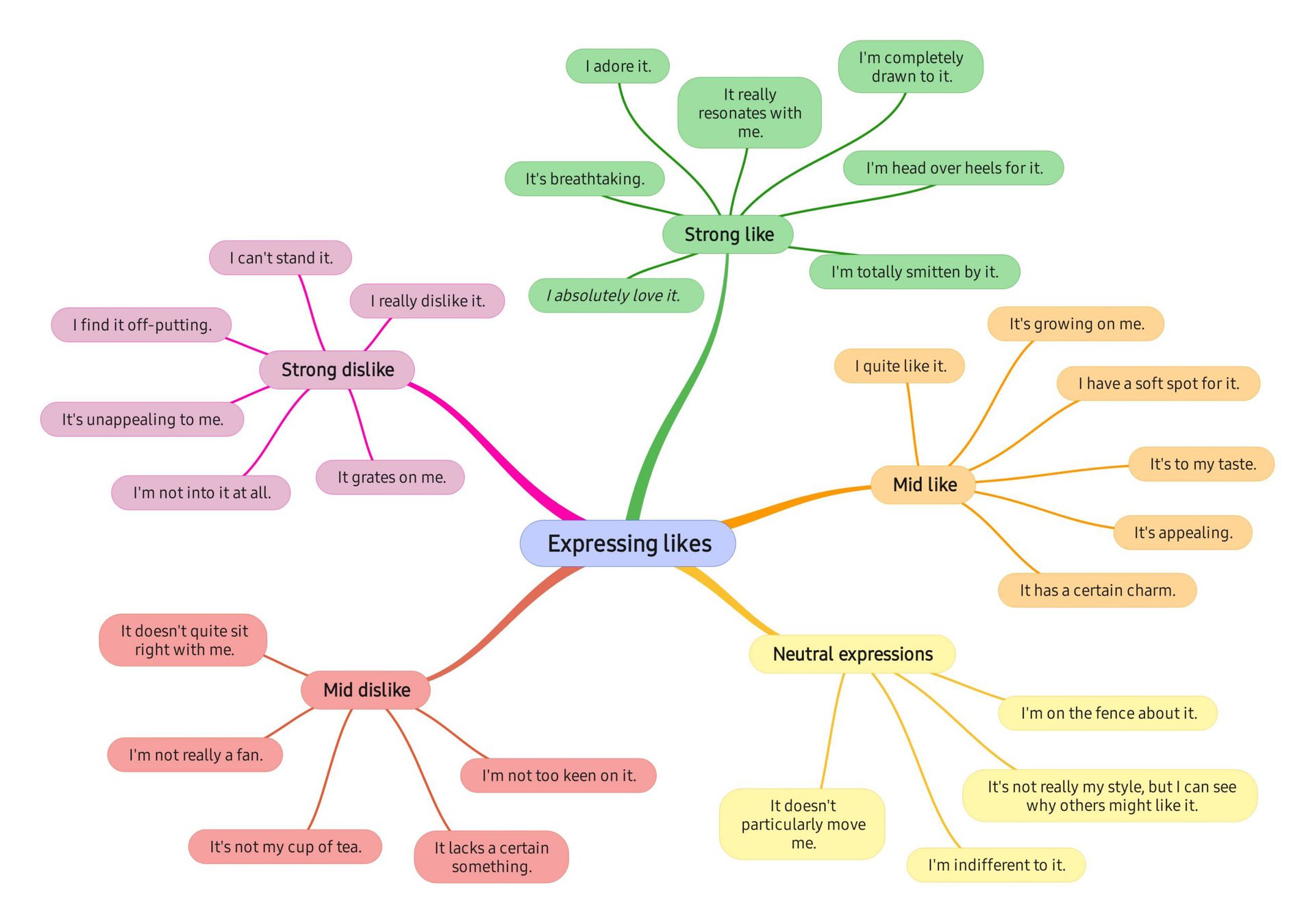
EXPRESSING LIKES – MIND MAP

Study the mind-map with more expressions of likes and dislikes. Cope some of the expressions. You will  need them for some other tasks in this lesson. 

reading

Getting to know watercolour art and artist

Read this brief information about watercolour and the main artists who created paintings using this method. Did you know about them?

1. What is Watercolor Painting?

Watercolor is a painting method in which paints are made of pigments 1. suspended in a water-based 2. solution. The paint is often applied to paper, producing transparent and luminous effects.

2. Famous Watercolor Masters:

John James Audubon (1785-1851): An American ornithologist, naturalist, and painter, he’s best known for “The Birds of America,” a book in which he documented and painted every bird species in North America.

William Turner (1775-1851): Often called “the painter of light”, Turner from England was known for his expressive, imaginative landscapes and 3. turbulent, often violent 4.marine paintings.

John Singer Sargent (1856-1925): An American artist, he was considered the “leading portrait painter of his generation.” While known for his oil paintings, his watercolors are masterful, full of light and atmosphere.

Winslow Homer (1836-1910): Another American artist, he started as an illustrator but 5.transitioned to watercolor painting. His works often 6.depicted the sea, fishermen, and other nautical themes.

Georgia O’Keeffe (1887-1986): Known for her large-scale flower paintings, O’Keeffe was an American modernist artist who also created some 7.stunning watercolors early in her career.

3. Characteristics of Watercolor:

Transparency: Unlike oils or acrylics, watercolors are often 8.transparent. This means you can see the layers beneath the top one, giving depth to the painting.

Flow and Bleed: Watercolors have a mind of their own! They flow and blend in unique ways, which is part of the charm.

Lightness: Artists have to think in reverse! In watercolor, you often work from light to dark because it’s hard to cover dark colors with light ones.

4. Cool Facts:

Ancient Art: Watercolor painting dates back to cave paintings. Ancient Egyptians also used a similar technique for their wall paintings.

Portable: Because watercolor paints are lightweight and only require water to activate, they have historically been used by artists outdoors or when traveling.

Versatility: Despite their delicate appearance, watercolors can be 9.vibrant and bold. It’s a very 10.versatile medium.

5. Tips to Start:

Paper Matters: Invest in good quality watercolor paper. It makes a difference!

Experiment: Before diving into a big project, play around. Test how the colors blend, how water affects the flow, and what happens when you layer colors.

Less is More: With watercolor, it’s often better to be reserved than to overwork the paint. Let the water and color interact naturally.

rozpuszczone w

roztwór

gwałtowne, dynamiczne

marynistyczne, morskie

zmienić, przenieść się

przedstawieć (na obrazie)

niezwykle piękne, przepiękne

przeźroczysty

 żywy (o kolorze), intensywny

uniwersalny, wszechstronny

TALKING ABOUT ART

Imagine William Turner meeting John Singer Sargent. Here’s a hypothetical conversation these two great watercolour artists might have had.

Study the words from this Quizlet first.

Now, read the dilalogue.

A Quaint Town in Greece: Midday

The narrow cobblestone streets of the town glisten under the brilliance of the sun. White-washed houses with blue shutters contrast beautifully with the azure sky. The town square, filled with the hum of everyday life, has a small pavement cafe where two gentlemen sit, engaged in a deep conversation.

William Turner: You know, John, every time I look at this Grecian light, it reminds me of why I love watercolors so much. The transparency of the medium captures the ephemeral quality of light like no other.

John Singer Sargent: Indeed, William. I’ve always felt that watercolors have a way of conveying the atmosphere of a place, especially when you’re in such a beautifully lit location as this. It’s spontaneous, almost like sketching with colors.

Turner: Ah, the spontaneity! That’s the essence of watercolors, isn’t it? It’s like dancing with nature – the unpredictability, the flow, the blending… there’s a certain freedom to it that’s both challenging and liberating.

Sargent: Precisely. While oils give you control and time, watercolors demand decisiveness. It teaches an artist to observe quickly, understand the subject, and make committed brush strokes. You cannot simply “correct” watercolors; you have to work with your so-called mistakes.

Turner: I’ve always enjoyed that challenge. The way water and pigment react on paper can often lead to delightful accidents, creating effects that one hadn’t even envisioned. And the way it translates light and shadow! It feels like capturing a fleeting moment in time.

Sargent: True, and it’s not just about landscapes or the play of light. The portraits I’ve painted with watercolors have an intimacy to them. They capture the essence of a person in a way that feels fresh and immediate. It’s as if the medium breaks down barriers, allowing one to truly see.

Turner: That’s an interesting perspective on portraits. And while we’re on the subject, I’ve noticed that in your watercolors, you masterfully use the white of the paper. It’s a restraint that many artists find difficult.

Sargent: Thank you, William. Leaving the paper untouched in places allows the light to shine through, providing a luminosity that’s hard to replicate with opaque mediums. And you, my friend, have pushed the boundaries of watercolor to such an extent that many of your pieces feel like they’re brimming with raw emotion. Your works have a dreamlike, ethereal quality that transcends the subject.

Turner: Much appreciated, John. In many ways, watercolor is like life itself – unpredictable, fleeting, and beautiful. You can’t control every aspect of it, but you can immerse yourself in its flow and let it lead you to unexpected places.

Sargent: A poetic thought for a poetic medium. Here’s to watercolors and the magic they bring to our canvas and life.

The two gentlemen raise their coffee cups in a toast, the rich aroma blending seamlessly with their shared appreciation for the art of watercolor. The midday sun casts playful shadows on the ground as life in the quaint Grecian town unfolds around them.

CAN YOU GUESS WHOSE PAINTING THIS IS

Let’s check if you can recognize whose paintings these are. Move your mouse over the image to reveal the name of the artist. How many did you get right?

Practise the language of likes and dislikes on these images.

John Singer Sargent

Georgia O'Keeffe

William Turner

John James Audubon

John Singer Sargent

Georgia O'Keeffe

William Turner

Winslow Homer

John James Audubon

Winslow Homer

John James Audubon

John Singer Sargent

OVER TO YOU

Prepare a prompt for the AI image generating tool. Include as much information as possible. Use the tool to generate your image. Are you satisfied with the result?

POLL

Cast your vote in the poll below.

Who of the watercolour painters do you like the most?
6 votes

×

COMMENTS

Share your views and opinions here.

Don’t use advanced English

Don’t use advanced English

Sorry, but lessons on The Blue Tree work only on a computer or a tablet.

Bardzo mi przykro, ale lekcje na platformie The Blue Tree działają jedynie na komputerze lub tablecie.

Do zobaczenia na większym ekranie 🙂

Zespół The Blue Tree

Don’t use advanced English
Learn more words

THE BLUE TREE

Everyday English

CEF B1

CEFR B1

Intermediate

Practise English by describing this image

warm up

Answer these questions.

  • How long have you been learning English?
  • Why does learning a foreign language take a long time?
  • What does it mean to be an advanced user of a foreign language for you?

key language

Study the words in this flashcard game. All of them appear in the video.

watch the video

Watch the video.

Comprehension

Answer the questions below. Use the information from the listening and your own experience. 

  • 1. What does it mean that a word is advanced?
  • 2. What effect can using advanced vocabulary have on listeners?
  • 3. Who do you have to speak more often: native speakers or learners of English?
  • 4. What’s the problem with Terms and Conditions?
  • 5. Do you read such documents before you click ACCEPT?
  • 6. What is successful communication for you?
  • 8. How can the feeling of guilt affect our performance in speaking a foreign language?
  • 9. What does Christian think learners need more of?
w

DISCUSSION

Discribe these two pictures.

Now this one.

Discuss the questions below.

  • Which picture better illustrates your approach to learning English?
  • Why thinking about progress as climbing a ladder may be limiting?
  • What is this gap the woman is jumping across in language learning?
  • What does it mean to bridge the gap in this context?
  • What can learners do to be able to express their thoughts and ideas more fluently?
  • What does it mean that “You don’t need more English. You need more practice”?

POLL

Cast your vote in the poll.

My ultimate goal in learning English is to:
12 votes

×

PRACTICE

Look at this list of language functions. How many can you do today? Click on the function to highlight it. Make a note of all the functions you don’t know yet. 

Discussion and opinion

Doubt, guessing and certainty

Feelings and emotions

AgreeingAsking for clarificationApologizing
Asking for opinionsCorrecting yourselfCongratulating somebody
Conceding a pointExpressing certaintyExpressing sympathy
Dealing with questionsExpressing ignoranceMaking complaints
DisagreeingExpressing likelihoodThanking somebody
Expressing preferencesSpeculatingWishing somebody luck
Giving reasons
Interrupting somebody

Openings and endings

Permission and obligation

Suggestions and advice

Ending conversationsAsking about obligationAsking for help
Introducing somebodyAsking for permissionAsking for information
Inviting somebody to somethingForbidding somethingGiving someobody advice
Leaving phone messagesGiving ordersMaking recommendations
Opening conversationsMaking requestsMaking suggestions
Wrapping up discussionsOffering help
Offering somebody something
Warning somebody of danger

Based on Oxford Learer’s Dictionaries, Conversations.

COMMENTS

Submit your views and opinions below.