
Bardzo mi przykro, ale lekcje na platformie The Blue Tree działają jedynie na komputerze lub tablecie.
Do zobaczenia na większym ekranie 🙂
Zespół The Blue Tree

THE BLUE TREE
Man & Society

CEFR C1
Advanced

warm up
Answer the questions below. Listen to same people answering these questions. Report back or read the transcript to practise speaking.
| What motivates you to do your best work or study? Is it money, praise, passion – or something else? |
TRANSCRIPT
I think passion is what motivates me the most. When I’m interested in a topic, I want to learn more and do my best without anyone pushing me. Money is nice, but it doesn’t keep me going for long. I need to feel that my work has meaning.
| Do you work better when someone tells you exactly what to do, or when you have the freedom to decide how to do it? Why? |
TRANSCRIPT
I definitely work better when I have the freedom to decide how to do things. I like being creative and choosing my own methods. When someone tells me exactly what to do, I feel less motivated. I prefer having clear goals but also space to find my own way to reach them.
| How much freedom or autonomy do you have in your job or studies? Would more autonomy help you do better? |
TRANSCRIPT
Right now, I don’t have much autonomy – most things are planned for me. I think more freedom would help me focus and be more responsible. When I can choose how and when to work, I feel more trusted, and that motivates me a lot.

part one

KEY LANGUAGE
Go through the flashcards below. Make sure you understand all the words and expressions.

VIDEO
Watch the first part of the video.

DISCUSSION
How practical do you think these rules are? Select from 0 (useless) to 5 (useful). Explain your answers.
part two
KEY LANGUAGE
Go through the flashcards below. Make sure you understand all the words and expressions.
VIDEO
Watch the second part of the video.
DISCUSSION
Now do the same with the next ten rules for life by Daniel Pink.
part three
KEY LANGUAGE
Go through the flashcards below. Make sure you understand all the words and expressions.
VIDEO
Watch the third part of the video.
DISCUSSION
Discuss the next ten rules for life.
part four
KEY LANGUAGE
Go through the flashcards below. Make sure you understand all the words and expressions.
VIDEO
Watch the fourth part of the video.
COMPREHENSION
Asnwer these questions using the information from the film.
part five
KEY LANGUAGE
Go through the flashcards below. Make sure you understand all the words and expressions.
VIDEO
Watch the fifth part of the video.
COMPREHENSION
Asnwer these questions using the information from the film.
part six
KEY LANGUAGE
Go through the flashcards below. Make sure you understand all the words and expressions.
VIDEO
Watch the sixth part of the video.
COMPREHENSION
Asnwer these questions using the information from the film.
DISCUSSION
MOTIVATION THAT WORKS
Context: Alita and Pete have just watched Daniel Pink’s TED Talk in a professional development session at work.
Read their dialogue. Whose views do you lean towards?
Alita: That talk really made me think. I’ve always believed that money is a good motivator, but now I’m not so sure.
Pete: Yeah, the part about rewards actually dulling creative thinking was surprising. I mean, I thought offering bonuses would incentivize people to do better.
Alita: Me too. But it makes sense. If I’m under pressure to get a reward, I focus too much on the goal and not on the process. I lose curiosity.
Pete: Right. I liked how he talked about autonomy. Having the freedom to decide how to do my work really makes a difference for me.
Alita: Same here. When I worked in a place where everything was micromanaged, I felt no energy. But now, with more self-direction, I feel much more engaged.
Pete: And don’t forget purpose. When you know your work matters, you want to do it well—even without extra rewards.
Alita: Absolutely. I’ve also felt that when we have the chance to come up with ideas ourselves, we’re more committed.
Pete: True. I think more companies should get rid of those outdated, carrot-and-stick approaches and focus on intrinsic motivation.
Alita: Agreed. It’s not about becoming soft or touchy-feely. It’s about creating an environment where people can actually perform better.
OVER TO YOU
Discuss these questions.
 | What motivates you more: external rewards (like money or praise), or internal satisfaction? Why? |
| Have you ever had a job or project where you had real autonomy? How did it affect your performance? |
| What kind of work gives you a sense of purpose? |
| Why do you think traditional carrot-and-stick methods are still used if they often don’t work? |
| If you could redesign your workplace, what changes would you make to increase motivation? |
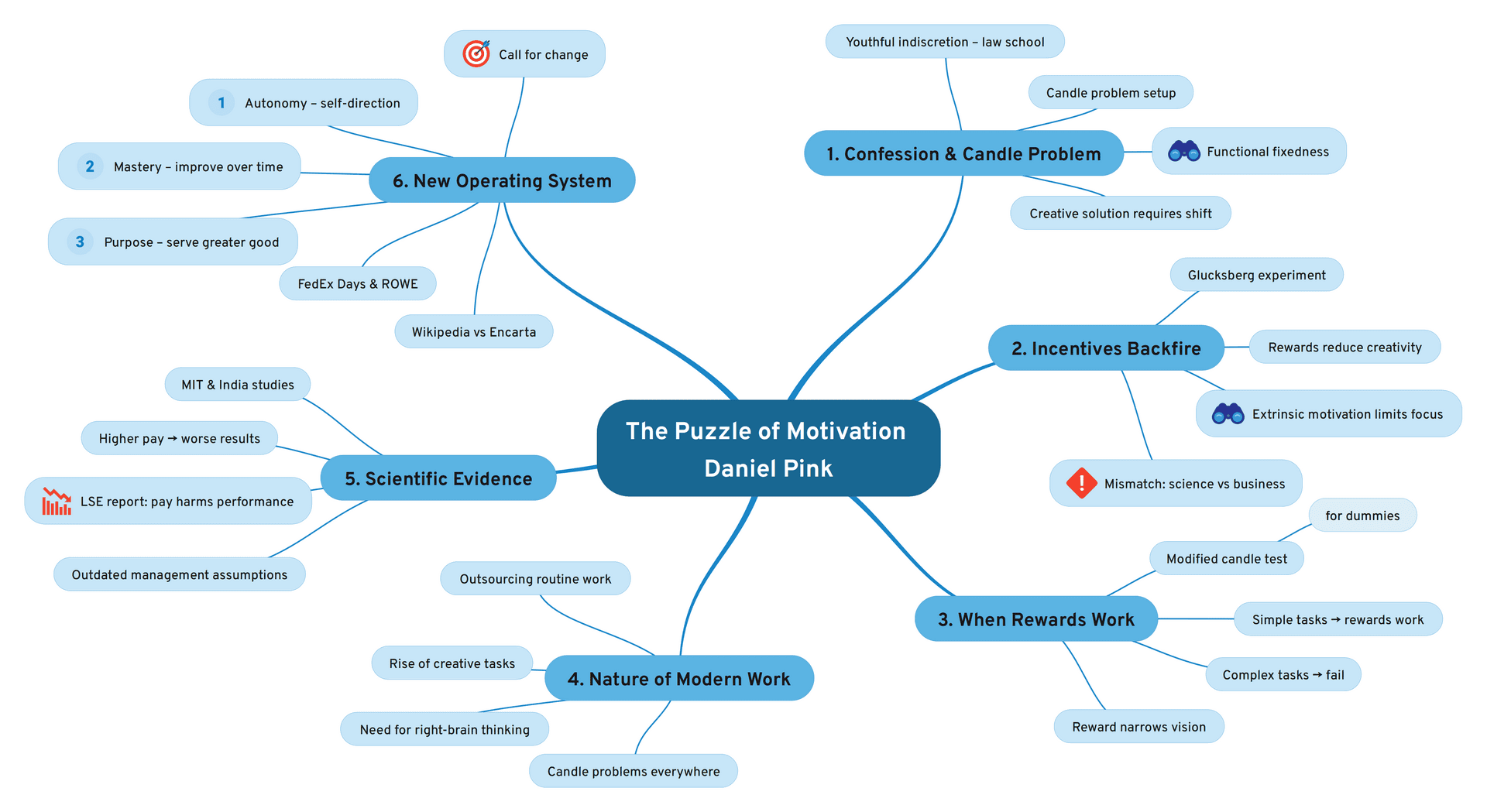
MIND-MAP
Use the mind-map to have a more in-depth discussion on this topic or to better remember that main points.
COMMENTS
What do you think of the ideas presented in this lesson?
Share your views and experience here.
0 Comments