10 Steps
to a Great Lesson
on The Blue Tree

Quizlet

Multidecker

Wordwall

I wish you many interesting, practical and inspiring lessons on The Blue Tree.

on The Blue Tree
Follow these ten steps and make the most of the place that makes people grow.
Look at the image on top of every lesson. Ask yourself questions like:
Here are three examples from random lessons. How would you answer these questions about them?


Discuss the questions in the Warm up sections. There are usually two or three questions in this part of the lesson.
Many questions ask about your personal experience or preferences. Express your opinions freely.
Ask follow up questions if you see that the discussion is developing well. After all, isn’t an English lesson about speaking English?

Learning new words before doing the main material is very important. That’s why The Blue Tree pracises key language before it shows the main part of the lesson.
In most lessons it is presented using Quizlet – a famous flashcard app. Some lessons use a great flashcard website: Multidecker.com. There are also Wordwall exercises to help you remember key language from lessons.
You can work in two ways with the key vocabulary on Quizlet. The first way is to use English words on the front and Polish on the back. This method is a bit easier. If you want to challenge yourself, set the cards to Polish first. This way you will have to think a bit harder about English words.
Finally, remember to set the audio on. Listen to all or some words and learn how to pronounce them well in English.

Quizlet

Multidecker

Wordwall
Watch, read or listen to the main content of the lesson.
Most posts on The Blue Tree are based on:
If the video is longer than five minutes, it is usually split into parts to help you understand it better.
Some films have time stamps ⌚. Use them to double-check your answers to comprehension questions.
Use the questions in the Check Your Understanding part of the lesson to see if you understood everything correctly.
Go back to the main content if something is not clear. Some videos have time stamps like this: ⌚. These will help you find the answers in the video.
Make sure you understand as much as possible. Most lessons on The Blue Tree are based on materials not designed specifically for English learning – authentic materials.
Do you like surveys? Well, I do. That’s why there are many surveys on The Blue Tree.
There’s usually a question or a statement with three or more options to choose from. Select the one which is closest to how you feel about this issue.
When you click on the option, you will see how other users voted before you.
Some lessons have a special section where users can leave their opinion about the topic.
Read through the comments which are already there and write a few words too.
This is a great opportunity to practise English. Writing is one of the best ways to activate newly learnt vocabulary and grammar.
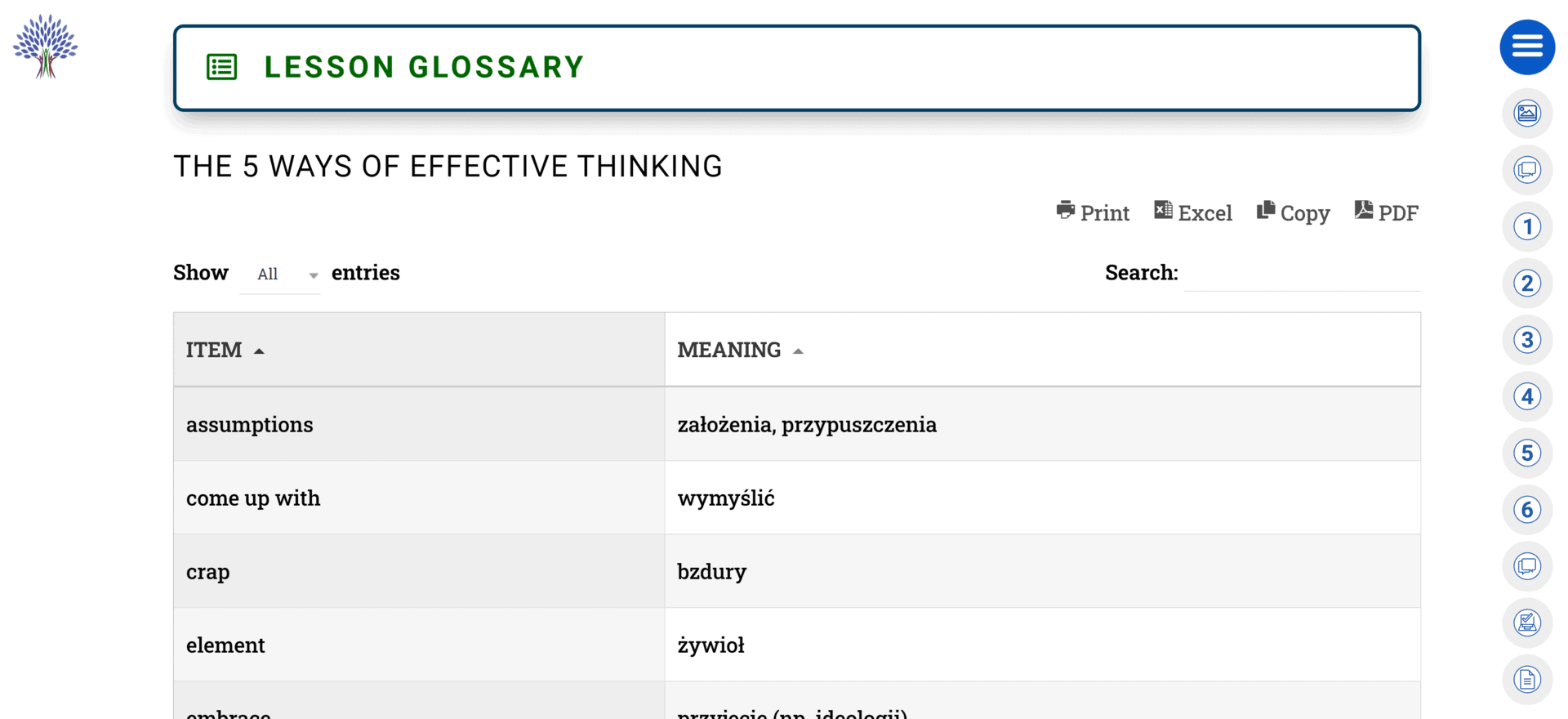
Most lessons on The Blue Tree have a list of key words at the end.
You can download this list as a pdf or excel file. You can also print it.
Why don’t you use it to revise the language from the class as part of self-study?
Choose at least three words or expressions which you would like to learn and use when you speak English. Here’s an example from one of the lessons.

Finally, remember to add your lesson to learning history.
You can check which lessons you have already completed in the top menu tab: Historia Lekcji.
This is a great feature of The Blue Tree. It can boost your motivation. Many people feel encouraged when they see how much progress they have made. Additionally, there will be prizes for learners who complete 10 or more lessons in a month! Check our Facebook page for details.
Here’s an example Learning History of one of the Learners from June 2020.

I wish you many interesting, practical and inspiring lessons on The Blue Tree.