Bardzo mi przykro, ale lekcje na platformie The Blue Tree działają jedynie na komputerze lub tablecie.
Do zobaczenia na większym ekranie 🙂
Zespół The Blue Tree

THE BLUE TREE
Business English

CEFR A2
Pre-Intermediate

warm up
Answer these questions. Use the model answers to practice listening and reading.
| When considering business communication, do you prefer to meet people in person, call them or write to them an email? |
TRANSCRIPT
I prefer to meet people in person because it’s easier to understand each other. But if I can’t meet, I usually send an email. It gives people time to read and think. I don’t like calling much because sometimes it’s hard to hear clearly. But it can be fast if something is urgent.
| What are the advantages and disadvantages of phones for business use? |
TRANSCRIPT
Phones are good for quick answers. You don’t have to wait like with emails. It’s easy to ask follow-up questions. But the bad thing is that there’s no record of the call, and people might forget what you said. Also, sometimes it’s hard to understand the other person, especially if the line is bad or they speak fast.
| How is business communication different today from the one before the Pandemic? |
TRANSCRIPT
Before the pandemic, people met in the office more often. Now, we use video calls and send more messages online. Many people work from home, so it’s harder to talk face-to-face. But it’s also faster to connect with someone from another city or country. I think business is more digital now.

part one

Find the odd one out
Each toggle contains some telephoning language. Read and listen to these expressions. There is one expression that is not appropriate for the business context. Can you guess which one it is?
answering the phone
- Hello, Jill Smith speaking.
- Good morning, Top Sports Ltd.
- Yo, who’s there?
- Good afternoon, purchasing department, Angela Bree speaking. How can I help you?
making contact
- I’d like to speak to Karol Wanat.
- Push me through to your boss now.
- Can you put me through to Mr Duckworth?
- Could I have Marketing Department, please?
Identifying yourself
- This is Bruce White.
- My name’s Robert Went.
- It’s me, don’t you recognise me?
- It’s Bob here.
Making excuses
- I’m sorry, he’s in a meeting.
- I’m afraid she’s not available.
- I’m terribly sorry, but he won’t be able to talk to you right now.
- Stop calling him, he doesn’t want to talk to you.
Stating your purpose
- Why haven’t you paid me yet?
- I’m calling about your invoice.
- I’m returning his call.
- The reason I’m calling is that I haven’t received the money yet.
Checking understanding
Could you spell that?
- Can I ask you to repeat the surname, please?
- I didn’t get that, why can’t you speak clearly?
Can I read that back to you?
Asking for information
- Could I have your name?
- May I have your name, sir?
- Can I take your number?
- And your name again?
Showing understanding
- What?
- Right.
- Uhm.
- That’s fine.
Promising action
- I’ll make sure he gets the message.
- I’ll pass your message to him.
- I’ll tell her when she gets back.
- I’ll tell him, OK, don’t sweat it.
Ending a call
- Thank you. Goodbye.
- Thanks for calling.
- That’s it. I need to finish now.
- Is there anything else?

formal vs informal
Decide if the expression on the card is appropriate for the business context or is it too informal.

PHONE CALLS
Practice reading the transcript of these short phonecalls.
📞 Conversation 1: Asking for Someone
Receptionist: Good morning, GreenTech Ltd. How can I help you?
Caller: Hello, this is Tom Nowak. I’d like to speak to Anna Kowalska, please.
Receptionist: One moment, I’ll put you through.
Caller: Thank you.
📞 Conversation 2: Someone Is Not Available
Receptionist: Hello, HR department, Jane speaking.
Caller: Hi, this is Marek from ABC Recruitment. Could I speak to Mr. Johnson?
Receptionist: I’m afraid he’s not available at the moment.
Caller: No problem. Could you ask him to call me back?
Receptionist: Sure. I’ll pass the message.
📞 Conversation 3: Wrong Number
Receptionist: Good afternoon, Finance Department, Sarah speaking.
Caller: Hello, could I speak to David Miller, please?
Receptionist: I’m sorry, I think you have the wrong number.
Caller: Oh, I see. Sorry for the mistake.
Receptionist: No problem. Goodbye.
Caller: Goodbye.
📞 Conversation 4: Stating the Purpose
Receptionist: Purchasing department, John speaking.
Caller: Hello, this is Eva Zielińska. I’m calling about the delivery.
Receptionist: Yes, can you give me your order number?
Caller: Sure, it’s 3857.
Receptionist: Got it. I’ll check and get back to you soon.
📞 Conversation 5: Leaving a Message
Receptionist: Hello, Marketing Department.
Caller: Hi, this is Robert Smith. Can I speak to Ms. Lee?
Receptionist: I’m sorry, she’s in a meeting right now.
Caller: OK, could you tell her I called?
Receptionist: Of course. I’ll make sure she gets the message.
part two
Time for a little test. Do you remember the exact words which were used in the following telephoning expressions?
Score more than 60% and get a beautiful certificate.

DOWNLOAD
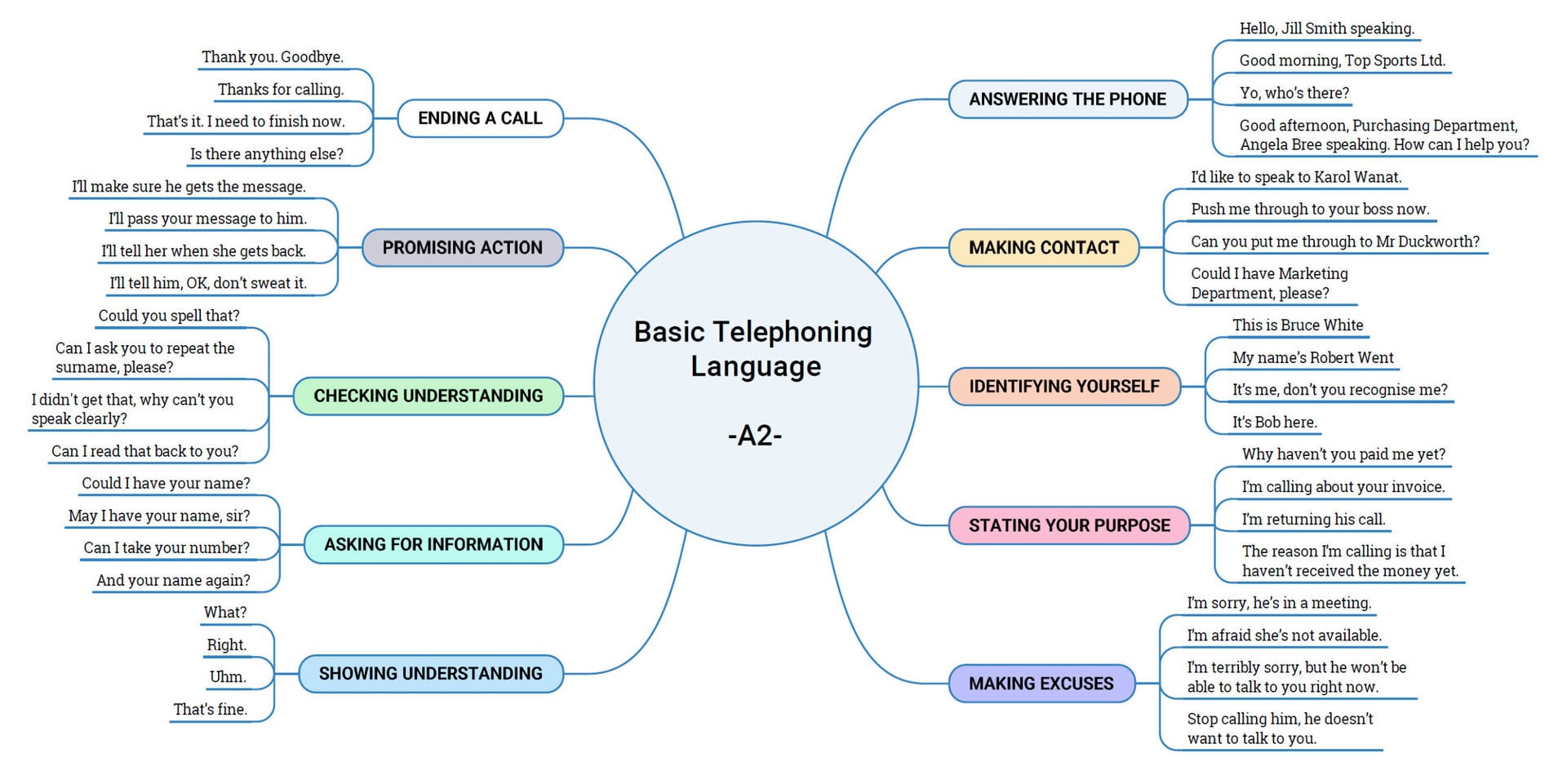
Study the mind-map below to remember the basic telephoning expressions from this lesson.
You can also download the mind-map in a PDF format.