
Bardzo mi przykro, ale lekcje na platformie The Blue Tree działają jedynie na komputerze lub tablecie.
Do zobaczenia na większym ekranie 🙂
Zespół The Blue Tree

THE BLUE TREE
Man & Society

CEFR B2
Upper
Intermediate

warm up
Answer the questions below. Listen to same people answering these questions. Report back or read the transcript to practise speaking.
| Is it true that with age comes wisdom? Why or why not? |
TRANSCRIPT
I think it’s often true, but not always. Some people learn from their mistakes and become wiser, while others keep repeating the same problems. Experience helps, but reflection is what really makes someone wise. You can be old and still make poor decisions if you never stop to think. On the other hand, some young people are surprisingly wise because they read, observe, and stay curious.
| Imagine you are 85 years old and your grand-daughter asks you for some life advice. What do you think you could tell her? |
TRANSCRIPT
I’d probably tell her not to worry so much about what other people think. Most people are too busy thinking about themselves. I’d also tell her to take risks when she’s young—travel, try things, learn from failures. Life goes by quickly, and regrets often come from the things we didn’t do, not the ones we tried. So I would tell her to be kind, stay curious, and enjoy the journey.
| There are many books people use to improve their lives. Is there any book you like coming back to for advice on your life issues? |
TRANSCRIPT
Yes, for me it’s The 7 Habits of Highly Effective People by Stephen Covey. Every time I read it, I notice something new. It helps me think about what I can control and how to set better goals. I like how the book focuses on values, not just success. It reminds me that character is more important than reputation.

part one

KEY LANGUAGE
Go through the flashcards below. Make sure you understand all the words and expressions.

VIDEO
Watch the first part of the video.

DISCUSSION
How practical do you think these rules are? Select from 0 (useless) to 5 (useful). Explain your answers.


part two
KEY LANGUAGE
Go through the flashcards below. Make sure you understand all the words and expressions.
VIDEO
Watch the first part of the video.
DISCUSSION
Now do the same with the next ten rules for life by Daniel Pink.
part three
KEY LANGUAGE
Go through the flashcards below. Make sure you understand all the words and expressions.
VIDEO
Watch the third part of the video.
DISCUSSION
Discuss the next ten rules for life.
part four
KEY LANGUAGE
Go through the flashcards below. Make sure you understand all the words and expressions.
VIDEO
Watch the fourth part of the video.
DISCUSSION
What about the final ten pieces of advice from Daniel Pink? What do you think of them?
DISCUSSION
🎙️ Life Truths That Stick
Context: Alita and Pete are having coffee after watching Daniel Pink’s video “40 Harsh Truths I Wish I Knew in My 20s.” They each share three truths they found especially useful and discuss how those ideas connect to their own lives.
Read their dialogue. Whose views do you lean towards?
Alita:
You know what? That Daniel Pink video really hit me. I kept nodding like, “Yep. Wish I’d heard that 15 years ago.”
Pete:
Only 15? I was nodding like I was listening to my future ghost trying to warn me.
Alita:
[Laughs] Okay, philosopher. So, which truths stood out to you?
Pete:
Number ten. Hofstadter’s Law. “Everything takes longer than you expect.” I felt personally attacked.
Remember the kitchen redecoration project?
Alita:
Oh, you mean the “it’ll take one weekend, tops” kitchen makeover that took five weekends, three arguments, and one call to your dad?
Pete:
Exactly. I budgeted three hours to put up the shelves. Took me five—plus one minor injury and a crooked spice rack.
Alita:
It’s still a little crooked, by the way. But charmingly so.
Pete:
It’s got character! Anyway, it taught me that even when you plan for delays, you’re still wrong. Hofstadter was right.
Alita:
Fair. For me, the one that really landed was “Don’t wait for permission.”
In my 20s, I kept waiting for someone to say “You’re ready.” Like I needed a permission slip to take chances.
Pete:
Totally. You didn’t even apply for that leadership role last year until I practically dared you.
Alita:
I know! And now I’m leading the whole team. I’m so glad I stopped asking people for approval and just… started asking myself.
Pete:
Which ties into another one I liked: “You’re always in sales.”
It’s not just selling a product, it’s convincing your team, your manager, even convincing yourself on a Monday morning that life is good.
Alita:
[Laughs] True. You totally sold me on that awful 7am Monday meeting this week. I still don’t know how you did it.
Pete:
Pure charm and the promise of post-meeting donuts. Which brings me to another favorite: “It doesn’t hurt to ask.”
If you want something—ask. Worst case, someone says no. Best case? You get a chocolate-filled croissant.
Alita:
A life lesson and breakfast strategy. Impressive.
Pete:
And your second?
Alita:
“Consistency beats intensity.” I’ve always thought doing something once really well was enough. But I’ve realized that small daily actions—like journaling, learning, even just stretching—are way more powerful.
Pete:
That’s why you’ve stuck with your morning yoga?
Alita:
Yep. Ten minutes a day. Even when the cat walks across my mat.
Pete:
I admire that. Meanwhile, I try to cram all my health into Saturday mornings.
Alita:
[Laughs] Yes, your “Weekend Warrior” phase.
Pete:
Hey, I’m learning. Slowly. Like the tortoise.
Alita:
Well, as long as I’m not the hare who takes a nap halfway through.
Pete:
Deal. So, what’s your third truth?
Alita:
“Happiness is a byproduct, not a goal.”
When I focus on learning, contributing, being with people I love—you, obviously—happiness shows up. Not always loud, but real.
Pete:
That’s my favorite one too. Especially the part about love being the most powerful force.
And I’m not just saying that because I’m married to you.
Alita:
Mm-hmm. But it helps.
They clink coffee cups and smile. Somewhere in the background, a timer goes off. Pete mutters something about “Hofstadter’s Law striking again.”
OVER TO YOU
Discuss these questions.
 | Which life truth from the video do you agree with most? Why? |
| Have you ever done something where persistence was more important than talent? |
| Do you think it’s better to take action or to plan things carefully? Why? |
| Do you live more by intensity or consistency? Give an example. |
| What advice from this lesson would you like to pass on to your younger self? |
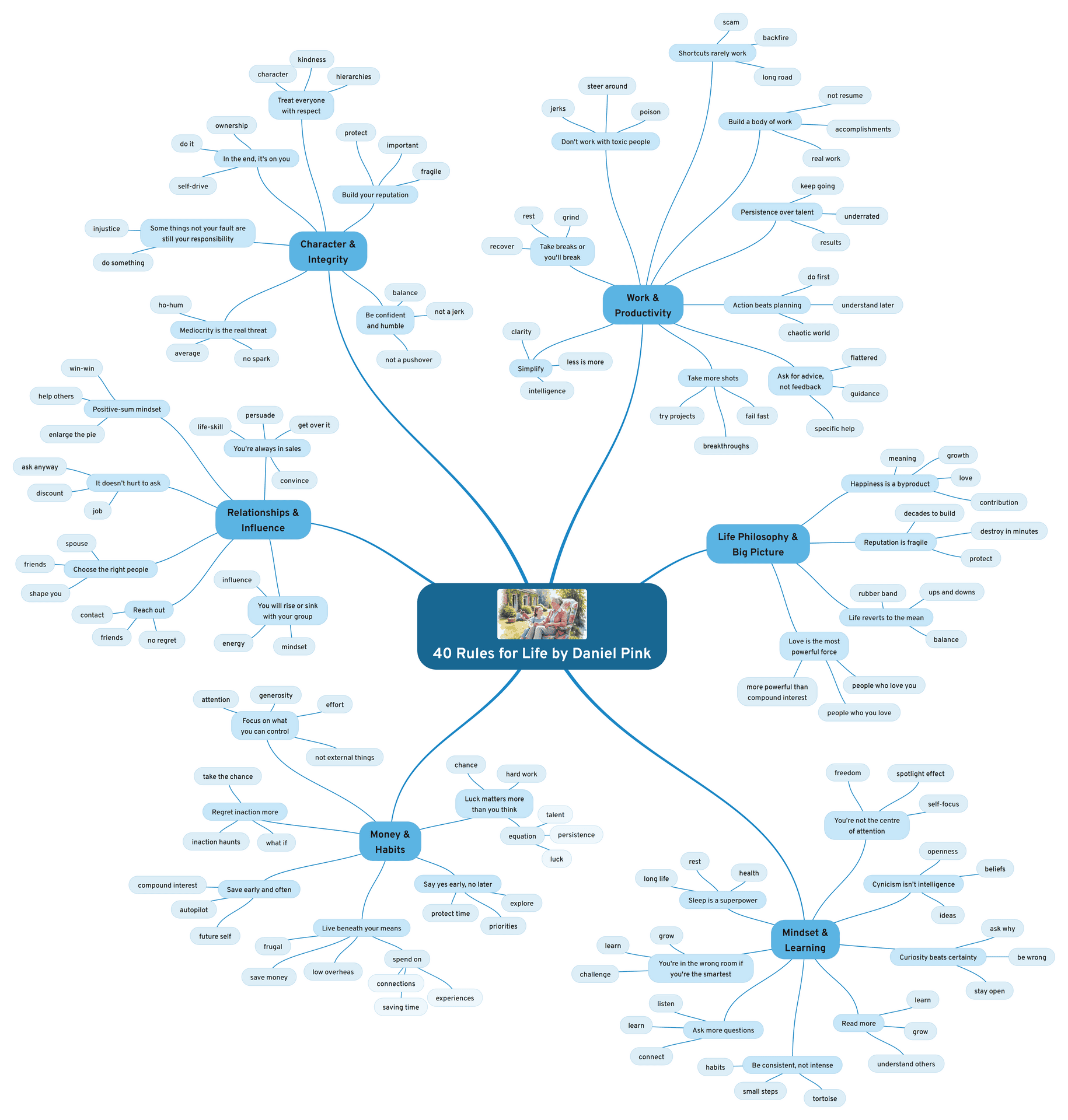
MIND-MAP
Use the mind-map to have a more in-depth discussion on these 40 rules.
COMMENTS
What do you think of the ideas presented in this lesson?
Share your views and experience here.
0 Comments