


back to HOME > Personal Development > Personal Productivity >

THE BLUE TREE
Personal
Productivity

CEFR B2
Upper
Intermediate

warm up
Answer the questions below.
| Why is it so hard to achieve our goals? |
TRANSCRIPT
It’s hard to achieve our goals because staying committed over time can be challenging. Life gets busy, we lose motivation, or we hit setbacks that make us doubt if we can really succeed. Also, big goals can feel overwhelming, and without a clear plan, it’s easy to lose focus. I’ve realized breaking down goals into smaller steps helps, but even then, it takes discipline and patience.
| How does change affect goals? |
TRANSCRIPT
Change affects our goals in significant ways, sometimes making us rethink or adjust them. Whether it’s changes in our personal lives or the workplace, we often need to adapt to new realities. A change can also create new opportunities, but it might also bring challenges that make it harder to stay on track. I think the key is to stay flexible and open to adjusting our plans as needed.
| How can we increase our chances of success as regards reaching goals? |
TRANSCRIPT
We can increase our chances of success by staying consistent and disciplined. It’s about developing good habits that support our goals and sticking with them, even when things get tough. Also, setting up a system for tracking progress and regularly evaluating what’s working and what’s not is important. Getting feedback from others and continuously improving can help us stay on course.

key language
Go through the flashcards below. Memorise as many words and their definitions as you can.
watch the video
Watch a short video summary of the book “Choosing Change. How leaders and Organizations Drive results one person at a time” by Walter McFarland and Susan Goldsworthy.
COMPREHENSION
Answer the questions below. Throw some newly learned words and phrases into your answers.
- ⌚ 0:21 How should leaders view change?
- ⌚ 1:16 Why do goals need to be specific?
- ⌚ 1:21 What is the idea behind “time-stamped” goals?
- ⌚ 1:28 What makes goals achievable?
- ⌚ 1:34 What else, apart from performance indicators, should goals have?
- ⌚ 1:45 When is it particularly useful to have inspiring goals?
- ⌚ 1:53 What is the benefit of adding a narration to our goals?
- ⌚ 1:59 What adds momentum to our goals?
- ⌚ 2:13 How can STAMINA goals help us when we hit a bump in the road?
DISCUSSION

STAMINA IN REAL LIFE
Alita missed the training session on STAMINA goals, so Pete is giving her a friendly, simple walk-through as they grab a quick coffee before work.
Listen to their dialogue.
Now read or role play this a slightly different version of this conversation between Alita and Pete.
Alita:
Ugh, I can’t believe I missed yesterday’s training. You mentioned something about “STAMINA goals”? Can you give me the short version?
Pete:
Sure. STAMINA is just a way to make goals easier to stick to. Think of it as a checklist. The first one — S for Specific — means you should say exactly what you want. Not “I’ll get healthier,” but “I’ll go for a 20-minute walk every morning.”
Alita:
Okay, that already sounds more doable.
Pete:
Then comes T for Time-Stamped. A goal needs a deadline or a rhythm. Like “by March,” or “three times a week.” No time? No progress.
Alita:
Right, otherwise it lives in that magical land called “later.”
Pete:
Exactly. Next is A for Achievable. It should challenge you but not destroy you. If you haven’t run in years, a marathon next month is a bad idea. A 5 km run is better.
Alita:
So it’s about building confidence, not torture?
Pete:
That’s a nice way of putting it.
After that comes M for Measurable. You need a way to track your progress. Kilometres run, pages read, money saved — anything you can count.
Alita:
I love ticking boxes. It makes me feel productive even when I’m not.
Pete:
Same here.
Then we move to I for Inspiring — something that actually motivates you. “Because my doctor said so” works for a week. “Because I want more energy for my kids” lasts longer.
Alita:
So the emotional part matters too.
Pete:
A lot.
Next up: N for Narratable. Basically, can you explain your goal in a simple story? “I’m learning Spanish because I want to travel to Peru next year.” When your goal has a story, people remember it — and you remember it too.
Alita:
That’s true. A story makes it feel real.
Pete:
And finally A for Actionable — meaning you know the next step. Not the whole plan, just the next tiny action. “Open the app,” “Book a class,” “Write the first paragraph.” When in doubt, do the smallest step.
Alita:
This actually sounds… friendly. Not like another system that makes you feel guilty.
Pete:
That’s the point. STAMINA gives your goals structure but also energy. It keeps them alive when life gets messy — which it always does.
Alita:
Thanks, Pete. I think I’ve got it. Maybe missing the training wasn’t such a disaster after all.
Pete:
Happy to help. Now… about that coffee — is your goal to buy it or make it?
Alita:
Buy it. Definitely buy it.
Answer these questions on the basis of the dialogue between Alita and Pete.

dive deeper into stamina
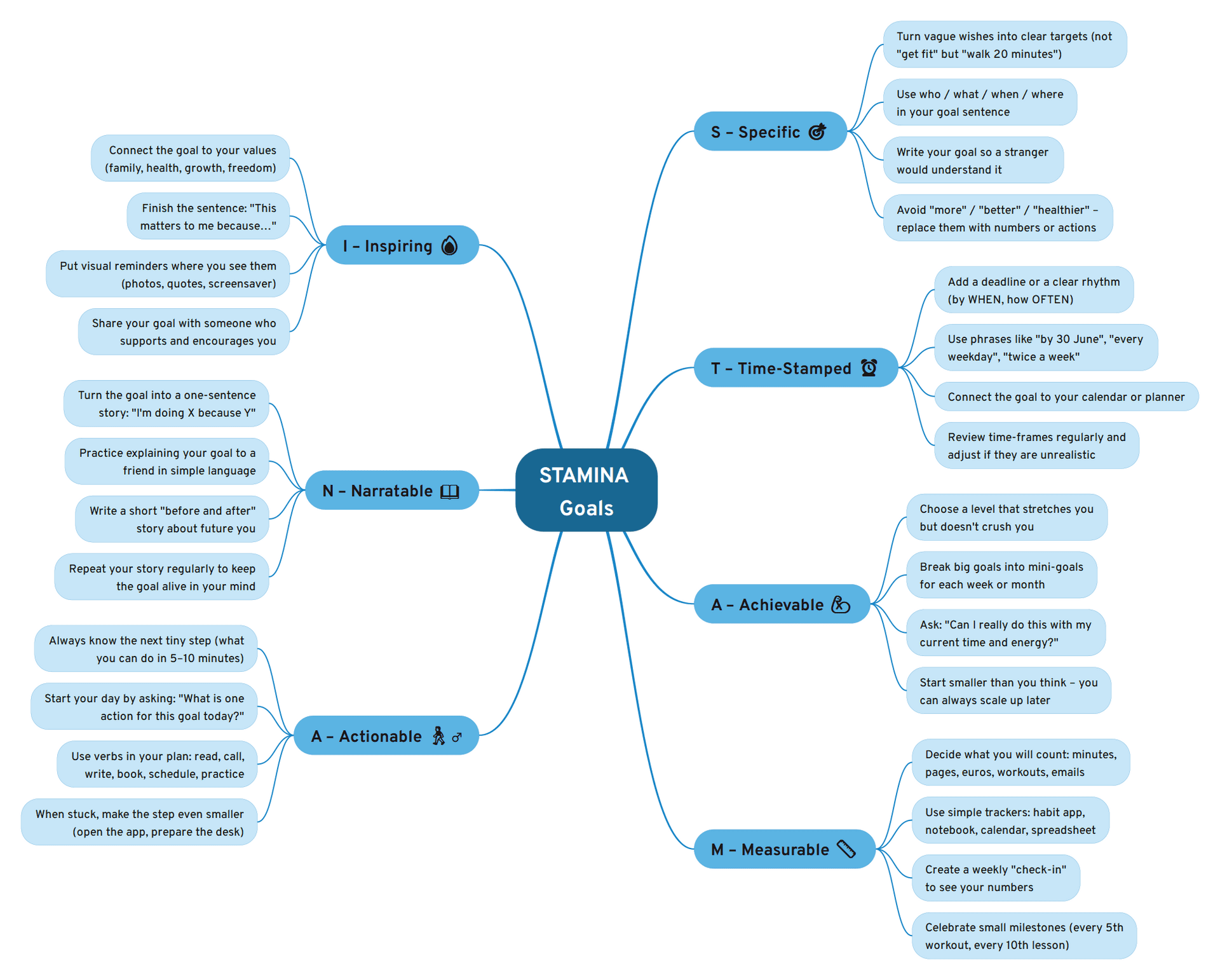
Use the mind-map below to dive deeper into this topic or to remember key ideas.
POLL
Cast your vote in the poll.