


Bardzo mi przykro, ale lekcje na platformie The Blue Tree działają jedynie na komputerze lub tablecie.
Do zobaczenia na większym ekranie 🙂
Zespół The Blue Tree
back to HOME > General Interest > Man and Society >

THE BLUE TREE
Man & Society

CEFR C2
Proficiency

warm up
Answer the questions below. Listen to the sample answers.
| How much do you know about yourself? |
TRANSCRIPT
I think I know a fair amount about myself, but there’s always more to discover. Over the years, I’ve learned about my strengths and weaknesses, what motivates me, and what stresses me out. But self-awareness is a constant process. Life experiences continue to shape who we are, so I believe there’s always something new to learn about how I react in different situations.
| Does our personality adffect the way we communicate? |
TRANSCRIPT
Yes, our personality definitely affects how we communicate. For example, an extroverted person may be more comfortable speaking up in meetings or social situations, while someone who’s more introverted might prefer to listen and process information before sharing their thoughts. Understanding these differences can help us adapt our communication style depending on who we’re talking to.
| To what extend can we change our personality? |
TRANSCRIPT
I think we can change aspects of our personality, but only to a certain extent. Some traits, like being naturally introverted or extroverted, are harder to change because they’re part of our core makeup. But we can work on improving how we react to situations, manage emotions, and adapt to different environments. It’s about finding a balance between staying true to yourself and evolving over time.

part one

KEY LANGUAGE
Go through the flashcards below. Make sure you understand all the words and expressions.

VIDEO
Watch the first part of the video.

COMPREHENSION
Answer these questions. Refer to the information from the video.
- ⌚ 1:01 What will Brian Little’s talk help the audience with?
- ⌚ 1:31 What branch of psychology is he involved in?
- ⌚ 2:08 What fascinates him the most about people?
- ⌚ 2:30 What is trait psychology?
- ⌚ 3:03 What does OCEAN stand for?
part two
KEY LANGUAGE
Go through the flashcards below. Make sure you understand all the words and expressions.
VIDEO
Watch the second part of the video.
COMPREHENSION
Answer these questions. Refer to the information from the video.
- ⌚ 3:25 What is opennes and conscientiousness a predictor of as regards success in life?
- ⌚ 3:36 What are extroversion and agreeableness conducive to?
- ⌚ 4:52 What do the three natures – biogenic nature, sociogenic, idiogenic – describe?
- ⌚ 5:17 What kind of stimulation do extrovert people need?
- ⌚ 5:33 Are introverted people antisocial?
- ⌚ 5:51 Who does caffeine work better on?
part three
KEY LANGUAGE
Go through the flashcards below. Make sure you understand all the words and expressions.
VIDEO
Watch the third part of the video.
COMPREHENSION
Answer these questions. Refer to the information from the video.
- ⌚ 7:41 What are the results of the study on the frequency with which individuals engage in the conjugal act?
- ⌚ 8:21 How do extroverted people communicate?
- ⌚ 9:11 How do introverted people like to talk?
- ⌚ 10:40 How was Tom and Brain talking past each other when they were describing Micheal?
part four
KEY LANGUAGE
Go through the flashcards below. Make sure you understand all the words and expressions.
VIDEO
Watch the fourth part of the video.
COMPREHENSION
Answer these questions. Refer to the information from the video.
- ⌚ 11:38 Are we just a collection of personality traits?
- ⌚ 12:09 What makes us different from each other?
- ⌚ 12:48 What are some of the situations when we act out of charachter?
- ⌚ 12:54 What are free traits?
- ⌚ 13:01 What is a better question to ask about people’s character?
- ⌚ 13:40 Why does Brain act more extrovertly for his students?
POLL
Cast your vote in the poll.

DISCUSSION
DIALOGUE
Alita and Pete are on a train. To pass the time, they watched this TED Talk. Here’s their conversation.
Read or role-play it.
Alita:
I’m glad we watched this on the train. It somehow fits — moving forward while thinking about who we really are.
Pete:
Yeah, it was surprisingly engaging. I expected another “personality types” lecture, but he went much deeper than that.
Alita:
Exactly. I liked how he challenged the idea that we’re just a bundle of traits. The concept of free traits really stuck with me.
Pete:
Same here. The idea that you can act out of character on purpose, because something matters to you — that felt very real.
Alita:
It made me think about work. I’m quite introverted by nature, but when I care about a project, I become much more outspoken than people expect.
Pete:
That’s a good example. I used to think that changing behaviour meant being fake. Now I see it more as adapting, not pretending.
Alita:
Yes — staying true to your values, not necessarily your default settings.
Pete:
Still, I wonder where the limit is. You can stretch yourself, sure, but you can’t rewrite your personality completely.
Alita:
True. And I think Brian Little isn’t denying that. He’s just saying we’re not prisoners of our traits.
Pete:
That’s reassuring, actually. It means growth doesn’t require becoming someone else — just choosing what matters enough to step outside your comfort zone.
Alita:
Well put. Makes this train ride feel a bit more… meaningful.
OVER TO YOU
Discuss these questions. Refer to the topic of the lesson and your own experience.
DIVE DEEPER
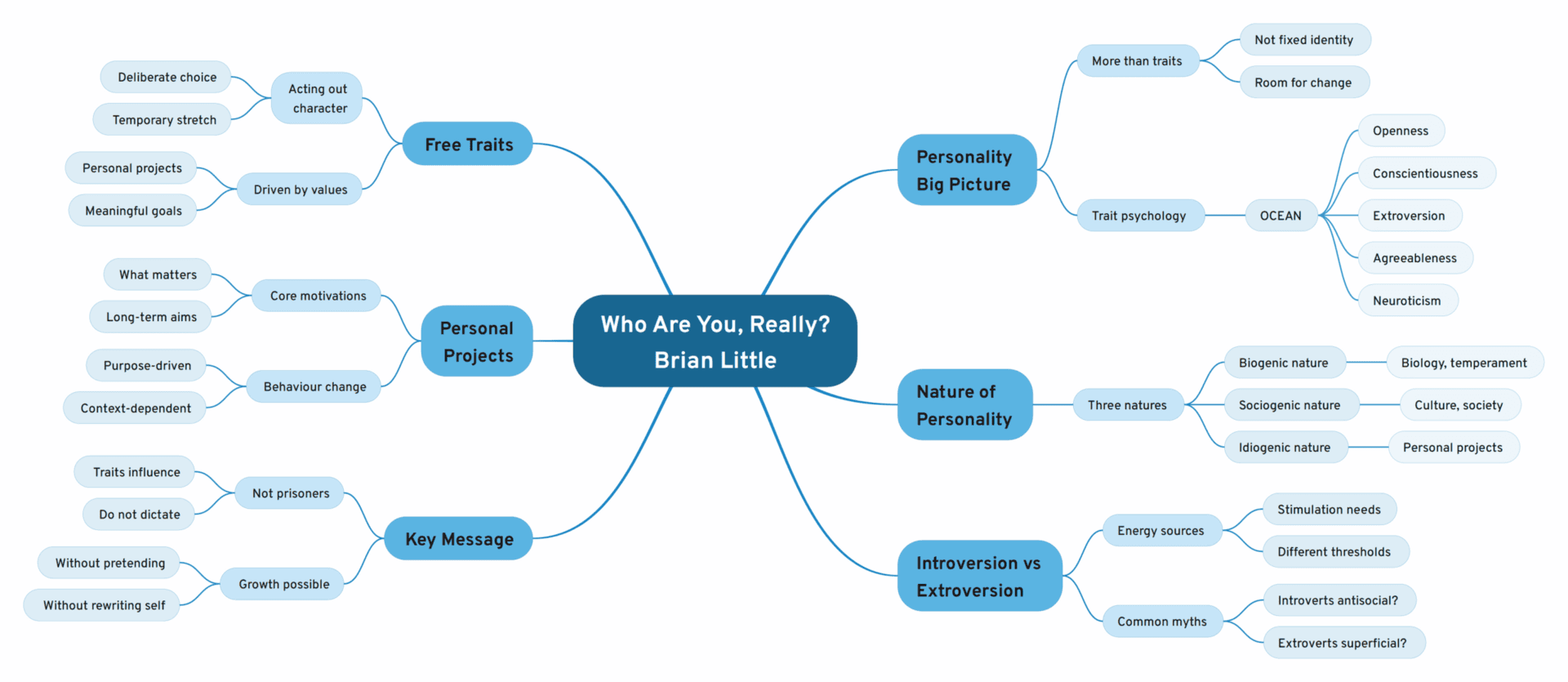
Study this mind-map to remember this topic better or a spring board to learn more about the ideas from this lesson.
lesson glossary
COMMENTS
What do you think of Brian Little’s approach to personality? Do you sometimes act out of character? Do you think people are just a bunch of traits or is there more to us?
Share your views and experience here.
0 Comments