FUNCTIONS:

Agreeing

Disagreeing

Hesitating

Introducing your opinion

Asking for opinions

Expressing preferences

Asking for clarification

Expressing likelihood

Speculating, guessing

Advice and recommendations

Describing a picture

Agreeing

I think you’re right

I would go along with the idea

I completely agree with you

That makes perfect sense

You have a point there

Absolutely, that’s spot on!

I couldn’t agree more

Disagreeing

That’s not how I see it

I couldn’t agree less

You must be kidding

That’s a ridiculous idea, don’t you think?

With all due respect, I must disagree

I’m afraid I can’t see it that way

No way, that’s nonsense!

Hesitating

I’m in two minds about it

I have some reservations regarding that

I’m not entirely convinced

There’s something that gives me pause

While I’m not entirely opposed, I do have some doubts

Introducing your opinion

To my mind

I reckon

In my opinion

As I see it

It seems to me

I would argue

From my point of view

Asking for opinions

Don’t you think …?

What’s your attitude to …?

What’s your opinion of …?

Are you in favour of …?

What’s your position as regards …?

You don’t support …, do you?

Expressing preferences

I prefer…

I would rather…

My preference would be…

I tend to favour…

If I had to choose, I would…

I lean towards…

I am inclined to…

I’m a big fan of…

I really enjoy…

I’m into…

I absolutely love…

I’m crazy about…

I’m fond of…

It’s right up my alley

It’s my thing

I can’t get enough of…

It appeals to me

It’s growing on me

I wouldn’t miss it for the world

I’m not a big fan of…

I don’t really enjoy…

I’m not into…

I can’t stand…

I’m not fond of…

It’s not my cup of tea

It doesn’t do anything for me

I’m sick of…

It gets on my nerves

It puts me off

I’d rather not…

It leaves me cold…

Asking for clarification

Could you please elaborate on that?

Would you mind explaining that further?

I’m not quite sure I understand. Could you clarify?

Could you provide more details?

Can you expand on that point?

Expressing likelihood

“It’s a foregone conclusion that…”

“There’s no doubt in my mind that…”

“I am almost certain that…”

“It’s highly likely that…”

“Chances are that…”

“I wouldn’t be surprised if…”

“It’s possible that…”

“There’s a chance that…”

“It’s unlikely that…”

“I doubt that…”

Speculating, guessing

“It seems to me that…”

“My gut feeling is that…”

“From what I gather…”

“If I were to guess…”

“It would appear that…”

“I reckon that…”

“I suspect that…”

“In all likelihood…”

“There’s a distinct possibility that…”

“It’s plausible that…”

Advice and recommendations

“You might want to consider…”

“Perhaps you could try…”

“If I were you, I would…”

“One thing you could do is…”

“Have you thought of…”

“May I suggest…”

“It might be beneficial to…”

“Consider this approach…”

“Why not give this a go…”

“If it were up to me, I’d…”

Describing a picture

“In the foreground…”

“In the background…”

“In the center of the image…”

“On the left side of the picture…”

“On the right side of the picture…”

“At the top of the picture…”

“At the bottom of the picture…”

“The picture depicts…”

“The image illustrates…”

“The photograph shows…”

“One can see…”

“Notice how…”

“This scene captures…”

“This photograph highlights…”

DICTIONARY

Add new and interesting words from this lesson to your English dictionary.

Store your words and expressions in this handy dictionary. You can create groups and play games based on your entries. There is also a practical importing feature.

You must log in to see content.

Trends and Changes
Learn more words

THE BLUE TREE

Business English

CEF B1

CEFR B2

Upper
Intermediate

warm up

Study this graph and then listen to and read the text that follows. Do you know what all the blue expressions mean?

The chart shows the US stock market (Dow Jones index) for last year and the first quarter of this year. As can be seen from the chart, last year started on a positive note. The market rose until late February when it almost reached the 11,000 level. But interest rates were rising, and investors decided to take profits. There was a sharp fall during the month of March and the Dow bottomed out at just over 10,000. At that point investors started buying again – strong economic numbers and global liquidity (central banks printing money) offered support to the market. Over the summer the Dow was flat, trading in a range from 10,300 to 10,700. The market was unable to break out of this range, even though company profits were increasing. What was the reason? It was almost entirely due to the price of oil, which had climbed dramatically from 42 dollars a barrel at the start of the year to 68 dollars in August. This price rise was caused by the hurricane season in the Gulf of Mexico and increasing tension in the Middle East.

In mid-October, the markets started to rally strongly and went from 10,200 to 10,900 over just four weeks. This sudden jump was as a result of comments made by a member of the Federal Reserve, who indicated that interest rates would soon stop rising. This is positive for business as the cost of borrowing also stops going up. From November to January the market remained more or less unchanged, failing to break through the February highs.

Over the last few months, the market has advanced again. The economic backdrop remains healthy: company profits are good, consumer spending is up, and interest rates are close to reaching a peak. The only dark cloud is the price of oil, which has risen back to the $70 level and looks certain to go up further. The next hurricane season is approaching and production worldwide cannot be significantly expanded.

part one

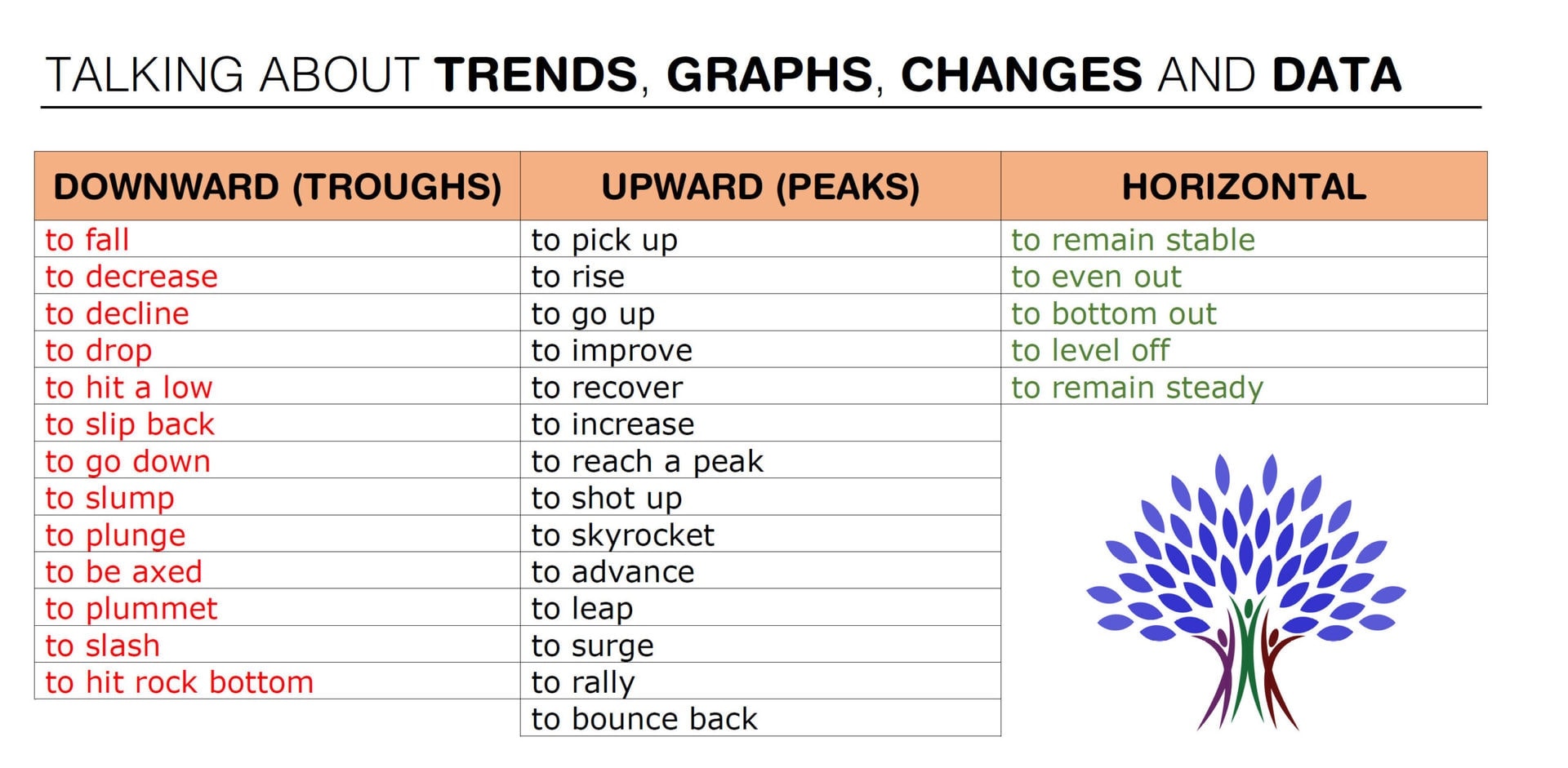
UPWARD MOVEMENT – PEAKS

Study the words and expressions that describe an upward movement or change.

Downward movement – troughs

Study the words and expressions for downward movement and changes.

Horizontal movement

How about words and expressions that describe no movement? Study these flashcards and make sure you know all of these expressions.

part two

LANGUAGE OF TRENDS

Play this flashcard game. There are four categories:

➡️ upward,

➡️ downward,

➡️ horizontal,

and new one:

➡️ reason and cause. 

Make note of all the new vocabulary. 

WHAT’S THE TREND

Do the test below. Decide if the sentences describe an upward, horizontal or downward trend. 


Decide if the sentences describe an upward, horizontal or downward trend. 

1.

The economy is at last beginning to recover.

2.

Traffic reaches its peak between 8 and 9 in the morning.

3.

Sales have levelled off after a period of rapid growth.

4.

It's good to see a rally in shares on the stock market after such a weak start in January.

5.

Profits slumped by over 50%.


Keep up the good work! 

6.

House prices keep rising and falling but they should eventually even out.

7.

Share prices surged on the news of the merger.

8.

The company reported a small decline in its profits.

9.

I hope my French will improve when I go to France.

10.

The economic boom sent property prices skyrocketing.

11.

They had hit a 52-week low of $18.25 last Friday.


Well done! You're almost there!

12.

Share prices plummeted to an all-time low.

13.

The workforce has been slashed by half.

14.

The recession is finally beginning to show signs of bottoming out.

SALES REPORTS

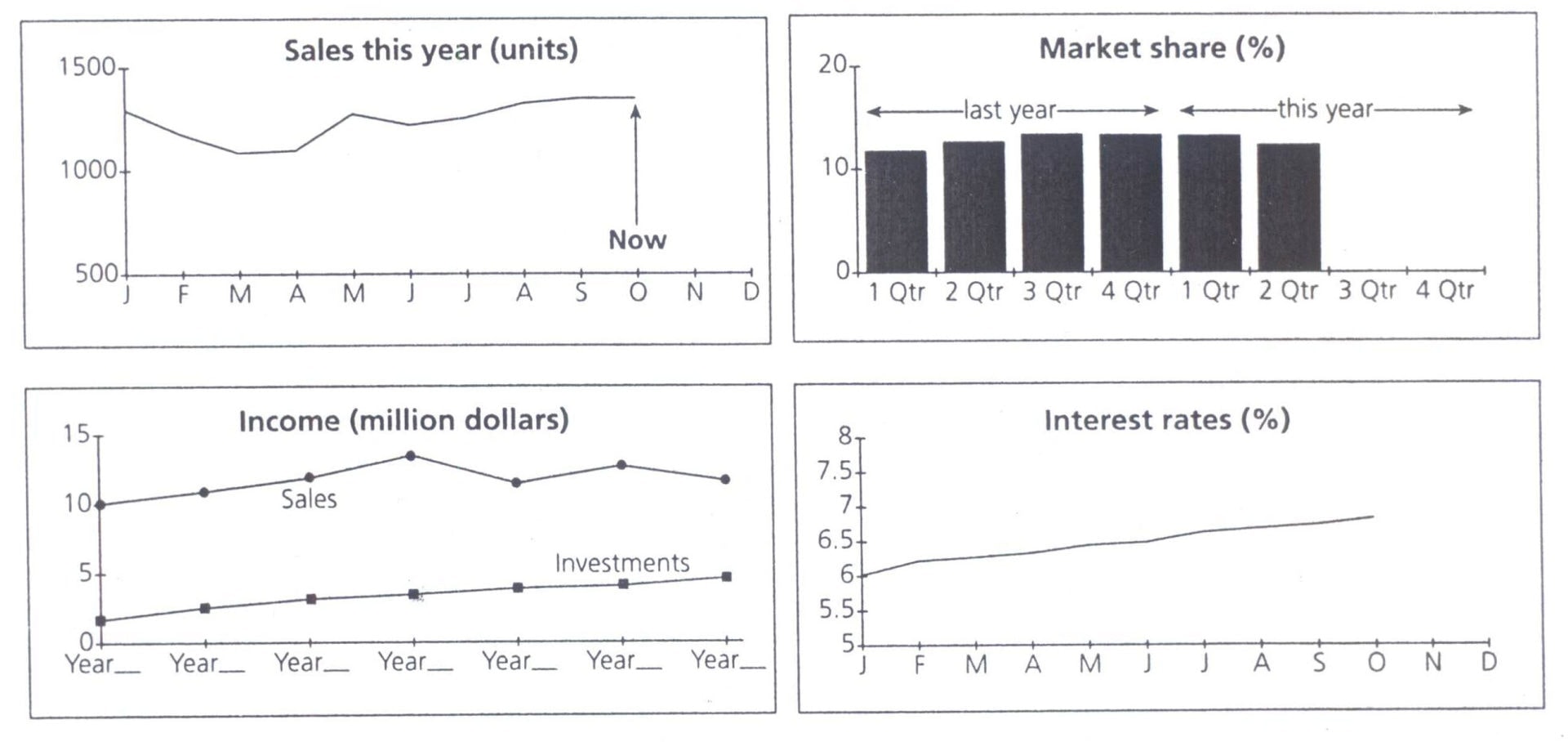
Study these four graphs below and then do the activity that follows.
FIND THE FUNNY SIDE

Complete the joke by matching each noun or noun phrase on the left to a verb or verb phrase on the right.

part three

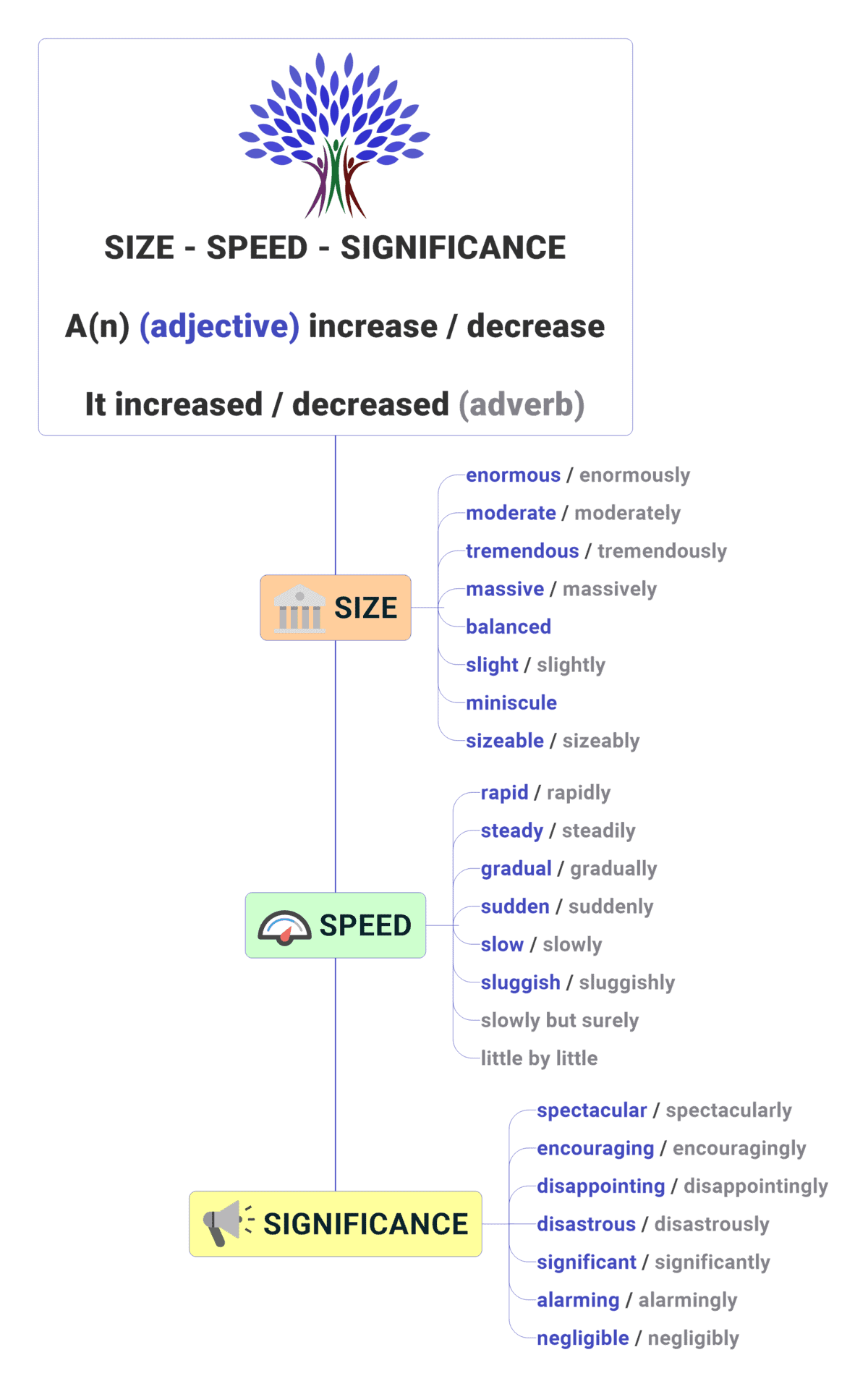
It is practical to qualify the trend with words or expressions from three categories:

  • size
  • speed
  • significance

Study the mind map and learn the adjectives and adverbs for qualifying trends.
PRACTICE 5

MD logo

Play this Multidecker game and decide if the words on the cards belong to the size, speed or significance category.

Finally, how would you complete the sentences below with these adjectives and adverbs for qualifying trends?

  1. In the last ten years there was a(n) ………………………… in my remuneration.
  2. Over the last decade my health has seen a(n) ………………………………
  3. Over the years, there has been a(n) ……………………………………… of my overall happiness.
  4. My country is experiencing a(n) …………………………. in prosperity.
  5. My overall outlook on life has seen a ……………………… over the years.

COMMENTING ON STATISTICS

When you are introducing trends, data or statistics in your presentations or reports, it is helpful to remember about three key steps:

1. HIGHLIGHT – draw your audience’s attention to your data

2. COMMENT – show your audience what this data mean to you

3. INTERPRET – explain the significance of these trends and statistics

Do the exercises below to learn some useful language for each of these steps.

You might need to comment on a trend by saying if it is good or bad news.

Practise some language of breaking good and bad news.

FINAL PRACTICE

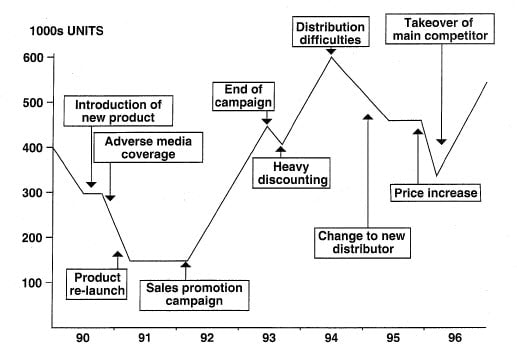
How would you comment on this graph?
DOWNLOAD
download a table

Learning is more effective when you use tables and charts!

THE END OF THE LESSON

Świetnie! Lekcja ukończona!

Pamiętaj, żeby dodać lekcję do zrobionych.

W ten sposób zapiszesz lekcję w swojej historii nauki. Możesz ją sprawdzić z poziomu swojego profilu.

[wp_customcalendar_single]