


Bardzo mi przykro, ale lekcje na platformie The Blue Tree działają jedynie na komputerze lub tablecie.
Do zobaczenia na większym ekranie 🙂
Zespół The Blue Tree
back to HOME > Personal Development > Better Communicator >

THE BLUE TREE
Better
Communicator

CEFR B2
Upper
Intermediate

warm up
Answer the questions below. Listen to model answers and read the transcript to get some more practice in conversational English.
| From your experience, what can prevent a disagreement from escalating into a fight? |
TRANSCRIPT
“In my experience, the best way to stop a disagreement from turning into a fight is to slow down and really listen. People often get louder because they feel ignored. If you repeat back what they said or ask a clarifying question, it shows you’re taking them seriously. Even if you don’t agree, they feel heard, and the conversation becomes calmer instead of more aggressive. Respect usually cools things down.”
| Do you believe it’s possible to argue with someone and still build a better relationship? Why or why not? |
TRANSCRIPT
“Yes, I believe it’s not only possible but sometimes very helpful. Julia Dhar, in her TED Talk, explained that we should separate the person from the idea. If we focus on discussing the idea, not attacking the person, arguments can actually strengthen trust. When I show curiosity about another perspective, the other person often appreciates it, even if we disagree. In the end, the relationship can grow stronger because we proved we can disagree respectfully.”
| What’s more important in a disagreement: proving you’re right or keeping the relationship strong? Why? |
TRANSCRIPT
“For me, keeping the relationship strong is much more important. Being right in one situation doesn’t matter if the argument damages the trust between people. I’ve seen many cases where someone ‘won’ the discussion but lost respect. If you focus on the relationship, you can return to the topic later and maybe solve it together. Proving you’re right feels good for a moment, but healthy relationships are what really last in the long run.”

part one

KEY LANGUAGE
Go throught the flashcards below. Make sure you understand all the language.

READING
Read an adaptation of the article from Harvard Business Review “A Smarter Way do Disagree” by by Julia A. Minson, Hanne K. Collins and Michael Yeomans
The link to the original article is here.
Tips for Handling Disagreements
These ideas come from years of research about how language shapes the outcome of conflicts. The main point is simple: words can help us escape the vicious cycle of arguing and fighting for control. To do that, we sometimes need to show a bit of vulnerability. That’s not easy—most of us go into disagreements ready to fight our corner. But if you rely on the right words, you can prove to yourself and others that you’re trying to build understanding instead of just dodging the tough moment.
- Show curiosity
In many studies, people assumed their opponents weren’t interested in hearing their side. But when someone clearly shows they want to understand, it changes the whole tone of the conversation. The easiest way? Just say you’re curious:
- “It looks like we see this differently. I’m curious to hear how you see it.”
- “I think there are a few ways of looking at this. I believe XYZ, but I’d love to know more about your point of view.”
You don’t have to give up your own opinion—you’re just opening the door to a real exchange.
💬 “When I said I was curious about my colleague’s view, she relaxed immediately, and the meeting stopped feeling like a battle.”
- Acknowledge the other side
Everyone wants to feel heard. In conflicts, people often worry that their words don’t even register. A simple way to show respect is to restate the key point:
- “I hear you—the team has been putting in crazy hours, and the client is very demanding. But here’s why we can’t add more staff right now…”
Even if you disagree, acknowledgment proves you were listening. And if you don’t understand, don’t fake it—just ask for clarification.
💬 “I repeated my teammate’s main point back to him, and you could almost see the tension leave his face.”
- Find common ground
Even when you strongly disagree, you usually share some values, beliefs, or goals. It helps to zoom out and point to what you have in common:
- “I agree with part of what you’re saying…”
- “We both want the project to succeed…”
- “I noticed the same thing in that meeting…”
Highlighting common ground reminds everyone why you’re working together in the first place.
💬 “As soon as I said, ‘We both want the project to succeed,’ the whole conversation became more cooperative.”
- Hedge your claims
In fact-based arguments, half the time we’re wrong. Instead of sounding overconfident, show some humility. Use hedging expressions:
- “From my perspective…”
- “Sometimes it seems…”
This makes you sound thoughtful and open-minded. You can also combine hedging with acknowledgment:
- “I understand you’re concerned about staffing, and yes, this client is really important. On the other hand, we need to be careful not to stretch our resources too thin. What do you think?”
💬 “When I started saying things like ‘from my perspective,’ people stopped treating me like I was stubborn and started taking my ideas more seriously.”
- Share your story
Our strongest beliefs usually come from personal experience, not just data. Sharing your own story can build more trust than throwing facts and figures at someone. For example, instead of quoting research, you might say:
- “I once worked on a project where we took on too much, and it really burned people out. That’s why I feel so strongly about this issue.”
Stories make your argument human and relatable. They can break the cycle of battling facts with more facts and open the door to collaboration.
💬 “When I shared a personal story instead of statistics, people leaned in and actually listened.”
👉 In short: be curious, show you’re listening, look for common ground, hedge your claims, and don’t be afraid to tell your story. These moves can turn a heated argument into a constructive conversation.

comprehension questions
Answer the questions below using the information from the article and your own experience.
Show curiosity
- Why does showing curiosity change the tone of a disagreement?
- What simple phrase can you use to signal that you’re interested in the other person’s perspective?
Acknowledge the other side
- Why is acknowledgment important in a conflict, even if you don’t agree?
- What should you do if you don’t fully understand the other person’s point of view?
Find common ground
- What kinds of things can people usually find in common, even if they disagree?
- How does pointing out common ground help during an argument?
Hedge your claims
- Why is it risky to sound overconfident in fact-based arguments?
- Which phrases can you use to hedge your claims and sound more open-minded?
Share your story
- Why can sharing personal stories be more effective than quoting data or research?
- How can stories change the way people listen during a disagreement?
part two
real-life snippets
Use the scenarious below to practise using tips on handling disagreements.
1. Show Curiosity
Anna: I think we should spend more money on marketing. That’s the only way we’ll reach new customers.
Tom: I don’t agree. I feel our budget is already stretched too thin.
Anna: It seems we’re looking at this differently. I’m curious to hear how you see it.
Tom: Well, in my view, we should improve the product first before spending on ads.
Anna: That’s interesting. So for you, quality comes before promotion. Thanks for explaining—let’s explore how we could balance both.
2. Acknowledge the Other Side
Sara: Honestly, the client is too demanding. We’ve been working evenings and weekends, and the team is exhausted.
David: I hear you—the workload has been crazy, and everyone is tired.
Sara: Exactly, so I think we really need to hire more people.
David: I understand, but at the same time, the budget doesn’t allow for new staff right now.
Sara: Okay, I don’t like it, but I see you’ve understood my point. That helps me accept the decision a bit more.
3. Find Common Ground
Mark: I don’t think your plan for the project will work. It’s too risky.
Julia: I see your point, but we both want this project to succeed, right?
Mark: Of course, that’s true. I just don’t want us to fail.
Julia: And I share the same worry. That’s why I think we need a creative solution.
Mark: Fair enough. Let’s focus on what we agree on and then discuss how to reduce the risks.
4. Hedge Your Claims
Lisa: We must hire more people immediately, or this project will collapse.
Paul: From my perspective, it might not be the best moment to expand the team.
Lisa: Why not? Can you explain?
Paul: Because sometimes when we take on too many new staff, we lose focus. I’m not saying I’m 100% right, but I think we should weigh the risks. What do you think?
Lisa: I see. You’re cautious about resources. That makes sense. Let’s check the numbers before we decide.
5. Share Your Story
Emma: I don’t understand why you’re so strongly against taking this client. It’s a big opportunity.
James: I get that. But I once worked on a project where we accepted a big client, and it burned the team out completely. That’s why I’m cautious now.
Emma: Okay, that explains your point of view. I didn’t know you had that experience.
James: Exactly. For me, it’s personal. I don’t want us to repeat the same mistake.
Emma: Fair enough. Thanks for sharing—it helps me see the bigger picture.
YOUR OWN EXAMPLE
Create your own dialogue which illustrates the use of these tips for handling disagreements.
DISCUSSION
which is the most practical
Read (role-play) a dialogue between Alita and Pete. They are discussing the practical value of these tips.
(In the office lounge. Alita is sitting with arms crossed, looking slightly frustrated. Pete is leaning back in his chair, calm but engaged.)
Alita (frowning): You know, I don’t think all those strategies from the article are practical. In real life, people don’t have time to hedge their claims or share stories.
Pete (leaning forward, open hands): I see what you mean, but I disagree. I think those small things actually change the atmosphere of a conversation.
Alita (shrugs, slightly defensive): Really? To me, it feels like wasting time. If I’m sure I’m right, why not just say it directly?
Pete (smiling slightly): Because sounding too confident can make you look stubborn. Remember the section about humility? If you admit you might be wrong, people see you as thoughtful instead of arrogant.
Alita (pauses, tilts head): Hmm, maybe. But I still think curiosity is the only tip that really matters. If I say “I’m curious to hear your view,” it opens the door. The rest feels unnecessary.
Pete (nodding, calm tone): Curiosity is powerful, yes. But imagine you’re in a heated argument and someone says, “I hear you, the team is tired.” That acknowledgment can lower the tension immediately.
Alita (relaxes a bit, uncrosses arms): Okay, I admit that would help. Maybe I was too quick to dismiss the other tips.
Pete (smiles warmly): And maybe you’re right that curiosity is the easiest place to start.
Alita (smiling now): So we agree—curiosity first, but the other strategies also have their place.
Pete (laughs softly): Exactly. Looks like we’ve just practiced what the article teaches!
DISCUSSION QUESTIONS
Discuss these questions. Refer to the lesson and your own experience.
 | Can you describe a time when a disagreement at work or school turned out better than you expected? What made the difference? |
| Have you ever managed to calm down an argument by choosing your words carefully? What exactly did you say or do? |
| Think of a time when you and a friend or colleague strongly disagreed. How did it affect your relationship afterwards? |
| Have you ever changed your opinion after hearing someone else’s story or personal experience? What was the situation? |
| Was there ever a moment when you realized that being right was less important than keeping the peace? How did you handle it? |
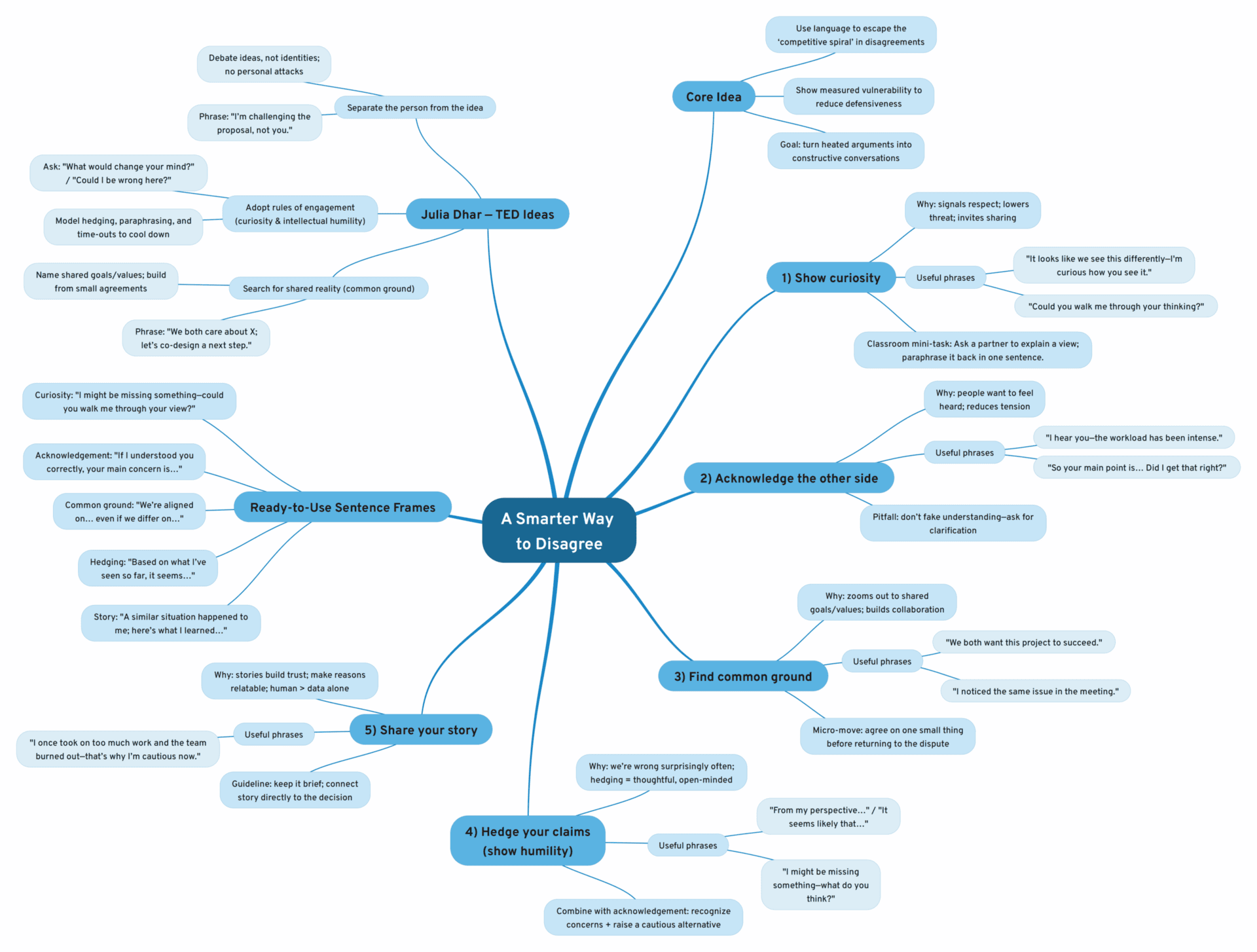
MIND-MAP
Use the mind-map below to learn, revise and remember the key points on how to handle disagreements.
POLL
Cast your vote in the poll below.

COMMENTS
Add your own dialogue that shows the use of these tips on handling disagreements.
Share your views and experience here.
0 Comments