


Bardzo mi przykro, ale lekcje na platformie The Blue Tree działają jedynie na komputerze lub tablecie.
Do zobaczenia na większym ekranie 🙂
Zespół The Blue Tree
back to HOME > Personal Development > Better Communicator >

THE BLUE TREE
How to Learn

CEFR B2
Upper
Intermediate
warm up
Answer the questions below. Listen to model answers. Read the transcript.
| At school we learn a lot of stuff, but does school teach us how to think or learn? |
TRANSCRIPT
That’s something I’ve wondered about for a long time. At school, I memorised a lot of facts, but nobody really showed me how to organise my thinking. I had to figure that out on my own later. I think schools focus mostly on what to learn, not how to learn. If students practised things like making connections between ideas, learning would feel much more natural.
| What helps you think more clearly when you feel overwhelmed? |
TRANSCRIPT
I think the most important thing is to slow down and create some distance from the noise. When there is too much information, the mind needs structure, not more input. I usually try to write down the key ideas and look for connections between them. Over time, I have learned that clarity comes not from thinking faster but from thinking more deliberately.
| Do you think schools help creativity grow, or do they sometimes restrain it? |
TRANSCRIPT
I think schools do both. They give us knowledge and useful skills, but they often focus too much on finding the right answer. From what I have seen, children start out very creative, but over time they learn to follow rules instead of experimenting. Creativity needs a bit of freedom and space for mistakes. Schools could do more to encourage that.
part one

KEY LANGUAGE
Go through the flashcards below. Make sure you understand all the words and expressions.

VIDEO
Watch the first part of the video.

COMPREHENSION
Answer these questions. Refer to the information from the video.
- ⌚ 0:13 How many people admitted that they suffer from information overload?
- ⌚ 0:24 What age are not in any more according to Tony Buzan?
- ⌚ 0:35 What is the new age called?
- ⌚ 0:45 What do we call people raised in this age?
- ⌚ 1:38 What is more important to manage than knowledge?
- ⌚ 1:47 What is a manager of knowledge?
- ⌚ 2:07 What does the brain uses to manage knowledge?
- ⌚ 2:47 What is the third age Tony hopes will come next?
- ⌚ 3:46 How does Tony Feel about the future of Intelligent Workers?
part two
KEY LANGUAGE
Go through the flashcards below. Make sure you understand all the words and expressions.
VIDEO
Watch the second part of the video.
COMPREHENSION
Answer these questions. Refer to the information from the video.
- ⌚ 4:20 What did Tony Buzan ask people to think about?
- ⌚ 4:39 How long did it take people to access information about mangoes in their brain?
- ⌚ 5:05 What didn’t people see in their mind’s eye? What did they see instead?
- ⌚ 5:30 What does Tony mean when he says: “Welcome to the human race”?
- ⌚ 6:28 Tony introduces the idea of a personal language. What two words describe it?
- ⌚ 6:45. Why does this idea of the language of imagination and associations matter?
part three
KEY LANGUAGE
Go through the flashcards below. Make sure you understand all the words and expressions.
VIDEO
Watch the third part of the video.
COMPREHENSION
Answer these questions. Refer to the information from the video.
- ⌚ 7:11 What, according to studies, happens to creativity as we age?
- ⌚7:30 Does Tony Buzan believe this decline in creativity is natural?
- ⌚ 7:54 How many ideas did a boy generate for uses of a paper-clip when he was using linear thinking?
- ⌚ 8:15 What did the teacher teach him about for an hour?
- ⌚ 8:34 How many ideas did he have for the elastic band?
- ⌚ 9:12 How did the boy’s assessement of his own creativity change?
part four
KEY LANGUAGE
Go through the flashcards below. Make sure you understand all the words and expressions.
VIDEO
Watch the fourth part of the video.
COMPREHENSION
Answer these questions. Refer to the information from the video.
- ⌚ 10:36 In what sense the idea of radiant thinking and mind-maps are egalitarian?
- ⌚ 11:01 Who is a scientist?
- ⌚ 11:16 What are the stages in the scientific method?
- ⌚ 12:19 WHat does the experiment with a sheet of paper and a baby prove?
part five
KEY LANGUAGE
Go through the flashcards below. Make sure you understand all the words and expressions.
VIDEO
Watch the next part of the video.
COMPREHENSION
Answer these questions. Refer to the information from the video.
- ⌚ 13:00 Why is the question: “How many of you were babies?” funny?
- ⌚ 14:00 How many of us are scientists?
- ⌚ 14:55 Who do people write poems to?
- ⌚ 15:33 What is the benefit of thinking of yourself as a scientist or a poet?
part six
KEY LANGUAGE
Go through the flashcards below. Make sure you understand all the words and expressions.
VIDEO
Watch the last part of the video.
COMPREHENSION
Answer these questions. Refer to the information from the video.
- ⌚ 16:03 What did the little girl say when the train was going too fast?
- ⌚ 16:20 How did the mother react to her daughter’s observation?
- ⌚ 16:45 What does Tony belive we have done to the way we teach creativity and poetry?
- ⌚ 17:08 Why does Tony encourage us to be wariors of the mind?
- ⌚ 17:30 Whas was Ted Hughes’s poetry about?
POLL
Cast your vote in the poll.
DISCUSSION
Dialogue
Alita and Pete are discussing how the way people think and learn has changed over time.
Read or role-play their dialogue.
Alita: I found the idea of the three ages really interesting — the Information Age, the Knowledge Age, and the Intelligence Age.
Pete: Me too. In the Information Age, the focus was mainly on access. People just wanted more and more data.
Alita: Yes, and now we’re clearly in the Knowledge Age. We can access information instantly, but we also need to organise it properly.
Pete: Exactly. Without good knowledge management, people start to suffer from information overload.
Alita: And that’s where the Intelligence Age comes in. It’s not about how much you know, but how you think and make connections.
Pete: Right. Using imagination and associations becomes more important than memorising facts.
Alita: I like that idea. The Intelligence Age feels more human — more about meaning than speed.
Pete: I agree. If we understand how to use our minds well, information becomes useful instead of overwhelming.
Alita: So maybe progress isn’t about more technology, but better thinking.
Pete: That’s a good way to put it. Smarter thinking, not just more data.
OVER TO YOU
Discuss these questions.
 | Why does moving from the Information Age to the Intelligence Age require a change in how we think, not just what we know? |
| Many people believe that having well-organised knowledge is enough. Why might intelligent thinking still go beyond good knowledge management? |
| What’s best for the Intelligence Age: collecting reliable information or learning how to connect ideas meaningfully? Why? |
| Advise someone who constantly consumes information but struggles to turn it into clear thinking or insight. What should they change? |
| Many people believe faster access to information leads to better decisions. Why might slower, more reflective thinking be more valuable today? |
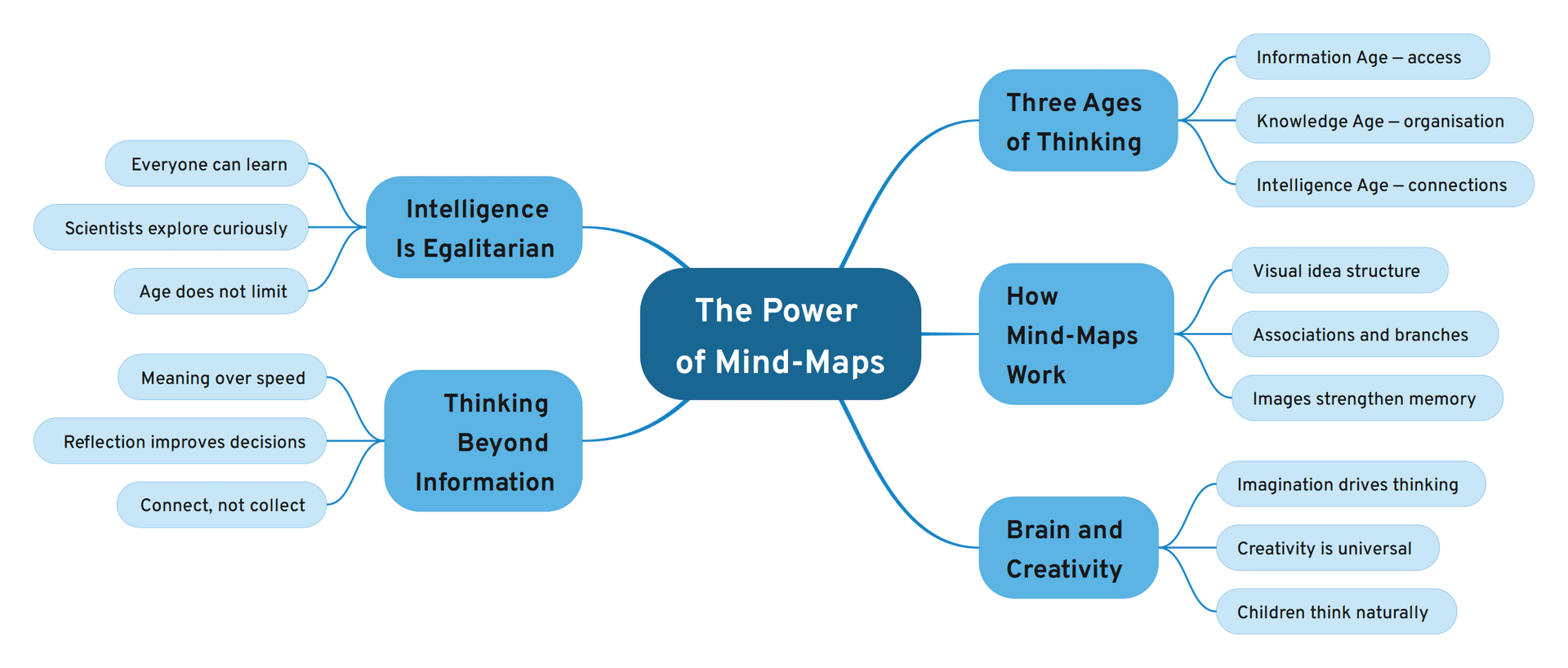
MIND-MAP
Use the mind-map below to have a more in-depth conversation about this topic.
COMMENTS
Share your views and experience here.
0 Comments