back to HOME > Personal Development > Better Communicator >

THE BLUE TREE
Better
Communicator

CEFR B2
Upper
Intermediate

warm up
Answer these questions. Then listen to Bella share her views. Report back what you heard.
| How long do you think it takes to make a first impression? |
TRANSCRIPT
I think it takes just a few seconds to make a first impression — maybe five or six. It happens almost instantly, before we even realise it. Our brain is wired to notice things like body language, tone of voice, and facial expressions right away. Of course, that impression can change later, but the first few seconds definitely set the tone for how we see someone.
| They say, “You only have one chance to make the first impression.” What do you think about it? |
TRANSCRIPT
I think that’s mostly true, but not completely. The first impression is powerful — people often decide whether they like or trust us within seconds. But I also believe we can change that impression over time, especially if we act consistently and show our real personality. Sometimes people just need to see us in a different context to realise who we truly are.
| How much control do we have over what first impression we make on others? |
TRANSCRIPT
I think we have some control, but not total control. We can choose how we dress, how we smile, or how confident we sound — that’s the part we manage. But people’s reactions also depend on their mood, experiences, or expectations, and that’s something we can’t influence. So, I’d say we can guide the impression, but we can’t fully control how others see us.

part one

KEY LANGUAGE
Go through the flashcards below. Make sure you understand all the words and expressions.

VIDEO
Watch the first part of the video.

COMPREHENSION
Answer these questions. Refer to the information from the video.
- What does our brain do when you meet a new person?
- What serves as a frame of reference when we make a first impression?
- What happens when our first impression is wrong?
- What does it mean “to see the other person”?
part two
KEY LANGUAGE
Go through the flashcards below. Make sure you understand all the words and expressions.
VIDEO
Watch the second part of the video.
COMPREHENSION
Answer these questions. Refer to the information from the video.
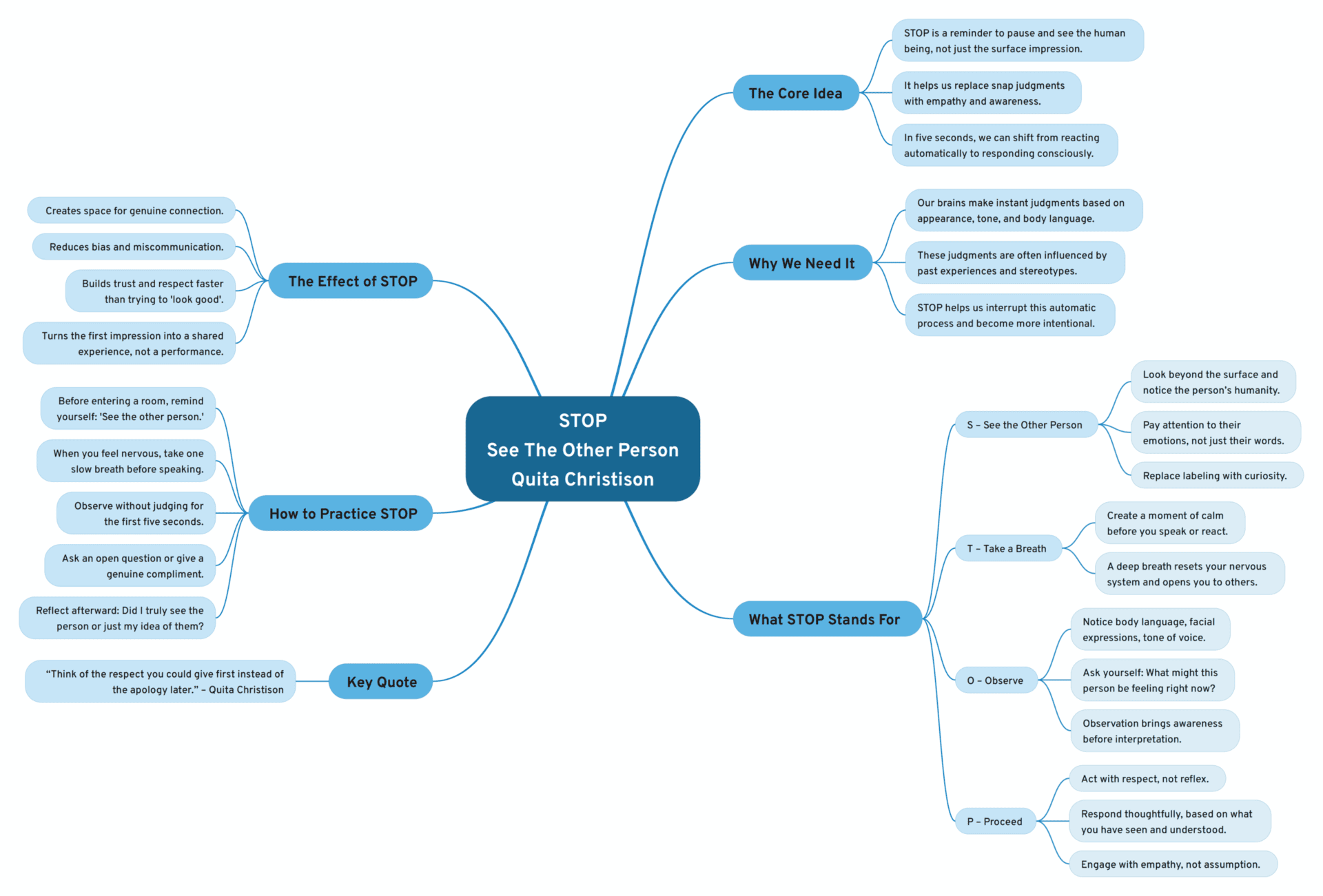
- What does the acronym STOP mean?
- What is the advantage of the STOP approach?
- What does Quita ask us to do when we meet a new person?
Quita Christison
The new 5 Second Rule
“Think of the respect you could give first instead of the apology later.”
POLL
Cast your vote in the poll.
DISCUSSION
Coming Home After the Company Reception
Read or role play this dialogue.
Alita: That was quite a reception! I didn’t expect so many new people. My head is still spinning from all the names and faces.
Pete: Same here. At first, I felt completely out of place. But then I remembered the STOP idea — See The Other Person.
Alita: Oh yes! I tried to use it too. Instead of worrying how I looked, I focused on really seeing the person in front of me.
Pete: That’s what helped me start a real conversation. I stopped thinking about making a perfect impression and just listened. One guy from IT was shy at first, but once I noticed his badge said “photography club,” we clicked right away.
Alita: That’s such a great example. I used to think first impressions were all about control — what I wear, how I smile. But tonight I realised it’s more about presence than performance.
Pete: Exactly. When we truly see others, they feel it. And that changes everything.
Alita: I agree. It’s almost like pressing pause on our inner critic for five seconds, and giving space for the other person to be seen.
Pete: Right. And it’s amazing how a small shift in focus can make us feel more relaxed and authentic too.
Alita: So true. Next time we have an event like this, I’ll remind myself: “STOP — See The Other Person.”
Pete: Me too. Maybe that’s the real secret behind a good first impression.
OVER TO YOU
Discuss these questions.
 | Quita says we often make snap judgments about people. Why do you think our brain does that so quickly? |
| What does it mean to “See The Other Person”? How can this mindset change your first impression of someone? |
| Quita suggests giving respect first instead of the apology later. Can you think of a situation where that advice would apply? |
| When was the last time your first impression of someone turned out to be wrong? What made you change your mind? |
| How can you use the “STOP” idea in everyday situations — not just at receptions or meetings, but also at work, school, or home? |
MIND-MAP
Use the mind-map below to have a more in-depth conversation about this topic.