


Bardzo mi przykro, ale lekcje na platformie The Blue Tree działają jedynie na komputerze lub tablecie.
Do zobaczenia na większym ekranie 🙂
Zespół The Blue Tree
back to HOME > Personal Development > Better Communicator >

THE BLUE TREE
Better
Communicator

CEFR B2
Upper
Intermediate

warm up
Answer the questions below. Then listen to the model answers and think about how you could improve yours.
| How often do you negotiate things in your professional life? |
TRANSCRIPT
I negotiate quite often in my professional life, whether it’s about deadlines, project goals, or even salaries. I think negotiation is a part of everyday business interactions, but sometimes it’s subtle. It’s not always about the big deals—sometimes it’s about finding a middle ground on smaller decisions too. I’ve learned that staying calm and focusing on what’s important to both sides helps me a lot.
| Do you have your favourite tactics that help you achieve the best outcome? |
TRANSCRIPT
When I negotiate, I always make sure to prepare in advance. I try to understand the other party’s needs as much as possible so that I can present solutions that benefit both of us. One tactic that works well for me is to stay flexible. Instead of sticking to one rigid idea, I propose multiple options. That way, I can pivot and still move towards the best outcome even if my initial offer isn’t accepted.
| What are the different options a negotiation can end with? |
TRANSCRIPT
Negotiations can end in a few different ways—either both sides reach an agreement, one side walks away, or sometimes, both sides may decide to revisit the negotiation at a later time. There’s also a chance that the agreement reached isn’t ideal for both parties, which could lead to more discussions down the line. The goal, of course, is to end with a win-win solution, where both parties feel satisfied with the outcome.

part one

KEY LANGUAGE
Go through the flashcards below. Make sure you understand all the words and expressions.

VIDEO
Watch the first part of the video.

COMPREHENSION
Answer these questions. Refer to the information from the video.
- Why did Harvard people choose to call them principles and not rules?
- What’s the advantage of using principles for negotiations?
- Can you guess what these principles are?
part two
KEY LANGUAGE
Go through the flashcards below. Make sure you understand all the words and expressions.
VIDEO
Watch the second part of the video.
COMPREHENSION
Answer these questions. Refer to the information from the video.
- ⌚ 1:23 What are the five possible strategies or outcomes of a negotiation?
- ⌚ 1:50 What tendency can we have when we negotiate with somebody we like?
- ⌚ 2:05 What tendency can we have when we negotiate with somebody we dislike?
- ⌚ 2:32 What should we separate according to the first principle?
- ⌚ 2:52 What does it mean in real life?
- ⌚ 3:02 What does it mean that ‘the other party is your partner’?
part three
VIDEO
Watch the third part of the video
COMPREHENSION
Answer these questions. Refer to the information from the video.
- ⌚ 3:57 What is the pupkin example about and how was it solved?
- ⌚ 4:10 What should we focus in accordance with the second principle?
- ⌚ 4:35 When is the third principle particularly useful?
- ⌚ 4:57 What did the Harvard people find about the speed people negotiate?
- ⌚ 5:13 What should we develop according to the third principle?
- ⌚ 6:13 Which example illustrates this need for developing the criteria for success?
- ⌚ 6:33 What is the benefit of working with criteria?
part four
VIDEO
Watch the fourth part of the video
COMPREHENSION
Answer these questions. Refer to the information from the video.
- ⌚ 7:24 What did the researcher find that people like?
- ⌚ 7:34 What should we offer to the other party during a negotiation?
- ⌚ 7:59 What is the advantage of offering different options?
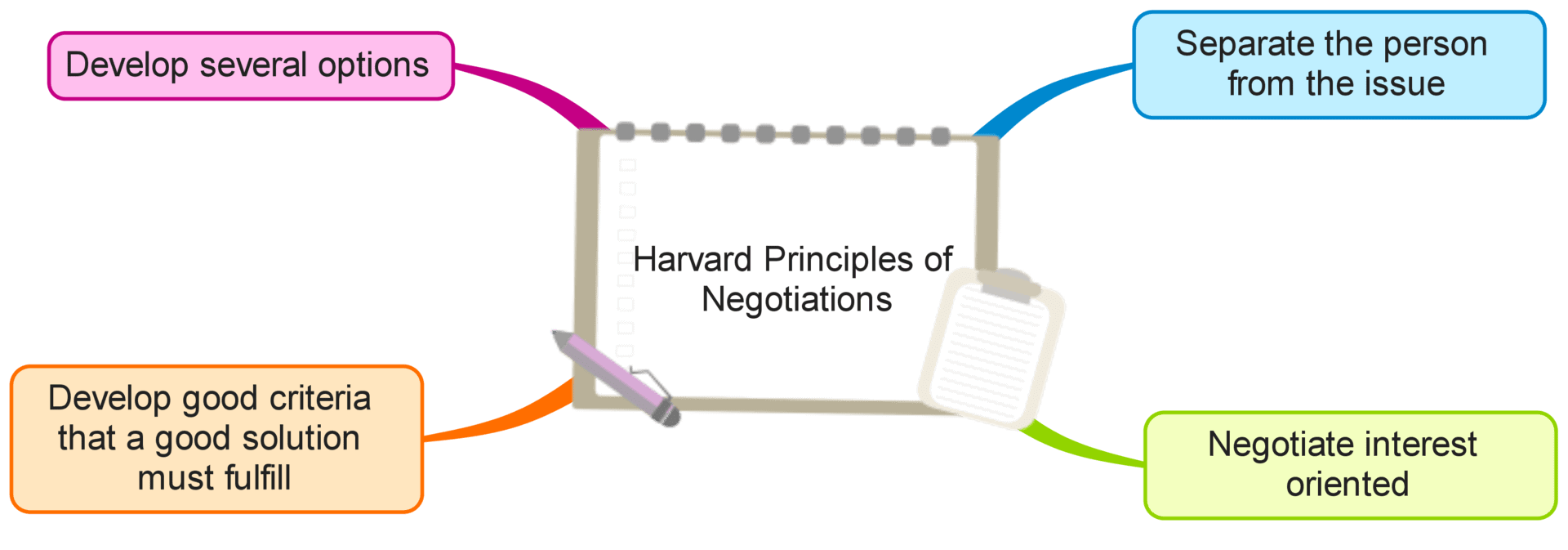
- ⌚ 8:19 What are the Four Principle of Negotiations of Harvard Model?
- ⌚ 8:29 What is benefit of apllying these principles in a negotiation?
POLL
Cast your vote in the poll.