


Bardzo mi przykro, ale lekcje na platformie The Blue Tree działają jedynie na komputerze lub tablecie.
Do zobaczenia na większym ekranie 🙂
Zespół The Blue Tree
back to HOME > Learning English > Everyday English >

THE BLUE TREE
Everyday English

CEFR B1
Intermediate
warm up
Answer these questions. Listen to some model answers. Read the transcipt.
| How have your dreams or ambitions changed since you were younger? |
TRANSCRIPT
When I was younger, I dreamed of having a well-paid office job in a big company and a stable lifestyle. I didn’t really think about the daily tasks or the pressure. Today, my ambitions are more specific. I’d like to work in a role where I can use my skills, learn continuously, and see clear results. I hope to feel satisfied with my work, not just busy or stressed.
| Is there something you still hope to achieve, even though it may take many years? |
TRANSCRIPT
Yes, I have a long-term goal that will probably take many years. I’d like to become very skilled in my job and feel confident in what I do every day. I hope to build a stable career step by step, even if progress is slow. I know I’ll make mistakes, but I see them as part of learning. For me, real success comes from patience and regular effort.
| Do you think it’s important to have clear ambitions, or is it better to stay flexible? |
TRANSCRIPT
I think having ambitions is important, but being too rigid can be risky. Life often changes in ways we don’t expect, and sometimes new opportunities appear by accident. I prefer to have a general direction rather than a fixed plan. This way, I still know what I’m aiming for, but I’m also open to adjusting my goals when my situation, priorities, or values change.

part one

TALKING ABOUT DREAMS, HOPES AND AMBITIONS
Read about people talking about their dreams, hopes and ambitions.
1️⃣ Marta
Well, right now I’m finishing my studies, so my main goal is to find a job that actually fits me. Not just any job. I’d like to work with people, maybe in HR or training. I hope I won’t rush into something just because I’m scared. I want to give myself a bit of time to figure things out.
2️⃣ Daniel
To be honest, my biggest ambition is to slow down a little. I’ve been working non-stop for years, always chasing the next promotion. Now I’m trying to get some balance back. I’d love to work fewer hours and focus more on my health. It’s not a dramatic dream, but it feels important right now.
3️⃣ Anna
I’ve always wanted to start my own small business. Nothing huge. Just something of my own. I’m still thinking it through, though. I can’t do it immediately because of my family and responsibilities, but I’m going to start preparing next year. I hope I won’t talk myself out of it like I did before.
4️⃣Tamara
Honestly, I’m still not sure what I want to do. And that worries me sometimes. But I hope to travel a bit before I settle down. Meet new people, see how others live. I think that once I get out of my comfort zone, things might become clearer. At least, that’s what I’m hoping for.
5️⃣ Ewa
I’m going to retire soon, so my dreams look a bit different now. I’m really looking forward to having more time for myself. I want to stay active, do some volunteering, maybe finally learn Italian. I don’t feel like life is slowing down — it’s just changing direction, that’s all.
6️⃣ Michał
My ambition is connected to my kids, actually. I hope I can give them a sense of security and good values. Career matters too, of course, but it’s not everything anymore. I’m aiming for stability rather than constant growth. I want to be present, not just busy all the time.

“Who Said This?” – Matching Task
Read the six interview answers again. Match each statement (A–J) with the person who said it.


part two
Grammar Overview
Study the grammar points below.
1️⃣ WANT / WOULD LIKE / WOULD LOVE
Use this language to talk about what you want in the future.
We use want when the desire is strong and direct. Would like sounds more polite and realistic, especially in conversation. Would love is used for big dreams or ambitions, often long-term and not guaranteed. These forms are common when people talk about personal goals, career plans, and life dreams.
Form
want + to + verb
would like + to + verb
would love + to + verb
Use
want → strong, direct desire
would like → polite, realistic aim
would love → strong dream, often long-term
Examples (general)
I want to change my career.
I’d like to work abroad one day.
I’d love to start my own business.
Examples (business)
I want to develop my leadership skills.
I’d like to take part in an international project.
I’d love to manage a team in the future.
2️⃣ TO BE GOING TO
Use this form to talk about plans you have already decided on.
When you say I’m going to…, it means the decision is made in your head. It is more concrete than a dream or a wish. We often use this form when we talk about near or medium-term plans, especially when we have already taken the first steps.
Form
be + going to + verb
Use
The decision is made. It’s more than a dream.
Examples (general)
I’m going to move to a bigger city next year.
She’s going to start a new course in September.
Examples (business)
We’re going to launch a new service soon.
I’m going to apply for a promotion this year.
3️⃣ PRESENT CONTINUOUS FOR FUTURE
Use this form for plans that are already arranged.
We usually mention a time or place, or another person. This form shows that the plan is fixed and organised, not just an idea. It is very common when talking about meetings, trips, and appointments.
Use
The plan is fixed, often with time and place.
Examples (general)
I’m meeting a friend tonight.
We’re travelling next weekend.
Examples (business)
I’m meeting the client on Friday.
We’re discussing the budget tomorrow.
4️⃣ HOPE
Use hope to talk about things you want to happen but cannot fully control.
Hope is often about the future, results, or other people’s decisions. We can hope for something positive, but we are not sure it will happen. This verb is often used when talking about work results, exams, health, or life changes.
Forms
hope + to + verb
hope (that) + present / will
❌ NOT: hope + going to
Examples (general)
I hope to find a better work-life balance.
I hope everything works out.
Examples (business)
We hope to increase sales next year.
I hope the project will be successful.
5️⃣ LOOKING FORWARD TO
Use this expression to show positive feelings about the future.
It focuses more on emotions than plans. We use it when something is already planned or expected and we feel happy or excited about it. Remember that the verb after to is always in the -ing form.
Form
look forward to + noun / verb-ing
Examples (general)
I’m looking forward to travelling again.
She’s looking forward to starting her new job.
Examples (business)
I’m looking forward to working with the new team.
We’re looking forward to meeting you in person.
6️⃣ CAN / CAN’T
Use can and can’t to talk about what is possible at the moment.
They help explain why a plan can happen or why it must wait. This language is useful when people talk about limits, responsibilities, money, time, or personal situation.
Use
Explains why plans are possible or not.
Examples
I can change jobs next year.
I can’t move abroad right now.
We can’t expand yet because of the budget.
7️⃣ LIKE / ENJOY
Use like and enjoy to talk about general preferences and activities you find pleasant.
We usually use these verbs to describe things we do regularly or things we feel positive about in general, not specific future plans. After like and enjoy, we use the -ing form. This structure helps show the difference between habits and one-time plans.
Helpful contrast
I like working with people. (general preference)
I’d like to work with you on this project. (specific plan or wish)
General context
I like learning new languages in my free time.
- She likes reading before going to bed.
He enjoys travelling, even if it’s sometimes tiring.
Work / business context
I like working in a structured environment.
She enjoys solving problems and finding solutions.
We like collaborating with international teams.
vocabulary booster
Go through some useful language related to dreams, hopes, ambitions and plans.

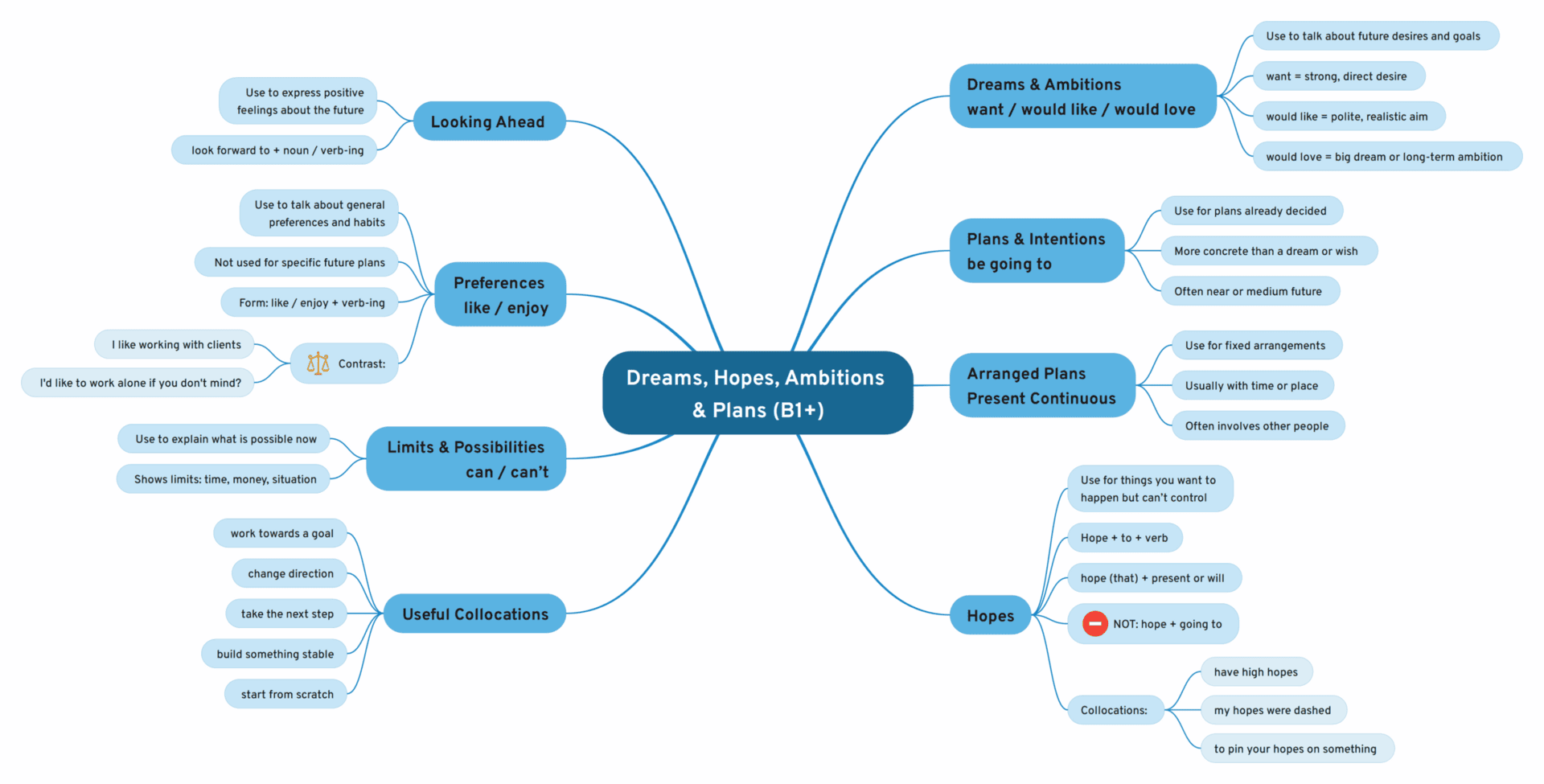
QUICK OVERVIEW
Study this useful mind-map of grammar and language points from this lesson.
part three
multiple choice quiz
Do the quiz below.
Discussion & Speaking Questions
Discuss these questions
OVER TO YOU
Prepare and present your own answer to the question the interviewer asked the people at the beginning of the lesson.
COMMENTS
Submit your views and opinions below.
0 Comments