


Bardzo mi przykro, ale lekcje na platformie The Blue Tree działają jedynie na komputerze lub tablecie.
Do zobaczenia na większym ekranie 🙂
Zespół The Blue Tree
back to HOME > Personal Development > Personal Productivity >

THE BLUE TREE
Personal
Productivity

CEFR C1
Advanced


warm up
Answer the questions below. Then listen to some model answers. Read the transcript.
| Does your company offer career development opportunities? Are you taking advantage of them? |
TRANSCRIPT
Absolutely, my company offers a ton of career development opportunities. I work at a bank, and they really invest in our growth. I’m 48 and have been with the company for over 20 years. I’ve taken advantage of various training programs, which have helped me stay updated with industry changes and new technologies. Plus, having a mentor has been invaluable. My mentor has guided me through some tough career decisions and helped me set and achieve my professional goals. Honestly, these programs have played a big part in my career progression.
Who can help you get ahead in your career the most? |
TRANSCRIPT
In my experience, the person who can help you get ahead the most is a good mentor. My mentor at the bank has been crucial to my career growth. He’s provided guidance, shared his experiences, and connected me with the right people. Besides a mentor, having a supportive manager also makes a big difference. My manager encourages me to take on new challenges and supports my professional development. Building a strong network within the company is essential too. Colleagues can offer advice, share opportunities, and give feedback that helps you improve.
| Is it useful to have a plan for one’s career? Do you have such a plan or a strategy? |
TRANSCRIPT
Definitely, having a plan for your career is really useful. It gives you direction and helps you focus on your goals. I’ve always had a rough plan for where I wanted to go in my career. Over the years, I’ve adjusted it based on new opportunities and changes in the industry. Right now, my strategy includes continuing my education through the bank’s training programs, seeking out challenging projects, and regularly checking in with my mentor to stay on track. Having this plan has kept me motivated and on course, even when things get tough.


part one

KEY LANGUAGE
Go through the flashcards below. Make sure you understand all the words and expressions.

VIDEO
Watch the first part of the video.

COMPREHENSION
Answer these questions. Refer to the information from the video.
| 1 | 00:35 | What is a “roundtable”? |
| 2 | 00:48 | How were people divided during this kind of evaluative process? |
| 3 | 00:54 | What was the consequence of being put in one of the buckets? |
| 4 | 01:17 | What three roles of people at the roundtable did Carla mention? |
| 5 | 01:40 | Why was Carla excited to be at this meeting for the first time? |
| 6 | 01:58 | How do many companies advertise their culture? |
| 7 | 02:05 | How does a meritocratic organisation work in theory? |

part two
VIDEO
Watch the next part.
COMPREHENSION
Answer these questions. Refer to the information from the video.
| 1 | 02:58 | How were Joe, Mary and Arnold assessed? |
| 2 | 03:17 | What question came to Carla’s mind at that moment? |
| 3 | 03:28 | What did she realize about the idea of a meritocratic organisation? |
| 4 | 03:38 | What prevents the meritocratic process from being objective? |
| 5 | 04:00 | What did she realize about her own situation? |

part tHREE
KEY LANGUAGE
Go through the flashcards below. Make sure you understand all the words and expressions.
VIDEO
Watch the next part of the video.
COMPREHENSION
Answer these questions. Refer to the information from the video.
| 1 | 04:08 | What did Carla want to know about this person who should speak on her behalf? |
| 2 | 04:30 | Why shouldn’t this person be called “a mentor”? |
| 3 | 05:20 | What name did she finally come up with for this person? |
| 4 | 05:32 | What questions came to her mind at that point? |

part four
KEY LANGUAGE
Go through the flashcards below. Make sure you understand all the words and expressions.
VIDEO
Watch the next part of the video.
COMPREHENSION
Answer these questions. Refer to the information from the video.
| 1 | 05:45 | Why do we need a sponsor? |
| 2 | 06:02 | Why is subjectivity an issue? |
| 3 | 06:18 | What do we have to make sure as regards our sponsors? |
| 4 | 06:45 | What is the ideal, if unrealistic, scenario of getting a sponsor? |

part five
VIDEO
Watch the next part of the video.
COMPREHENSION
Answer these questions. Refer to the information from the video.
| 1 | 07:01 | What are the two types of currencies? |
| 2 | 07:11 | How do we earn performance currency? |
| 3 | 07:52 | What are the three benefits of the performance currency? |
| 4 | 08:05 | Why may sponsors be attracted to a person who earns performance currency? |
| 5 | 08:19 | What kind of power can we exercise if we are looking for a sponsor? |

part six
VIDEO
Watch the next part of the video.
COMPREHENSION
Answer these questions. Refer to the information from the video.
| 1 | 08:28 | What type of currency becomes most important at this point? |
| 2 | 08:36 | How do we earn relationship currency? |
| 3 | 09:06 | What can we invest and what should our goal be? |

part sEVEN
KEY LANGUAGE
Go through the flashcards below. Make sure you understand all the words and expressions.
VIDEO
Watch the next part of the video.
COMPREHENSION
Answer these questions. Refer to the information from the video.
| 1 | 09:48 | What three characteristics should a good sponsor have? |
| 2 | 10:28 | How can you approach your sponsor? What might we say? |
| 3 | 11:18 | What are the three reasons they might say no to your request? |
| 4 | 11:33 | Why is getting rejected by your sponsor valuable information for you? |
| 5 | 11:54 | Why is it critical to have a sponsor in any organization? |
| 6 | 12:01 | What question should we ask ourselves regularly? |

part EIGHT
video
Watch the last part of the video.
COMPREHENSION
Answer these questions. Refer to the information from the video.
| 1 | 12:23 | Who does Carla address at the end? |
| 2 | 12:34 | What reponsibility do people at the table have? |
| 3 | 12:45 | What might these people worry about? |
| 4 | 12:50 | What does Carla encourage them to do? |
| 5 | 12:58 | What did she learn during her time on Wall Street? |

POLL
Cast your vote in the poll.


DISCUSSION
Dialogue
Friday evening. Sven and Pete are leaving the office. Sven has just found out he didn’t get the promotion he was hoping for.
Read or role-play this dialogue.
Sven:
I can’t believe it. I really thought this was my moment. I’ve worked so hard this year… and still nothing.
Pete:
I’m sorry, Sven. That must hurt. Did they give you any specific feedback?
Sven:
Not much. They said I’m reliable and solid, but they went with someone “more visible.” I don’t even know what that means.
Pete:
It probably means what Carla Harris talks about — performance currency isn’t enough. You also need relationship currency and visibility.
Sven:
So doing a good job isn’t enough?
Pete:
In theory it should be. In reality, someone has to speak for you in those roundtable meetings. If no one advocates for you, your name might not even come up strongly enough.
Sven:
That’s frustrating. I thought merit would speak for itself.
Pete:
That’s the myth. The real question is: who is going to speak on your behalf? Do you have a sponsor?
Sven:
Not really. I have a good relationship with my manager, but I’ve never asked anyone to support me strategically.
Pete:
Maybe that’s your next step. Identify someone influential. Show them your results. Ask for honest feedback. And make sure more people know what you’re working on.
Sven:
So I need to be more intentional?
Pete:
Exactly. Keep performing — that’s your foundation. But build relationships. Increase your visibility. And next time, don’t just hope you’ll be promoted. Prepare for the roundtable.
Sven:
You know what? That actually makes me feel better. At least now I have a strategy.
Pete:
That’s the spirit. This wasn’t the end of your story. It was just data.
OVER TO YOU
Discuss these questions.
 | In large organisations, what makes a person “visible” during promotion decisions? |
| Why might strong performance alone not guarantee career advancement? |
| What role can a sponsor play in professional growth? |
| How can someone build relationship currency without seeming artificial or manipulative? |
| How can rejection from a promotion become useful information for future growth? |
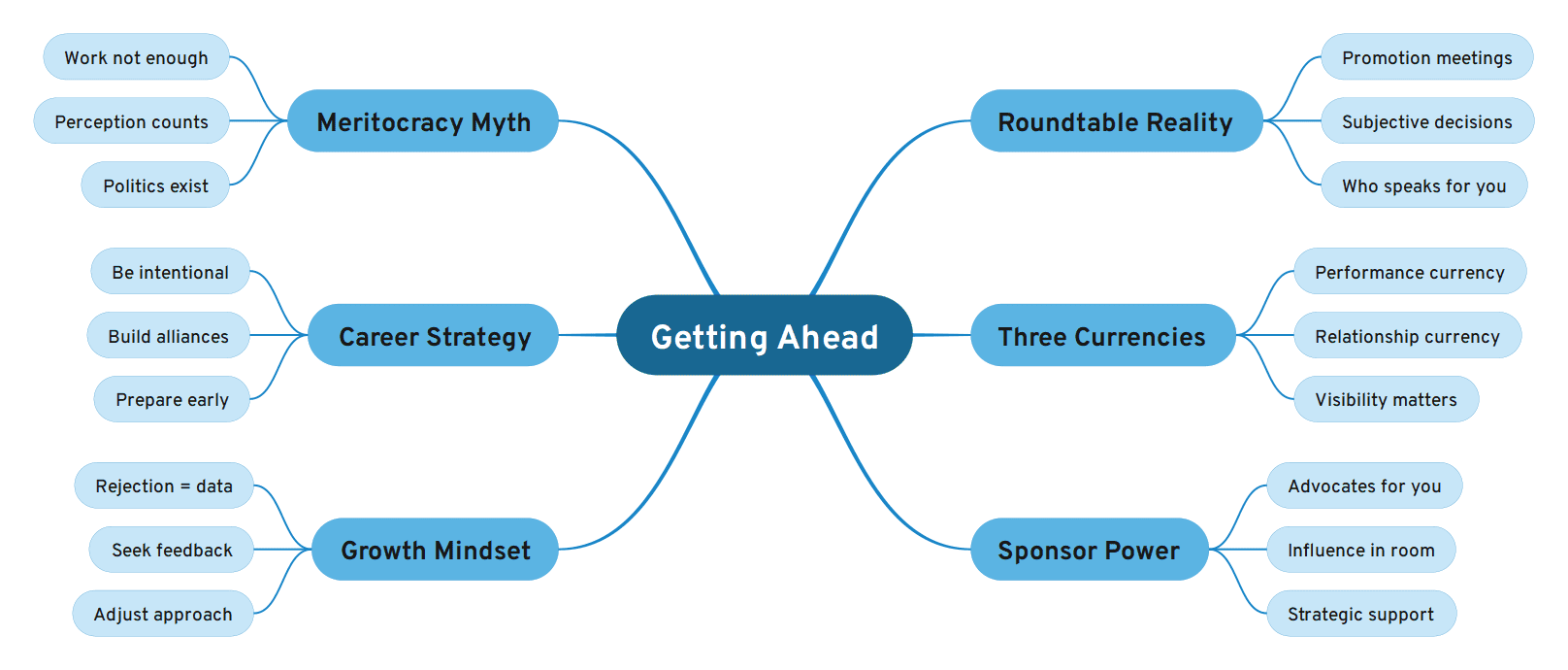
MIND-MAP
Use the mind-map below to have a more in-depth conversation about this topic.

lesson glossary
MY ENGLISH DICTIONARY
Add new and interesting words from this lesson to your English dictionary.
Store your words and expressions in this handy dictionary. You can create groups and play games based on your entries. There is also a practical importing feature.
You must log in to see content.
COMMENTS
What do you think of the idea of a sponsor? How do you feel about performance and relationship currencies? Has anybody played a role of a sponsor in your career?
Share your views and experience here.
0 Comments