


Bardzo mi przykro, ale lekcje na platformie The Blue Tree działają jedynie na komputerze lub tablecie.
Do zobaczenia na większym ekranie 🙂
Zespół The Blue Tree

THE BLUE TREE
Culture

CEFR B2
Upper
Intermediate

warm up
Answer the questions below. Then listen to some model answers.
| Which cultural differences do you notice most quickly when you meet new people? |
TRANSCRIPT
I usually notice differences in communication style and attitudes toward authority first. Some people speak very openly and question ideas freely, while others are more careful and respectful of hierarchy. I also pay attention to how comfortable people are with uncertainty and change. These small signals often reveal deeper cultural patterns and help me understand how to interact more effectively with others.
| Why do cultural differences sometimes lead to misunderstandings, even when people have good intentions? |
TRANSCRIPT
Cultural differences often lead to misunderstandings because people interpret behaviour through their own norms and expectations. What seems polite, honest, or normal in one culture may appear rude or strange in another. Even when intentions are positive, different communication styles, attitudes toward authority, or views on emotions can create confusion. Understanding that these differences exist helps reduce unnecessary tension and encourages more patient and open communication.
| Do you think learning about cultural differences is more important today than in the past? Why or why not? |
TRANSCRIPT
Yes, I think learning about cultural differences is more important today than ever before. People work, study, and communicate internationally on a daily basis, often online. Without cultural awareness, small misunderstandings can quickly grow into bigger problems. Learning how cultures differ helps people cooperate better, avoid conflict, and build trust in both professional and personal relationships.

part one

READING
Read a short article about diversity and tolerance and discuss the questions that follow.
🌍 Who Was Geert Hofstede?
Geert Hofstede was a Dutch psychologist and researcher who was interested in one big question:
Why do people from different countries think and behave differently?
In the 1970s, he worked with thousands of employees from one international company in many countries. He noticed that people from different cultures reacted differently to the same situations at work. This gave him the idea to study culture in a systematic way.
Thanks to his work, today we can compare national cultures in a simple and clear way.
🌍 What Is the Culture Factor Research?
The research is often called the Hofstede Cultural Dimensions Model and is published today by Hofstede Insights.
This model explains culture using six simple areas, called dimensions. These dimensions show how societies differ in things like:
- power and authority
- individual freedom
- ambition and competition
- dealing with rules and uncertainty
- thinking about the future
- enjoying life
Each country gets a score in every category. These scores help us understand:
- why people work differently
- why communication styles are different
- why some countries prefer rules and others prefer freedom
🎓 Why Is This Research Useful?
Hofstede’s research helps us:
- understand people from other countries
- avoid misunderstandings in international work and travel
- communicate more politely and effectively
- see that “different” does not mean “wrong”
It shows us that behind language, there is also culture — and culture strongly influences how we think, speak, work, and live.
✅ In One Simple Sentence:
Hofstede’s research helps us understand how national culture shapes people’s behavior, values, and communication.

COMPREHENSION
Answer these questions about the article.
 | 1. Who was Geert Hofstede, and what was he interested in studying? |
| 2. What observation did Hofstede make while working in an international company? |
| 3. What is the main goal of the Culture Factor (Cultural Dimensions) research? |
| 4. What kinds of cultural differences does the model help to explain? |
| 5. Why is Hofstede’s research useful for students and people working internationally? |
part two
power distance
Read about the six dimensions of the Culture Factor.
This dimension shows how people feel about power and authority.
Do people accept big differences between the boss and the employee?
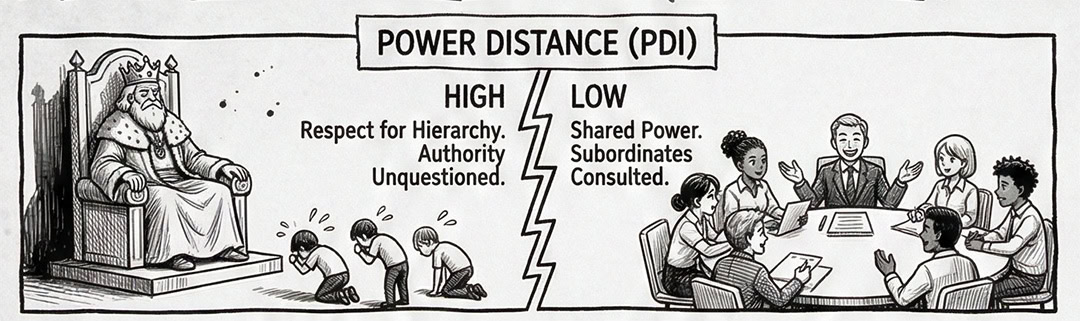
🔴 High Power Distance
(example: Malaysia)
People:
- accept that some people have much more power
- rarely question the boss
- expect clear hierarchy
- show respect through titles and formality
✅ In simple words:
“The boss decides, and we follow.”
🟢 Low Power Distance
(example: Denmark)
People:
- believe in equal treatment
- feel comfortable sharing opinions at work
- expect to be consulted
- are less formal with the boss
✅ In simple words:
“We all have a voice.”
Individualism vs. Collectivism
Dimension #2
This dimension shows how strong people’s connection is to groups and family.
Is identity based on “I” or “we”?
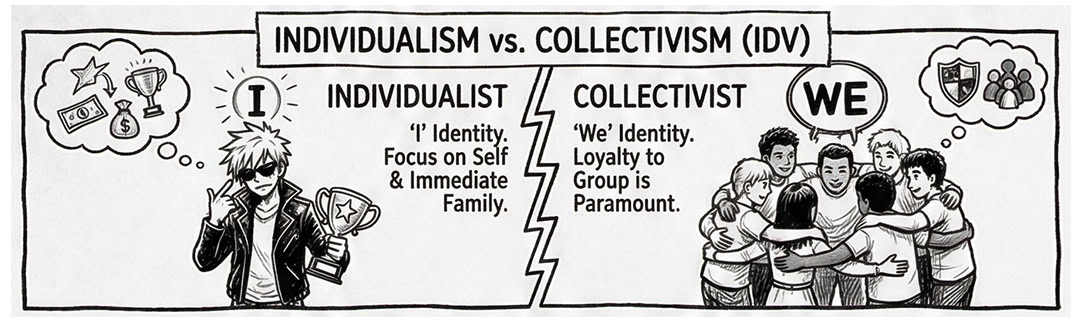
🟠 Individualist Culture
(example: Australia)
People:
- focus on personal goals
- value independence
- take care mainly of themselves and close family
- say what they think directly
✅ In simple words:
🔵 Collectivist Culture
(example: China)
People:
- strongly value family and group
- show loyalty to the group
- avoid open conflict
- think first about what is good for everyone
✅ In simple words:
“We are responsible for each other.”

MOTIVATION TOWARDS ACHIEVEMENT AND SUCCESS
Dimension #3
This dimension shows what people find more important in life:
success and competition or cooperation and balance.
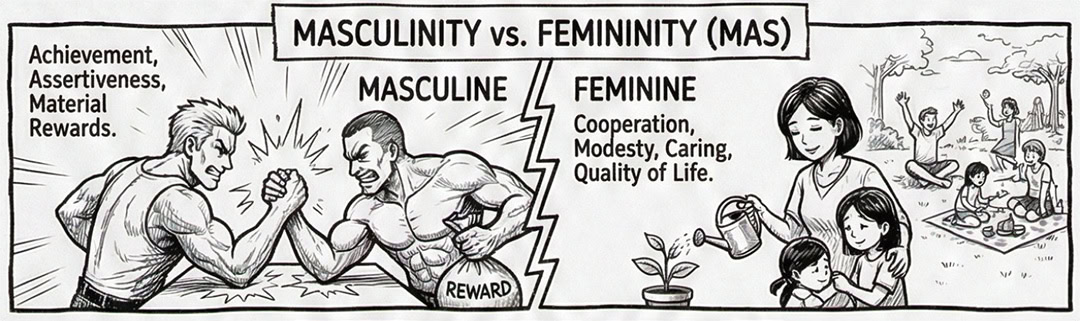
🔴 Masculine Culture
(example: Japan)
People:
- focus on achievement and success
- like competition
- respect strong leaders
- value money and career
✅ In simple words:
“Winning and success matter most.”
🟢 Feminine Culture
(example: Sweden)
People:
- care about quality of life
- value cooperation
- support equality
- care for others and weak people
✅ In simple words:
“Life balance and people matter most.”

UNCERTAINTY AVOIDANCE
Dimension #4
This dimension shows how people deal with the unknown and surprises.
Do they like strict rules, or are they more relaxed about change?
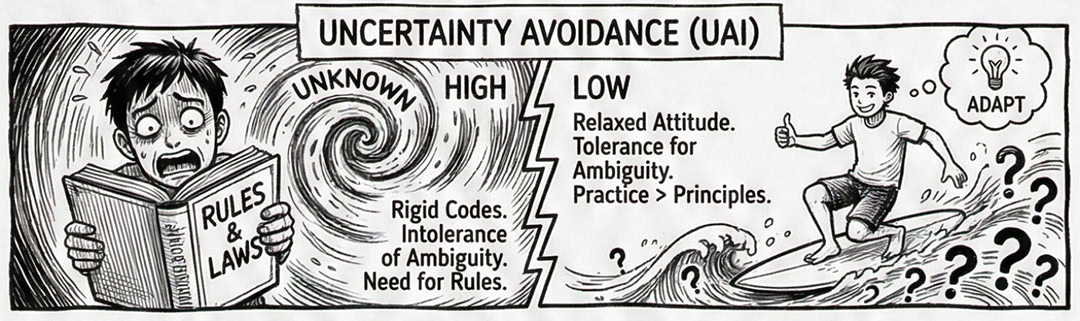
🔴 High Uncertainty Avoidance
(example: Greece)
People:
- feel uncomfortable with uncertainty
- like clear rules and plans
- avoid risks
- feel safer when everything is organized
✅ In simple words:
“We need rules to feel safe.”
🟢 Low Uncertainty Avoidance
(example: Singapore)
People:
- accept change easily
- are okay with new situations
- take risks more easily
- focus on what works in practice
✅ In simple words:
“Let’s see what happens — we can adapt.”

LONG-TERM VS SHORT-TERM ORIENTATION
Dimension #5
This dimension shows how people think about time:
Do they focus more on the future, or on the present and the past?
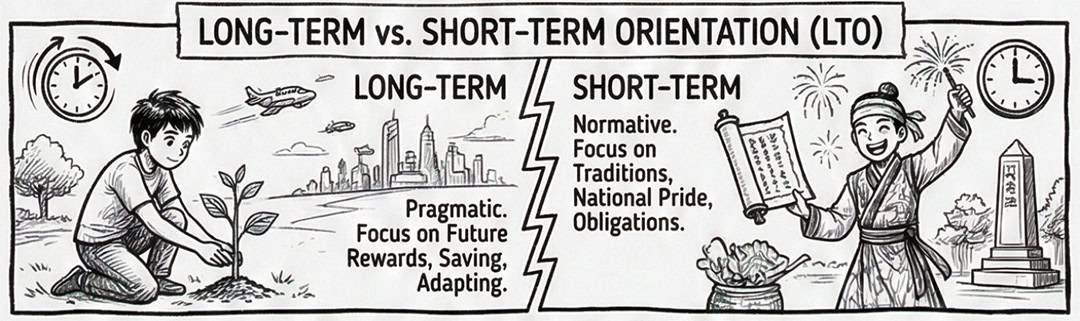
🟢 Long-Term Orientation
(example countries: South Korea, Germany)
People with a long-term way of thinking:
- care a lot about the future
- like to save money
- work patiently for long-term success
- accept that change is normal
- believe that effort today brings rewards later
✅ In simple words:
“Let’s think ahead and prepare for the future.”
🔵 Short-Term Orientation
(example countries: Nigeria, USA)
People with a short-term way of thinking:
- focus more on the present and the past
- strongly respect traditions
- feel proud of their nation and values
- want quick results
- care about social rules and expectations
✅ In simple words:
“Let’s respect tradition and focus on today.”

Indulgence vs Restraint
Dimension #6
This dimension shows how much people allow themselves to enjoy life.
Is it okay to have fun — or should desires be controlled?
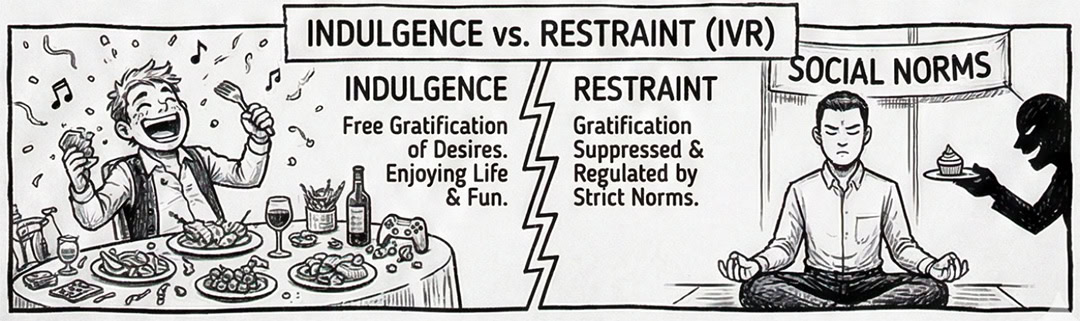
🟢 Indulgent Culture
(example: Mexico)
People:
- enjoy free time and fun
- spend money on pleasure
- show emotions openly
- believe life should be enjoyed
✅ In simple words:
“Enjoy life while you can.”
🔵 Restrained Culture
(example: Russia)
People:
- control their desires
- feel that life is about duty
- limit fun and pleasure
- believe strict rules are important
✅ In simple words:
“Duty comes before pleasure.”
part three
your personal cuture factor
Do this poll below.


LISTENINIG
Listen to some people commenting on their profile.
| Alita’s profile |
TRANSCRIPT
When I read my cultural profile, I felt that it described me quite accurately. I especially agreed with the idea that I value cooperation and long-term thinking more than competition or quick results. That really fits how I work with people and make decisions.
However, I had some doubts about the point on hierarchy. The profile suggests that I’m quite comfortable with structure and authority, but I think this depends a lot on the situation. I respect expertise, but I also need space to question and discuss decisions. Overall, though, the assessment helped me reflect on my cultural preferences in a meaningful way.
| Pete’s profile |
TRANSCRIPT
I found the cultural profile interesting and mostly accurate. It made sense to me that I’m described as someone who prefers flexibility and doesn’t feel stressed by uncertainty. I also agreed with the focus on relationships and shared responsibility, which I see as important in both work and private life.
The only part I’m not fully convinced about is the suggestion that I enjoy indulgence and pleasure quite strongly. I think I value balance more than enjoyment itself. Still, the profile helped me see patterns in how I approach decisions and interact with others.
| Bradford’s profile |
TRANSCRIPT
Overall, I felt that the profile captured my way of thinking quite well. I agreed with the idea that I’m more future-oriented and patient, especially when it comes to long-term goals. I also recognized myself in the description of being cooperative rather than competitive.
That said, I was a bit surprised by the low score on uncertainty avoidance. I do like flexibility, but in important matters I still need some structure and clear rules. Even so, reading the profile encouraged me to reflect more deeply on how culture shapes my behaviour.
YOUR OWN PROFILE
Create your own profile. Use the language from the model answers.
part four
Play this game based on The Culture Factor Dimensions.
COMMENTS
Share your views and experience here.
0 Comments