


Bardzo mi przykro, ale lekcje na platformie The Blue Tree działają jedynie na komputerze lub tablecie.
Do zobaczenia na większym ekranie 🙂
Zespół The Blue Tree
back to HOME > Personal Development > Personal Productivity >

THE BLUE TREE
Personal
Productivity

CEFR C1
Advanced

warm up
Answer the questions below.
| Are you feeling overwhelmed with work at times? |
TRANSCRIPT
Yeah, I do feel overwhelmed with work sometimes, especially when there’s so much to get done and not enough time. It’s hard not to get caught up in trying to do everything, but I’m learning to focus on what’s most important and let go of the rest. I’m trying to be kinder to myself and accept that I can’t do it all.
| How long is your bucket list? What are some of the items on it? |
TRANSCRIPT
My bucket list isn’t too long, but it’s full of things that really matter to me. Some of the items include traveling to Japan, writing a book, and maybe even learning a new language. I’ve realized it’s more about quality than quantity—choosing a few meaningful goals and really focusing on them rather than spreading myself too thin.
| Do you like being really good at what you take-up? |
TRANSCRIPT
I do like being really good at what I take up, but I’ve also learned that perfection isn’t always necessary. Sometimes, it’s better to aim for ‘good enough’ so I can spend my time on what matters most. It’s about finding a balance between doing things well and not letting the pursuit of perfection hold me back.

part one

KEY LANGUAGE
Go through the flashcards below. Make sure you understand all the words and expressions.

VIDEO
Watch the first part of the video.

COMPREHENSION
Answer these questions. Refer to the information from the video.
- ⌚ 00:16 How long is the average life?
- ⌚ 00:49 Why do we take more responsibilites than we can handle?
- ⌚ 01:06 What do pebbles and rocks illustrate?
- ⌚ 01:18 What is Existential Overwhelm?
- ⌚ 01:38 What is the Efficiency Trap?
- ⌚ 01:57 How do people caught in Existential Overwhelm and The Efficiency Trap feel?
part two
KEY LANGUAGE
Go through the flashcards below. Make sure you understand all the words and expressions.
VIDEO
Watch the second part of the video.
COMPREHENSION
Answer these questions. Refer to the information from the video.
- ⌚ 02:18 What did Warren Buffet’s pilot ask him about?
- ⌚ 02:36 What did Mr Buffet tell him to do?
- ⌚ 02:51 What does the modern world supply us with?
- ⌚ 03:06 How does wanting to do many things lead to Existential Overwhelm?
- ⌚ 03:59 How can we get rid of Existential Overwhelm?
- ⌚ 04:34 What is the bonus benefit of having an Open and Closed lists?
part three
KEY LANGUAGE
Go through the flashcards below. Make sure you understand all the words and expressions.
VIDEO
Watch the third part of the video.
COMPREHENSION
Answer these questions. Refer to the information from the video.
- ⌚ 05:31 What is strategic underachievement and how can we practise it?
- ⌚ 05:56 What effect will being good enough have?
- ⌚ 06:16 What do you think of Jon Acuff’s quote?
“When you decide in advance what things you are going to bomb, you remove the sting of shame.”
part four
KEY LANGUAGE
Go through the flashcards below. Make sure you understand all the words and expressions.
VIDEO
Watch the fourth part of the video.
COMPREHENSION
Answer these questions. Refer to the information from the video.
- ⌚ 06:41 How can we enrigh the remaining weeks?
- ⌚ 06:49 What assumptions should we make?
- ⌚ 07:35 What is the advantage of adopting this mindset?
POLL
Cast your vote in the poll.
DISCUSSION
Dialogue
Alita & Pete talk about Four Thousand Weeks by Oliver Burkeman.
Read or role-play their dialogue.
Alita:
You know, I didn’t expect this book to hit me so much. My workmate Mario is really into Burkeman’s ideas. He even showed me his diary last week.
Pete:
His diary? That already sounds a bit extreme. What was so special about it?
Alita:
It wasn’t packed with tasks. Quite the opposite. He had an “open list” and a “closed list.” The closed one was surprisingly long—things he consciously decided not to do. It made his days look calmer, almost intentional.
Pete:
I don’t know… It sounds like giving up before you even try. Aren’t we supposed to be efficient and get more done?
Alita:
That’s exactly the trap Burkeman talks about. Mario said that the more efficient he used to be, the more work he attracted. Now he accepts he can’t do everything in his four thousand weeks, so he chooses more carefully. It felt… honest.
Pete:
Hmm. I admit I’m always chasing that feeling of being “on top of things,” and it never really comes. My to-do list just keeps growing.
Alita:
Same here. What really stayed with me was the idea of treating some moments as if they might be the last time. Mario wrote things like “last time walking my daughter to school.” That really stopped me.
Pete:
Okay… that’s actually powerful. Maybe embracing limits isn’t laziness after all. Maybe it’s a way of paying better attention.
Alita:
Exactly. It’s not about doing less for the sake of it—it’s about doing what matters, and accepting the trade-offs.
Pete:
Alright, you’ve convinced me more than I expected. I might not start a diary tomorrow, but I could start by deciding what not to worry about.
Alita:
That already sounds very Burkeman-like.
OVER TO YOU
Discuss these questions.
 | Have you ever felt that the more efficient you became, the more work you had? Can you give an example from your job or daily life? |
| How do you usually decide what goes on your to-do list? Would it be difficult for you to create a “closed list” of things you choose not to do? |
| What do you think about the idea of “strategic underachievement”? Are there areas in your life where “good enough” would actually be better than perfect? |
| Have you ever experienced a moment that felt special only after it had passed? How could “last time” thinking change the way you experience such moments? |
| If you truly accepted that your time is limited, what would you do differently next week? Is there one small change you could realistically make? |
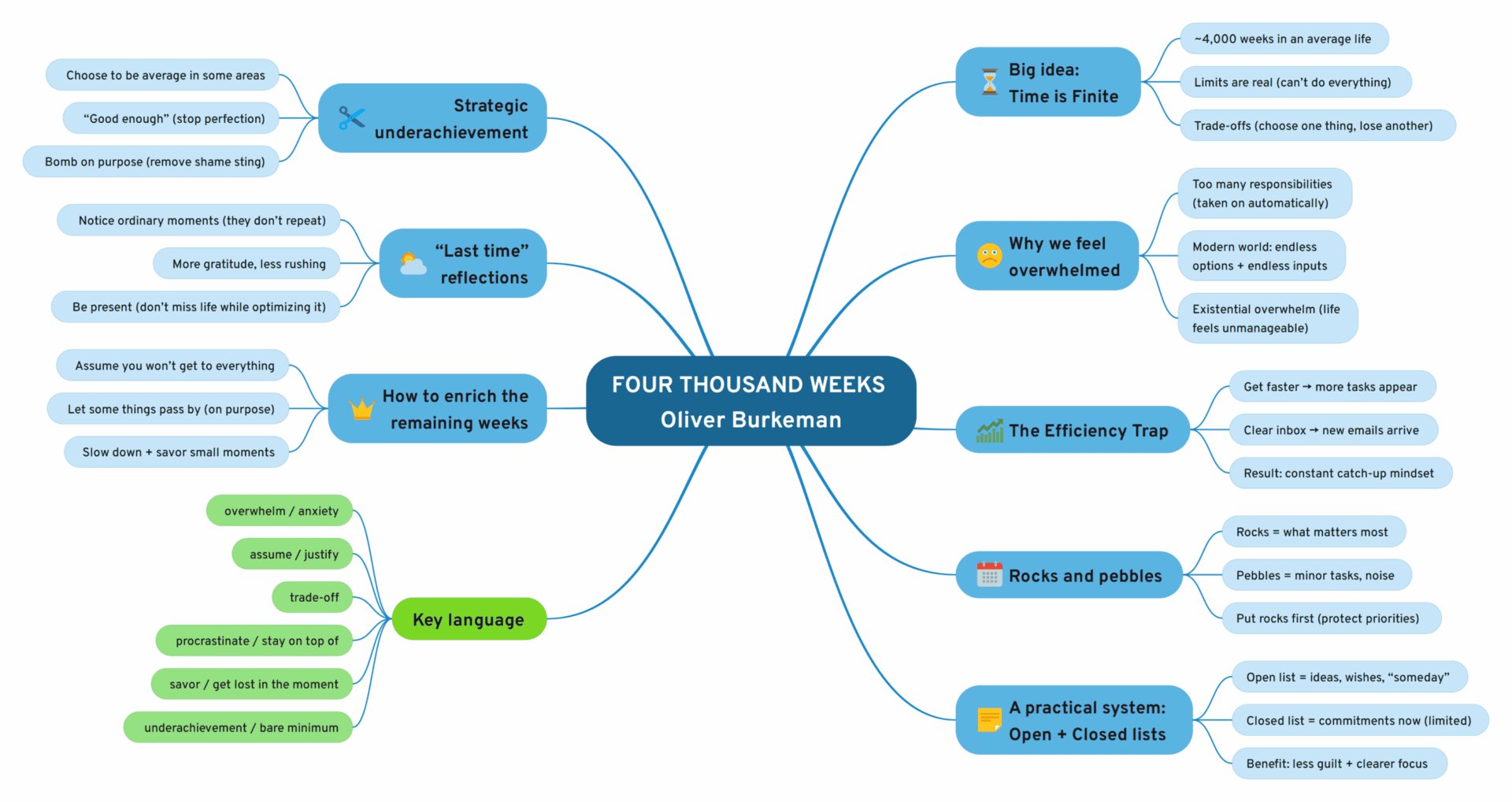
MIND-MAP
Use the mind-map below to have a more in-depth conversation about this topic.
COMMENTS
What do you think of the ideas presented in this lesson?
Share your views and experience here.
0 Comments