


Bardzo mi przykro, ale lekcje na platformie The Blue Tree działają jedynie na komputerze lub tablecie.
Do zobaczenia na większym ekranie 🙂
Zespół The Blue Tree
back to HOME > Personal Development > Personal Productivity >

THE BLUE TREE
Personal
Productivity

CEFR B2
Upper
Intermediate

warm up
Answer the questions below. Then listen to the model answers and think how you could improve yours.
| Do you think working very hard can sometimes be a good thing, even if it looks unhealthy from the outside? |
TRANSCRIPT
Yeah, I think it can be. If you’re a striver and you really want an edge, you sometimes work intensely, especially for a short time. That doesn’t feel wrong to me. Problems start when people keep doubling and tripling down on work and forget to stop. The underlying problem isn’t effort — it’s not knowing when enough is enough.
| Do you agree that ambition usually leads to neglecting personal life? |
TRANSCRIPT
I wouldn’t say usually. A lot of ambitious people seek success and still manage their relationships well. Working hard doesn’t automatically mean you neglect your family or your marital relationship. For me, the bottom line is balance. It really comes down to how you deal with pressure and whether work starts to substitute for everything else.
| What role do friends play in your life? |
TRANSCRIPT
Friends keep me grounded. When work starts to take over, they help me see things more clearly and not take myself too seriously. I value friends who can listen without judging and tell me the truth, even when it’s uncomfortable. Spending time with them reminds me that success feels empty if you have no one to share it with.

part one

KEY LANGUAGE
Go through the flashcards below. Make sure you understand all the words and expressions.

VIDEO
Watch the first part of the video.

COMPREHENSION
Answer these questions. Refer to the information from the video.
| 1 | 00:11 | What is Arthur Brooks interested in? |
| 2 | 00:17 | How does he call people who want an edge? |
| 3 | 00:27 | What do strivers open themselves up for? |
| 4 | 00:53 | How do workaholics behave? |
| 5 | 00:55 | What did he find in his research about workaholism? |
part two
KEY LANGUAGE
Stude these words. Make sure you understand them well before you watch the video.
VIDEO
Watch the second part of the video.
COMPREHENSION
Answer these questions. Refer to the information from the video.
| 1 | 01:14 | What is the primary addiction according to Arthur Brooks? |
| 2 | 01:09 | What is the definition of success? |
| 3 | 01:37 | How does reaching success make people feel? |
| 4 | 01:57 | Which brain chemical drives motivation and makes achievement feel rewarding? |
part three
KEY VOCABULARY
Go through this set of flashcards.
VIDEO
Watch the third part of the video.
COMPREHENSION
Answer these questions. Refer to the information from the video.
| 1 | 02:05 | What leads to work addiction? |
| 2 | 02:16 | What do people reduce themselves to? |
| 3 | 02:31 | What do people often focus on instead of who they are as a person? |
part four
KEY VOCABULARY
Go through this set of flashcards.
VIDEO
Watch the forth part of the video.
COMPREHENSION
Answer these questions. Refer to the information from the video.
| 1 | 02:39 | What does one need to do when they exhibit workaholic behaviour? |
| 2 | 03:02 | What kind of team do workaholics need to build? |
| 3 | 03:10 | What question should we ask our friends or family? |
| 4 | 03:28 | Why is loving work a bad idea? |
| 5 | 03:58 | What does Brooks want us to cultivate? What does he mean by that? |
| 6 | 04:08 | What can married people do? |
part five
KEY VOCABULARY
Go through this set of flashcards.
VIDEO
Watch the next part of the video.
COMPREHENSION
Answer these questions. Refer to the information from the video.
| 1 | 04:52 | Why didn’t Arthur spend more time with his children? |
| 2 | 04:33 | What does he mean when he says that his children “got their revenge”? |
| 3 | 04:59 | What’s the difference between real and deal friends? |
| 4 | 05:11 | What substitutes for work? |
| 5 | 05:12 | What is happiness according to Brooks? |
part six
KEY VOCABULARY
Go through this set of flashcards.
VIDEO
Watch the last part of the video.
COMPREHENSION
Answer these questions. Refer to the information from the video.
| 1 | 05:28 | What is Arthur’s first rule of thumb to fight workaholism? |
| 2 | 05:51 | How many friends do we need? |
| 3 | 06:15 | Who are “strivers'” best friends? What does Brooks think about it? |
| 4 | 06:23 | What might investing in a relationship mean? |
POLL
Cast your vote in the poll below.

DISCUSSION
Dialogue
Alita and Pete are talking after watching a short video about workaholism and success. They reflect on ambition, balance, and personal choices.
Read or role-play this dialogue.
Alita: The video really made me think. Sometimes I work intensely, especially when I want an edge at work. It feels motivating at first, but I’m not sure it’s always healthy.
Pete: I get that. A lot of people are natural strivers and really seek success. That definitely has merit, especially early in your career.
Alita: True, but I’ve noticed that work can slowly substitute for other things. When that happens, people start to neglect friends, family, and even themselves.
Pete: Yes, and I think the underlying problem is how people define success. If they reduce themselves only to results and performance, work becomes everything.
Alita: Exactly. I still want to excel, but not at the cost of my personal life. I don’t want to feel guilty every time I take a break.
Pete: That makes sense. Working hard is fine, but it shouldn’t replace relationships or rest.
Alita: So maybe the real challenge is learning when to push and when to stop.
Pete: I agree. The bottom line is that work should support life, not replace it.
OVER TO YOU
Discuss these questions.
 | Workaholism often looks like ambition at first. Where is the line between the two? |
| Focusing only on results can change how people see themselves. Is this healthy? |
| Praise and rewards can motivate people. When can they become a problem? |
| Success can feel exciting but still leave people unsatisfied. Why might this happen? |
| A balanced life usually includes work, relationships, and something deeper. Which part is most often neglected? |
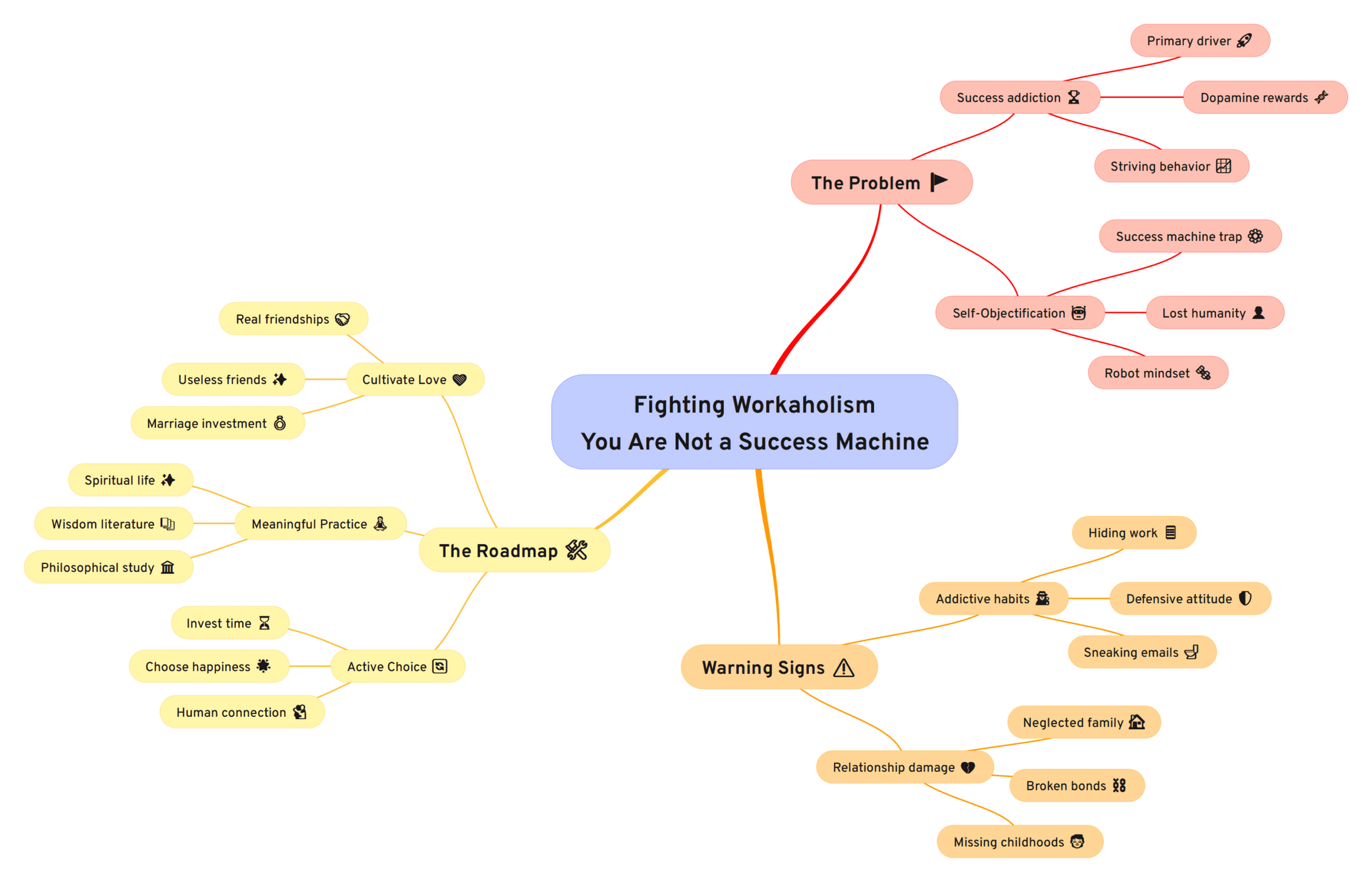
MIND-MAP
Use the mind-map below to have a more in-depth conversation about this topic.
COMMENTS
Share your views and experience here.
0 Comments