


Bardzo mi przykro, ale lekcje na platformie The Blue Tree działają jedynie na komputerze lub tablecie.
Do zobaczenia na większym ekranie 🙂
Zespół The Blue Tree

THE BLUE TREE
Man & Society

CEFR B2
Upper
Intermediate


warm up
Answer the questions below. Listen to some people answering these questions. Report back or read the transcript to practise speaking.
| What do you know about the concept of Emotional Intelligence? |
TRANSCRIPT
I first came across the idea of emotional intelligence a few years ago when I was reading about psychology. From what I understand, it is about recognising your own emotions and understanding how other people feel. I think it also includes things like managing stress and communicating well. It seems like something that affects almost every area of life, not just work. I find it fascinating how much our emotions influence our decisions without us even realising it.
| Do you think it is better to have higher IQ or EQ? |
TRANSCRIPT
I think both matter, but in different ways. IQ helps you get through the door — it opens opportunities in education and careers. However, once you are working with people, emotional intelligence becomes much more important. The ability to listen, stay calm under pressure, and understand others is what really builds trust. In my experience, people with high EQ tend to create better relationships and handle difficult situations more effectively.
| What qualities do you find attractive in people? |
TRANSCRIPT
I tend to value honesty and self-awareness the most. I find it impressive when someone can admit they were wrong or recognise their own weaknesses. I also appreciate people who listen properly instead of just waiting for their turn to speak. From a practical perspective, I think these qualities make cooperation much easier, whether at work or in personal relationships. People who are genuine and thoughtful are usually the ones I respect the most.


part one

KEY LANGUAGE
Go through the flashcards below. Make sure you understand all the words and expressions.

VIDEO
Watch the first part of the video.

COMPREHENSION
Answer the questions. Use the information from this part of the movie.
| 1 | 00:26 | What makes Emotional Intelligence particularly important? |
| 2 | 00:35 | What can IQ predict? |
| 3 | 00:48 | When does Emotional Intelligence kick in? |
| 4 | 01:21 | How many books has Daniel Goleman written and what are they mostly about? |

part two
KEY LANGUAGE
Go through the flashcards below. Make sure you understand all the words and expressions.
VIDEO
Watch the second part of the video.
COMPREHENSION
Answer the questions. Use the information from this part of the movie.
| 1 | 01:45 | What is Emotional Intelligence? |
| 2 | 01:57 | What does Socrates encourage us to do? |
| 3 | 02:05 | What made Goleman’s book so important? |
| 4 | 02:18 | Where did he find the title for his first book? |
| 5 | 02:28 | Why may somebody think that “emotional intelligence” is an oxymoron? |

part three
KEY LANGUAGE
Go through the flashcards below. Make sure you understand all the words and expressions.
VIDEO
Watch the third part of the video.
COMPREHENSION
Answer the questions. Use the information from this part of the movie.
| 1 | 02:55 | Who was Daniel writing his first book for? |
| 2 | 03:11 | Who did Goleman study to understand EQ better? |
| 3 | 03:29 | How many domains are there in the EQ framework? |
| 4 | 03:30 | How many competencies are there? Do you remember any of them? |

part four
KEY LANGUAGE
Go through the flashcards below. Make sure you understand all the words and expressions.
VIDEO
Watch the fourth part of the video.
COMPREHENSION
Answer the questions. Use the information from this part of the movie.
| 1 | 03:41 | What is self-awareness? |
| 2 | 03:56 | What did they find in their research regarding this domain? |

part five
KEY LANGUAGE
Go through the flashcards below. Make sure you understand all the words and expressions.
VIDEO
Watch the fifth part of the video.
COMPREHENSION
Answer these questions using the information from the film.
| 1 | 04:09 | What is Self-Management about? |
| 2 | 04:17 | What examples illustrate that people are not very good at it? |
| 3 | 04:23 | Do people in general need to get better at it? |

part six
VIDEO
Watch part six.
COMPREHENSION
Answer the questions below using the information from the video.
| 1 | 4:31 | What is Social-Awareness related to? |
| 2 | 4:35 | What are the two components of empathy? |
| 3 | 4:50 | Goleman mentions many kinds of people. What do they have in common? |

part SEVEN
KEY LANGUAGE
Go through the flashcards below. Make sure you understand all the words and expressions.
VIDEO
Watch the seventh part of the video.
COMPREHENSION
Answer these questions using the information from the film.
| 1 | 5:05 | What is Relationship Management about? |
| 2 | 5:13 | What does it mean to have a rapport with somebody? |

part EIGHT
KEY LANGUAGE
Go through the flashcards below. Make sure you understand all the words and expressions.
VIDEO
Watch part eight of the video.
COMPREHENSION
Answer these questions using the information from the film.
| 1 | 5:22 | What is the main difference between IQ and EQ? |
| 2 | 5:27 | What does it mean that EQ is learned and learnable at any point in life? |
| 3 | 5:42 | How is EQ like going to a doctor to get a physical? |
| 4 | 5:52 | Do we all have the same ability across these competencies? |

part NINE
KEY LANGUAGE
Go through the flashcards below. Make sure you understand all the words and expressions.
VIDEO
Watch part nine of the video.
COMPREHENSION
Answer these questions using the information from the film.
| 1 | 5:58 | What is the “common cold” of EQ? |
| 2 | 6:04 | How does it show in an interaction? |
| 3 | 6:36 | What is neuroplasticity? |
| 4 | 6:53 | What does the example with crossing our arms illustrate? |

part TEN
KEY LANGUAGE
Go through the flashcards below. Make sure you understand all the words and expressions.
VIDEO
Watch part ten of the video.
COMPREHENSION
Answer these questions using the information from the film.
| 1 | 7:20 | What does Goleman like to ask on his lectures? |
| 2 | 7:39 | What do leaders who people hate have in common? |
| 3 | 7:55 | How do people feel when they have a boss who has high EQ? |
| 4 | 8:19 | What is The Ripple Effect about? |
| 5 | 8:52 | How important is the leader’s mood? |
| 6 | 9:18 | What happens to teams who have a bad boss? |

part ELEVEN
KEY LANGUAGE
Go through the flashcards below. Make sure you understand all the words and expressions.
VIDEO
Watch the last part of the video.
COMPREHENSION
Answer these questions using the information from the film.
| 1 | 9:40 | What was the weather like when he took the bus? |
| 2 | 9:45 | What does it mean that people had “a bubble”around them? |
| 3 | 9:53 | How did the bus driver shock Daniel? |
| 4 | 10:15 | How did people feel when they were leaving the bus? |
| 5 | 10:44 | Who is Govan Brown? |
| 6 | 10:54 | How was he different from a regular bus driver? |
| 7 | 11:30 | How would our society benefit if we had higher EQ? |

POLL
Cast your vote in the poll below.


DISCUSSION
ROLE-PLAY
Alita and Pete are having coffee after work. Alita has just watched a talk about emotional intelligence and wants to discuss it.
Read their dialogue. Whose views do you lean towards?
Alita: I watched something really interesting today — a talk about emotional intelligence. It made me think about how much we underestimate it.
Pete: What do you mean?
Alita: Well, the speaker said that once you’re in a room with people who are equally smart, it’s not IQ that makes the difference. It’s how well you understand yourself and others.
Pete: That makes a lot of sense. I’ve seen brilliant people at work who are terrible at communicating with their team.
Alita: Exactly. And apparently, emotions are contagious — especially from leaders. If the boss is stressed and negative, the whole team feels it.
Pete: I’ve noticed that too. But I think it also works the other way. A calm leader can completely change the atmosphere in a room.
Alita: What I found most encouraging is that unlike IQ, emotional intelligence can actually be learned. It just takes intentional effort.
Pete: I believe that. It’s like any habit — the more you practise listening or managing your reactions, the more natural it becomes.
Alita: It makes you wonder why we spend so much time measuring intelligence but so little time developing empathy.
Pete: Maybe because empathy is harder to put on a test.
OVER TO YOU
Discuss these questions.
 | Why do many people focus more on developing technical skills than emotional intelligence? |
| What makes it difficult for people to manage their emotions in stressful situations? |
| How does the emotional atmosphere in a workplace affect people’s performance and motivation? |
| What habits or practices help people become more self-aware over time? |
| Why do some leaders inspire loyalty while others drive talented people away? |
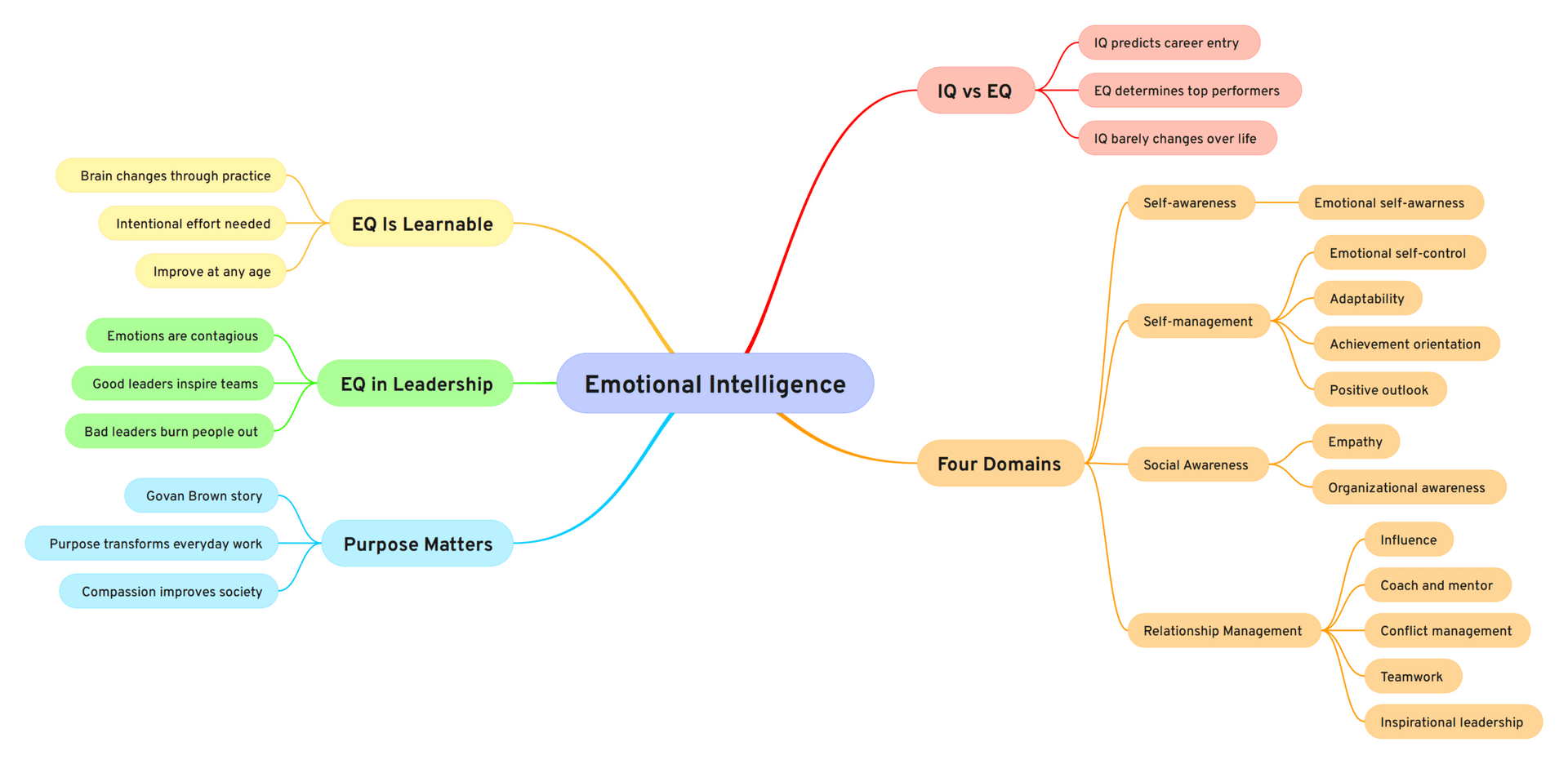
MIND-MAP
Use the mind-map to have a more in-depth discussion on this topic or to better remember that main points.

COMMENTS
What do you think of the ideas presented in this lesson?
Share your views and experience here.
0 Comments