

Bardzo mi przykro, ale lekcje na platformie The Blue Tree działają jedynie na komputerze lub tablecie.
Do zobaczenia na większym ekranie 🙂
Zespół The Blue Tree
back to HOME > Learning English > English Grammar >

THE BLUE TREE
English Grammar

CEFR B1
Intermediate


warm up
Answer these questions below. Listen to model answers and read them aloud.
| How many ways are there to talk about the present in English? |
TRANSCRIPT
I think there are at least three or four ways to talk about the present in English. We have the present simple for habits, the present continuous for things happening now, and the present perfect for actions connected to the present. It can be confusing at first, but with practice it starts to make more sense.
| Do you think having more grammar tenses is an advantage or a nuisance? |
TRANSCRIPT
Honestly, I think it’s both. More tenses allow us to express ideas more precisely, which is helpful. But when you’re learning a language, it can feel overwhelming. In Polish, we manage with fewer tenses, so English grammar sometimes feels unnecessarily complicated. Over time, though, I think the extra precision becomes an advantage.
| How important is it for you to speak grammatically correct? |
TRANSCRIPT
For me, grammar is quite important, but communication matters more. If people understand what I mean, small mistakes aren’t a big problem. However, in professional situations, correct grammar makes a better impression. I try to improve my grammar step by step, but I don’t want to be afraid of speaking just because I might make a mistake.


part one

The Fellowship of the Ring
Read and listen to the dialogue below. Focus on the way Gandalf explains the difference between Past Simple and Present Perfect tenses and the examples they discuss.

Frodo, Sam, and Gandalf sat around a small bonfire, enjoying a quiet moment during their long journey. They were drinking tea when Sam spoke up.
“Mr Gandalf, sir, can you explain the difference between the Present Perfect and the Past Simple?” he asked.
Gandalf raised an eyebrow. “That’s an unexpected question, Samwise. But why not? We have time for a little lesson.”
He began, “The Past Simple describes a finished action in the past. For example, ‘I walked to the store yesterday.’ The Present Perfect connects the past with the present. For example, ‘I have walked to the store many times.’ The action happened in the past, but it still feels relevant now.”
Frodo looked confused. “But why not just use the Past Simple for everything?”
“Good question,” Gandalf said. “The Present Perfect can show repetition or continuity. It can also show that a past action still matters now.”
“I think I understand,” Sam said. “So it’s like the difference between ‘I ate breakfast’ and ‘I have eaten breakfast every day this week’?”
“Exactly, Sam!” Gandalf said with a smile.
Gimli, who was sitting nearby, spoke up. “Well, I’m glad Dwarf language is much simpler!”
Everyone laughed.
Then Boromir asked, “Could you give us more examples?”
“Of course,” Gandalf said. “Past Simple: ‘I saw a film last night.’ The action is finished. Present Perfect: ‘I have seen that film before.’ The experience still matters now.”
Pippin joined in. “So the Present Perfect is like talking about the past in the present?”
“In a way, yes,” Gandalf said. “It links the past and the present. For example, ‘I have lost my keys’ — the action happened in the past, but the problem is still here now.”
Merry looked up from his tea. “What about irregular verbs?”
“Good point, Merry,” Gandalf said. “Some verbs don’t follow the normal pattern. For example, the past of ‘go’ is ‘went,’ not ‘goed.’ And we say ‘have eaten,’ not ‘have eated.'”
The conversation continued as the fire burned low and the night grew dark. But the warmth of their friendship and the joy of learning together kept them all in good spirits.

CAN YOU TELL THE DIFFERENCE
Read the pair of sentences. Do you understand why some sentences were built using Present Perfect and others using Past Simple?
PAIR 1
- 1A Frodo, you didn’t eat a thing yesterday.
- 1B No, Sam. And I haven’t eaten anything today, either. The burden of the ring is weighing heavily on me.
PAIR 2
- 2A Legolas, how long were you in the healing houses of Rivendell?
- 2B Legolas replied, “I have been in and out of the healing houses for centuries. My Elvish blood may make me immortal, but it doesn’t make me immune to injury.”
PAIR 3
- 3A Gandalf, I travelled around Europe last year.
- 3B “I’ve never even been abroad,” replied Boromir. “My duties to Gondor have always kept me close to home.”
PAIR 4
- 4A Gimli, I passed my driving test in 1987.
- 4B “That’s nothing,” says Gimli. “Driving carts and wagons has been in our blood for generations. We have been learning it since we were able to walk.”
PAIR 5
- 5A Aragorn, I had a shower before breakfast.
- 5B “I can’t go out yet,” Arwen said with a laugh. “I’ve just had a bath. My hair is still wet, and I don’t want to catch a cold.”
Comments
All A sentences use Past Simple for:
- finished time
- completed actions
All B sentences use Present Perfect for:
- past action with a present effect
- unfinished time
- actions completed a short time before the present

part two
WHAT’S THE DIFFERENCE
Watch the first part of the video. Jack is exmplaining the main difference between Past Simple and Present Perfect. Makes notes about the points he is making.
COMPREHENSION
Answer these questions. Refer to the information from the video.
| 1 | 00:47 | What does the speaker think about the subject of Present Perfect vs Past Simple? |
| 2 | 02:20 | What do we use the Past Simple for? |
| 3 | 02:45 | What is the meaning of the sentence: I have been to Madrid four times? |

part three
MORE EXAMPLES
Watch the next part of the video.
COMPREHENSION
Answer these questions. Refer to the information from the video.
| 1 | 03:24 | Why did Jack use Past Simple in the sentence about his grandma? |
| 2 | 03:52 | Why could Jack use Present Perfect in the example with Paul? |

PART FOUR
TIME EXPRESSIONS
Jack told us that there are some expressions that we use with Past Simple and others that we use with Present Perfect.
Play this Multidecker game to learn more about these expressions.
CHOOSE THE TENSE
Now play this game in which you need to decide if the verb should be in Past Simple (did), Present Simple (I do), or Present Perfect (I have done).

TRANSLATE THIS SENTENCE
Finally, play this Multidecker game. Here you need to think how you would translate these sentences from Polish into English. Click on the card to see the answer.

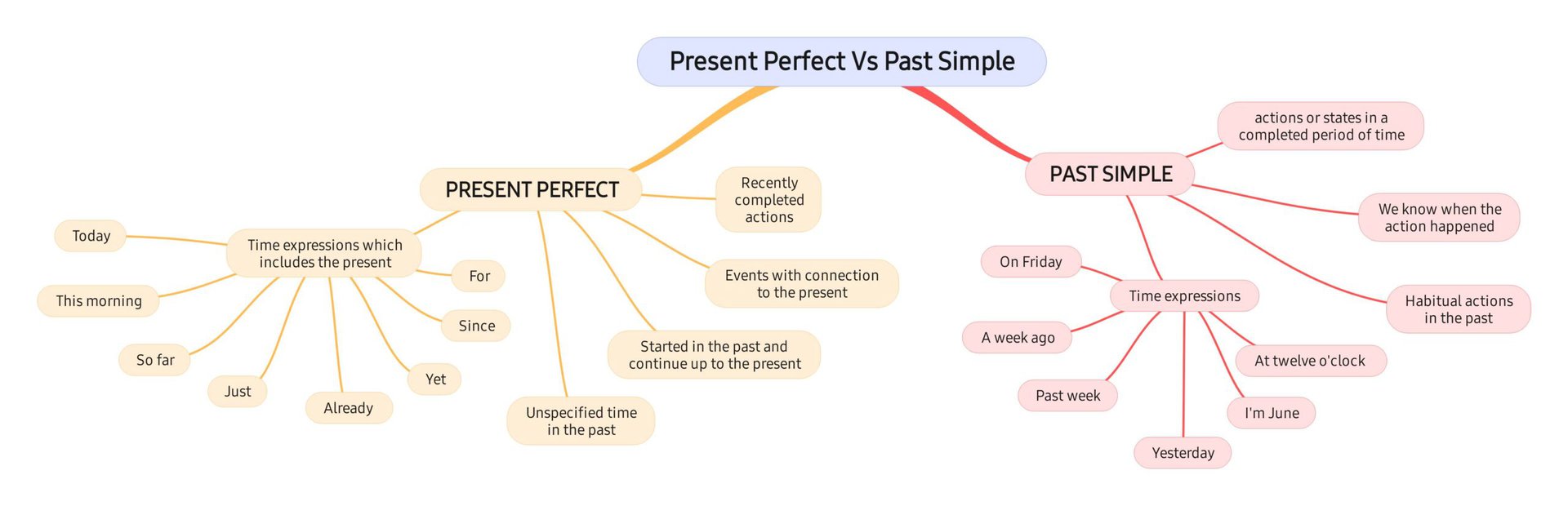
SUMMARY
Past Simple:
- Actions or events that happened and ended in the past
- A series of completed actions in the past
- Time expressions that refer to a specific past time
Present Perfect:
- Actions that started in the past and continue up to the present
- Actions that happened at an unspecified time in the past
- Recently completed actions or events with a connection to the present
- Time expressions that refer to a period of time that includes the present