


Bardzo mi przykro, ale lekcje na platformie The Blue Tree działają jedynie na komputerze lub tablecie.
Do zobaczenia na większym ekranie 🙂
Zespół The Blue Tree

THE BLUE TREE
Man & Society

CEFR C1
Advanced


warm up
Answer the questions below. Listen to some people answering these questions. Report back or read the transcript to practise speaking.
| In your opinion, does AI have more advantages or disadvantages? |
TRANSCRIPT
I think AI has more advantages overall, but the disadvantages are harder to ignore. It can process information quickly and handle repetitive tasks, which saves a lot of time. However, it also raises serious questions about jobs, creativity, and what we actually value in people. My feeling is that the real challenge isn’t AI itself — it’s learning how to work alongside it without losing the skills that make us genuinely useful.
| If you were to give career advice to a young person today, what jobs would you recommend them to pursue? |
TRANSCRIPT
I’d probably recommend careers that combine technical knowledge with strong people skills — things like teaching, healthcare, counselling, or strategic management. These roles require judgment, empathy, and creativity, which are difficult for AI to replicate. In my experience, the most secure jobs are ones where relationships and trust really matter. I’d also advise any young person to develop their ability to ask good questions and think critically, regardless of the field.
| What makes us human? |
TRANSCRIPT
That’s a question people have debated for centuries, but it feels especially relevant now. I think what makes us human is our ability to reflect — to question our own actions, feel responsibility for others, and find meaning in what we do. AI can simulate a lot of things, but it doesn’t have a conscience or genuine curiosity. It doesn’t wonder about its place in the world. That inner life, I think, is essentially human.


part one

KEY LANGUAGE
Go through the flashcards below. Make sure you understand all the words and expressions.

VIDEO
Watch the first part of the video.

COMPREHENSION
Answer the questions. Use the information from this part of the movie.
| 1 | 00:06 | What do the headlines predict? |
| 2 | 00:13 | How will Daniel’s Survival Plan help us? |
| 3 | 00:20 | How many skills is this going to be about? |
| 4 | 00:24 | What’s the title of the book that Daniel wrote on this topic? |

part two
KEY LANGUAGE
Go through the flashcards below. Make sure you understand all the words and expressions.
VIDEO
Watch the second part of the video.
COMPREHENSION
Answer the questions. Use the information from this part of the movie.
| 1 | 00:45 | What is the first human skill? |
| 2 | 01:07 | What makes questions more relevant these days? |
| 3 | 01:15 | What does Daniel connect questions with? |
| 4 | 01:29 | What examples show that questions can be a start of a breakthrough? |
| 5 | 01:46 | What phrases can we begin our questions with? |
| 6 | 02:03 | What’s the first piece of advice Daniel gives us to improve our questioning muscle? |
| 7 | 02:36 | How many times should we ask: “Why?”? |

part three
KEY LANGUAGE
Go through the flashcards below. Make sure you understand all the words and expressions.
VIDEO
Watch the third part of the video.
COMPREHENSION
Answer the questions. Use the information from this part of the movie.
| 1 | 03:09 | What is the second human skill? |
| 2 | 03:15 | Why is knowing what’s good a superpower? |
| 3 | 03:26 | How does Daniel define taste? |
| 4 | 04:28 | How does he use taste to come up with titles for his newsletter? |
| 5 | 05:12 | What should be put into the Hall of Fame and what should we do with it? |

part four
KEY LANGUAGE
Go through the flashcards below. Make sure you understand all the words and expressions.
VIDEO
Watch the fourth part of the video.
COMPREHENSION
Answer the questions. Use the information from this part of the movie.
| 1 | 05:25 | What is the third human skill? |
| 2 | 05:53 | What examples illustrate the importance of iteration? |
| 3 | 06:03 | Where does the magic of excellence lie according to Pink? |
| 4 | 06:32 | What is “Shitty First Draft” strategy about? |
| 5 | 06:49 | Why is it a good idea to space out our iterations? |
| 6 | 07:15 | What’s the “Version 0.8 Rule” about? Why is it tough for some people? |

part five
KEY LANGUAGE
Go through the flashcards below. Make sure you understand all the words and expressions.
VIDEO
Watch the fifth part of the video.
COMPREHENSION
Asnwer these questions using the information from the film.
| 1 | 07:27 | What is the 5th human skill? |
| 2 | 07:34 | How did Daniel explain it using the examples of ingredients and meals? |
| 3 | 07:09 | What are the elements of composition? |
| 4 | 08:18 | Why is it also relevant for people who are not artists? |
| 5 | 08:47 | What is the “Rule of Three”? |
| 6 | 09:12 | How can taking pictures help us learn to see structure? |
| 7 | 09:30 | What game can we play when we are watching a movie? |

part six
KEY LANGUAGE
Go through the flashcards below. Make sure you understand all the words and expressions.
VIDEO
Watch the sixth part of the video.
COMPREHENSION
Answer these questions using the information from the film.
| 1 | 09:40 | What is the 5th human skill? |
| 2 | 09:55 | What’s the difference between the knowledge economy and the allocation economy? |
| 3 | 10:37 | What do we need to learn to do to be better at allocating resources? |
| 4 | 10:53 | What is “Centaur Thinking”? |
| 5 | 11:05 | How can doing a “Team Inventory” help us become better allocators? |
| 6 | 11:32 | What two piles should we divide our work and why? |
| 7 | 11:52 | How can the third tip: “Time-as-talent Audit” help us? |

part SEVEN
KEY LANGUAGE
Go through the flashcards below. Make sure you understand all the words and expressions.
VIDEO
Watch the seventh part of the video.
COMPREHENSION
Answer these questions using the information from the film.
| 1 | 12:02 | What is the final human skill? |
| 2 | 12:17 | Why is integrity so important in the age of AI? |
| 3 | 12:31 | What doesn’t AI have? |
| 4 | 12:43 | What is wisdom rooted in? |
| 5 | 12:58 | What examples illustrate the practical value of integrity? |
| 6 | 13:43 | What is the “Washington Post Test” about? |
| 7 | 14:00 | How does “Integrity Inversion” help us ask with integrity? |

part EIGHT
KEY LANGUAGE
Go through the flashcards below. Make sure you understand all the words and expressions.
VIDEO
Watch part eight of the video.
COMPREHENSION
Answer these questions using the information from the film.
| 1 | 14:30 | Can you repeat the six human skills? |
| 2 | 14:14 | What do you we need to become when the world is becoming more artificial? |
| 3 | 14:55 | What question does Daniel ask in the end? |

POLL
Cast your vote in the poll below.


DISCUSSION
6 human skills
Read their dialogue. Whose views do you lean towards?
Pete:
I found this video really thought-provoking. People often ask whether AI will replace us, but Daniel Pink asks a better question: what makes us truly human?
Kat:
Yes, and his answer is quite encouraging. He says that in a world full of artificial intelligence, people need to develop more human qualities, not less.
Pete:
The first one was questioning, and I think that makes perfect sense. AI can give answers very quickly, but it still depends on the quality of the question. A lazy question usually gets a lazy answer.
Kat:
Exactly. That idea about asking “why” five times was really practical. It shows that the real problem is often hidden under the obvious one. Good questions help us think more deeply.
Pete:
I also liked the point about taste. AI can produce thousands of ideas, images, or texts, but somebody still has to decide what is actually good, useful, or beautiful.
Kat:
That’s true. Taste is difficult to define, but we all recognize it when we see it. It’s a mix of judgment, intuition, and experience. Machines can generate options, but they don’t really care which one has meaning.
Pete:
Then there was iteration, which is something many people dislike. Everyone wants great results, but few people enjoy revising, improving, and starting again.
Kat:
Yes, but that’s how quality is created. The idea of a “shitty first draft” is quite freeing, actually. It reminds us that first attempts don’t need to be impressive. They just need to exist.
Pete:
I think composition was one of the most interesting skills. AI can give us separate ingredients, but humans are better at putting them together into something coherent and emotionally strong.
Kat:
I agree. Composition is what turns information into communication. It’s not just what you say, but how you arrange it. Structure, rhythm, emphasis — all of that matters.
Pete:
The skill of allocation also feels very modern. It’s no longer just about doing everything yourself. It’s about deciding what should be done by you, what by AI, and what maybe by other people.
Kat:
Yes, that requires self-awareness. You need to know your strengths and also understand what technology is actually good at. Otherwise, you either overuse AI or ignore it completely.
Pete:
And finally, integrity. That may be the most important one of all. AI can help us act faster, but it can’t tell us whether something is fair, honest, or wise.
Kat:
Exactly. The tools are becoming more powerful, so character matters more than ever. Just because something can be done doesn’t mean it should be done.
Pete:
So maybe the message is not that humans should compete with AI in speed or volume. We should focus on the areas where conscience, judgment, and imagination still matter most.
Kat:
Yes. In a strange way, AI may force us to become more human — more thoughtful, more creative, and more responsible.
OVER TO YOU
Discuss these questions.
 | Which of the six skills seems the most important today? |
| Which skill is the hardest to develop well? |
| Can AI help people become more creative, or does it make them lazier? |
| Why does integrity become even more important in the age of AI? |
| What should people use AI for, and what should they keep for themselves? |
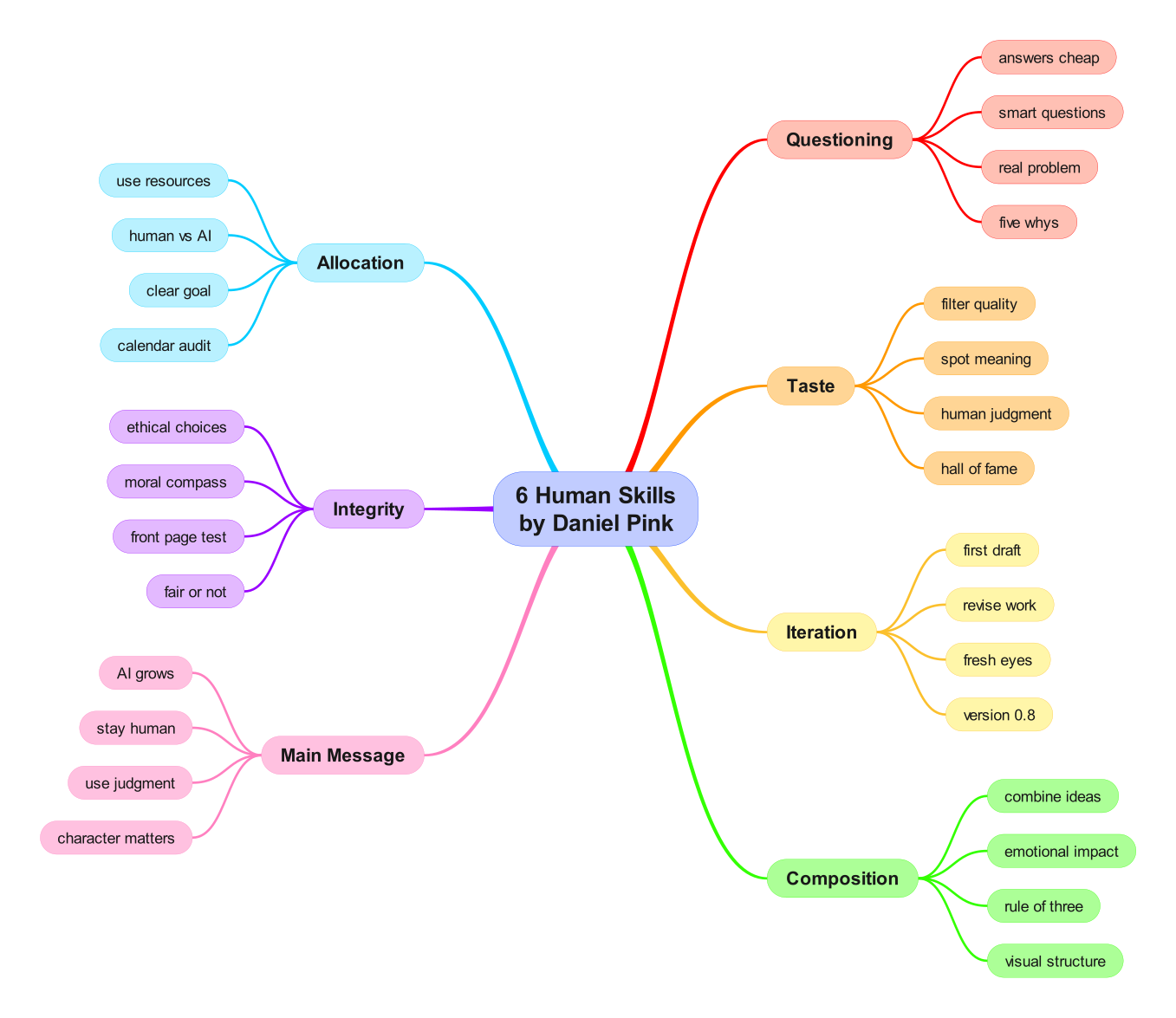
MIND-MAP
Use the mind-map to have a more in-depth discussion on this topic or to better remember that main points.

lesson glossary
Here’s a handy glossary for this lesson.
COMMENTS
What do you think of the ideas presented in this lesson?
Share your views and experience here.
0 Comments