


Bardzo mi przykro, ale lekcje na platformie The Blue Tree działają jedynie na komputerze lub tablecie.
Do zobaczenia na większym ekranie 🙂
Zespół The Blue Tree

THE BLUE TREE
Man & Society

CEFR C1
Advanced
warm up
Answer the questions below. Listen to some people answering these questions. Report back or read the transcript to practise speaking.
| What does vulnerability mean to you personally? |
TRANSCRIPT
For me, vulnerability means allowing yourself to be seen as you really are, not just as you’d like others to see you. It’s admitting that you don’t have everything under control and being okay with that. I think it takes quiet courage to say, “This matters to me,” or “I’m struggling.” But it also means choosing carefully who you open up to. It’s honesty with awareness, not emotional chaos.
| Would you describe yourself as a vulnerable person? Why or why not? |
TRANSCRIPT
I wouldn’t naturally describe myself as a vulnerable person. I’m open, but I don’t show my doubts or emotions easily, especially at work. I’ve always felt that being too emotionally exposed in a professional setting can weaken your position. I prefer to build trust through competence and results first. Once that foundation is there, I can open up more. For me, vulnerability works best when it’s balanced with confidence and self-control.
| Can vulnerability ever damage a relationship or career? |
TRANSCRIPT
Yes, I think it can. If you open up at the wrong moment or share too much with the wrong people, it might create awkwardness instead of connection. In a professional context, credibility really matters. If vulnerability starts to look like insecurity or a lack of direction, people may lose trust. For me, real courage also means knowing when to speak honestly and when it’s wiser to hold something back.
part one

KEY LANGUAGE
Go through the flashcards below. Make sure you understand all the words and expressions.

VIDEO
Watch the first part of the video.

COMPREHENSION
Answer the questions. Use the information from this part of the movie.
part two
KEY LANGUAGE
Go through the flashcards below. Make sure you understand all the words and expressions.
VIDEO
Watch the second part of the video.
COMPREHENSION
Answer the questions. Use the information from this part of the movie.
part three
KEY LANGUAGE
Go through the flashcards below. Make sure you understand all the words and expressions.
VIDEO
Watch the third part of the video.
COMPREHENSION
Answer the questions. Use the information from this part of the movie.
part four
KEY LANGUAGE
Go through the flashcards below. Make sure you understand all the words and expressions.
VIDEO
Watch the fourth part of the video.
COMPREHENSION
Answer the questions. Use the information from this part of the movie.
part five
KEY LANGUAGE
Go through the flashcards below. Make sure you understand all the words and expressions.
VIDEO
Watch the fifth part of the video.
COMPREHENSION
Asnwer these questions using the information from the film.
part six
KEY LANGUAGE
Go through the flashcards below. Make sure you understand all the words and expressions.
VIDEO
Watch the sixth part of the video.
COMPREHENSION
Answer these questions using the information from the film.
POLL
Cast your vote in the poll below.

DISCUSSION
MOTIVATION THAT WORKS
Context: Alita and Pete are having coffee after work. They start talking about vulnerability and connection after watching a TED Talk together.
Read their dialogue. Whose views do you lean towards?
Alita: I’ve been thinking about what real connection means. For me, it’s when you feel safe enough to show your vulnerability.
Pete: I agree, but I think it also needs trust. In HR, I see that people want belonging, but they’re afraid of being judged.
Alita: Yes, that fear can really numb emotions. Sometimes we pretend everything is fine just to protect our sense of worthiness.
Pete: True. But if we believe we are worthy of respect and kindness, it takes real courage to open up.
Alita: And maybe we are hardwired for connection, even if it feels uncomfortable.
Pete: It probably boils down to balance — being authentic but also respecting boundaries.
Alita: So real connection means accepting imperfection?
Pete: Exactly. We don’t need to be perfect. We just need honesty and compassion.
Alita: I like that. Maybe embracing vulnerability is not weakness — it’s strength.
Pete: Yes. When we stop trying to prove ourselves, connection happens naturally.
OVER TO YOU
Discuss these questions.
 | Why can a strong sense of worthiness influence the quality of connection between people? |
| Many people believe vulnerability is a weakness. What arguments support this view, and what arguments challenge it? |
| What’s best for building trust in a team: showing vulnerability early or developing competence first? Explain your reasoning. |
| Advise a company that wants to improve connection among employees. What principles should it focus on? |
| Many people believe perfectionism leads to success. How might this belief affect connection and belonging? |
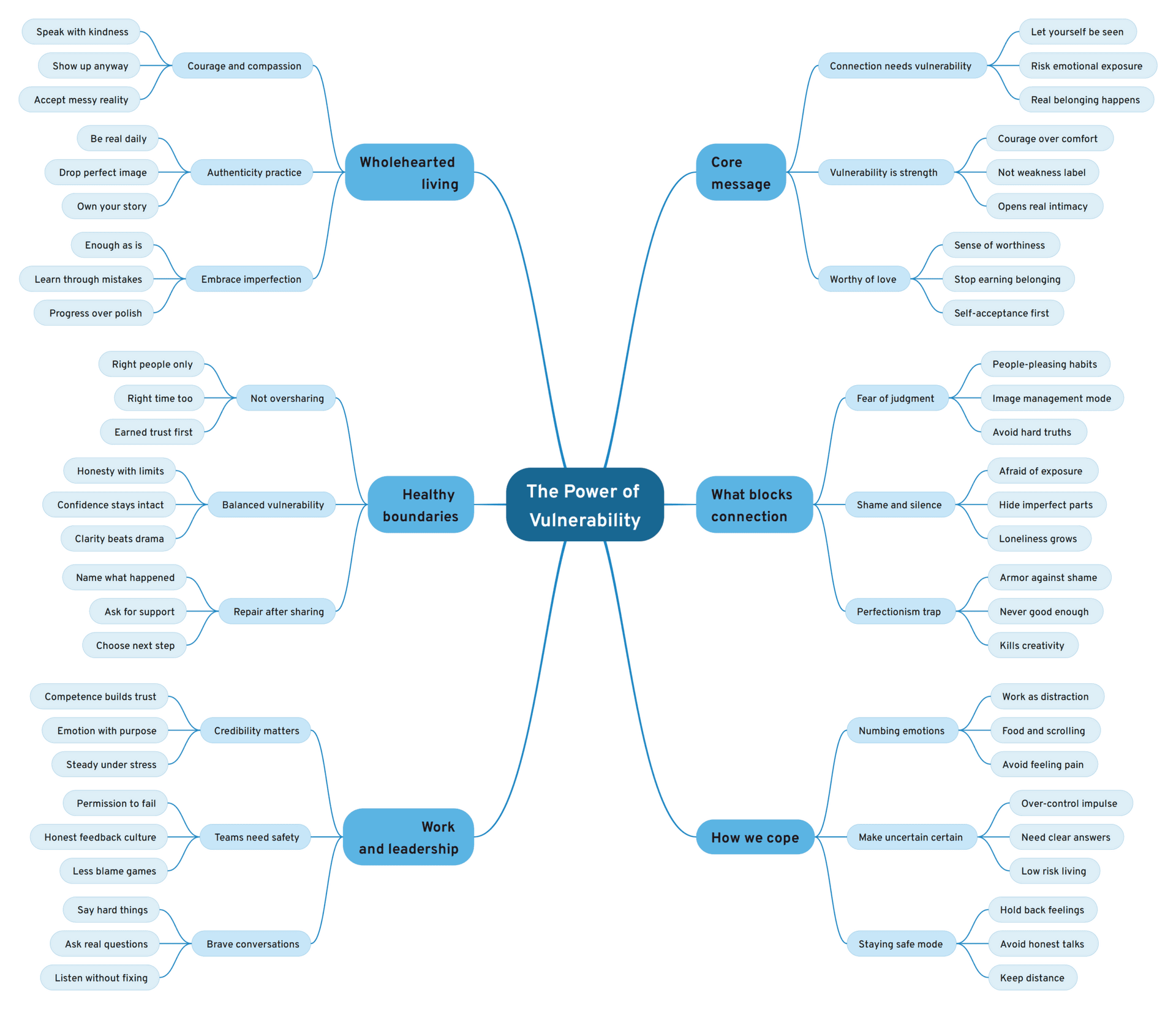
MIND-MAP
Use the mind-map to have a more in-depth discussion on this topic or to better remember that main points.
lesson glossary
COMMENTS
What do you think of the ideas presented in this lesson?
Share your views and experience here.
0 Comments