




Bardzo mi przykro, ale lekcje na platformie The Blue Tree działają jedynie na komputerze lub tablecie.
Do zobaczenia na większym ekranie 🙂
Zespół The Blue Tree
back to HOME > Personal Development > Personal Productivity >

THE BLUE TREE
Personal
Productivity

CEFR B2
Upper
Intermediate
warm up
Answer the questions below. Listen to the sample answers.
| What are the pros and cons of war? |
TRANSCRIPT
The pros of a war are hard to define, but historically, some argue it has led to technological advancements or the resolution of conflicts. However, the cons are overwhelming—loss of life, destruction of communities, and long-term psychological impacts. War should always be the absolute last resort, as the damage it causes often outweighs any potential benefits.
| Why is it so difficult to admit having made a mistake? |
TRANSCRIPT
It’s difficult to admit making a mistake because it makes us feel vulnerable and exposes our imperfections. We’re often worried about how others will perceive us, and there’s a fear of judgment or losing credibility. But I think the ability to own up to mistakes shows strength and maturity. Once we get past the fear, admitting a mistake can actually build trust with others.
| What do you think it means to take extreme ownership? |
TRANSCRIPT
To me, taking extreme ownership means accepting full responsibility for everything in your control, even if things go wrong. It’s about not blaming others or external factors but instead focusing on what you can do to fix the situation. It’s a leadership mindset—leading by example, owning your actions, and setting a standard of accountability that encourages others to do the same.
part one

KEY LANGUAGE
Go through the flashcards below. Make sure you understand all the words and expressions.

VIDEO
Watch the first part of the video.

COMPREHENSION
Answer these questions. Refer to the information from the video.
- How does Jocko describe war?
- What can war teach us?
- What happened in the spring of 2006?
- Can you imagine how Jocko must have felt at that time?
part two
KEY LANGUAGE
Go through the flashcards below. Make sure you understand all the words and expressions.
VIDEO
Watch the second part of the video.
COMPREHENSION
Answer these questions. Refer to the information from the video.
- What did Jocko expect to happen next?
- What did he put in his debrief?
- Who is Jocko talking about when he says that there is only one person to blame?
part three
KEY LANGUAGE
Go through the flashcards below. Make sure you understand all the words and expressions.
VIDEO
Watch the third part of the video.
COMPREHENSION
Answer these questions. Refer to the information from the video.
- Why did Jocko take the blame for what had happened?
- How did he feel about taking the blame?
- How did his bosses and his men react to his decision?
- What does it mean to take extreme ownership?
POLL
Cast your vote in the poll.
DISCUSSION
Pete & Sven Discuss Responsibility
Pete and Sven are talking about a colleague who shirks responsibilities.
Read or role-play their dialogue.
Pete: You know what really gets to me, Sven? Tom keeps blaming others for every mistake at work. It’s never his fault — always someone else’s.
Sven: Yeah, I’ve noticed that too. He’s good at avoiding responsibility. It reminds me of what Jocko Willink said about Extreme Ownership.
Pete: Oh, right — that idea that leaders should take full responsibility, even when things go wrong because of their team.
Sven: Exactly. Jocko said there’s no one else to blame. If something fails, it’s your fault because you didn’t plan well enough, didn’t communicate clearly, or didn’t supervise properly.
Pete: It’s a tough mindset to adopt, though. Most people want to protect their ego. Admitting fault feels like weakness.
Sven: True, but Jocko argues the opposite — that taking ownership builds trust and respect. It actually makes you stronger as a leader.
Pete: Maybe if Tom started thinking like that, he’d earn more respect around here. Instead, people just avoid working with him.
Sven: Yeah. Responsibility is contagious. When one person steps up, others usually follow. When one shirks it — the whole team suffers.
Pete: So, what’s our move? Should we tell him directly?
Sven: Maybe not lecture him, but we can lead by example. Take ownership ourselves — show him how it’s done.
OVER TO YOU
Discuss these questions.
 | Have you ever worked with someone who avoided taking responsibility? How did it affect the team’s results or atmosphere? |
| Why do you think so many people find it difficult to admit their mistakes? |
| In what ways can taking ownership actually make a person stronger rather than weaker? |
| Do you think leaders should always take full responsibility, even when their team members clearly make mistakes? Why or why not? |
| How can you personally apply the idea of Extreme Ownership in your everyday work or studies? |
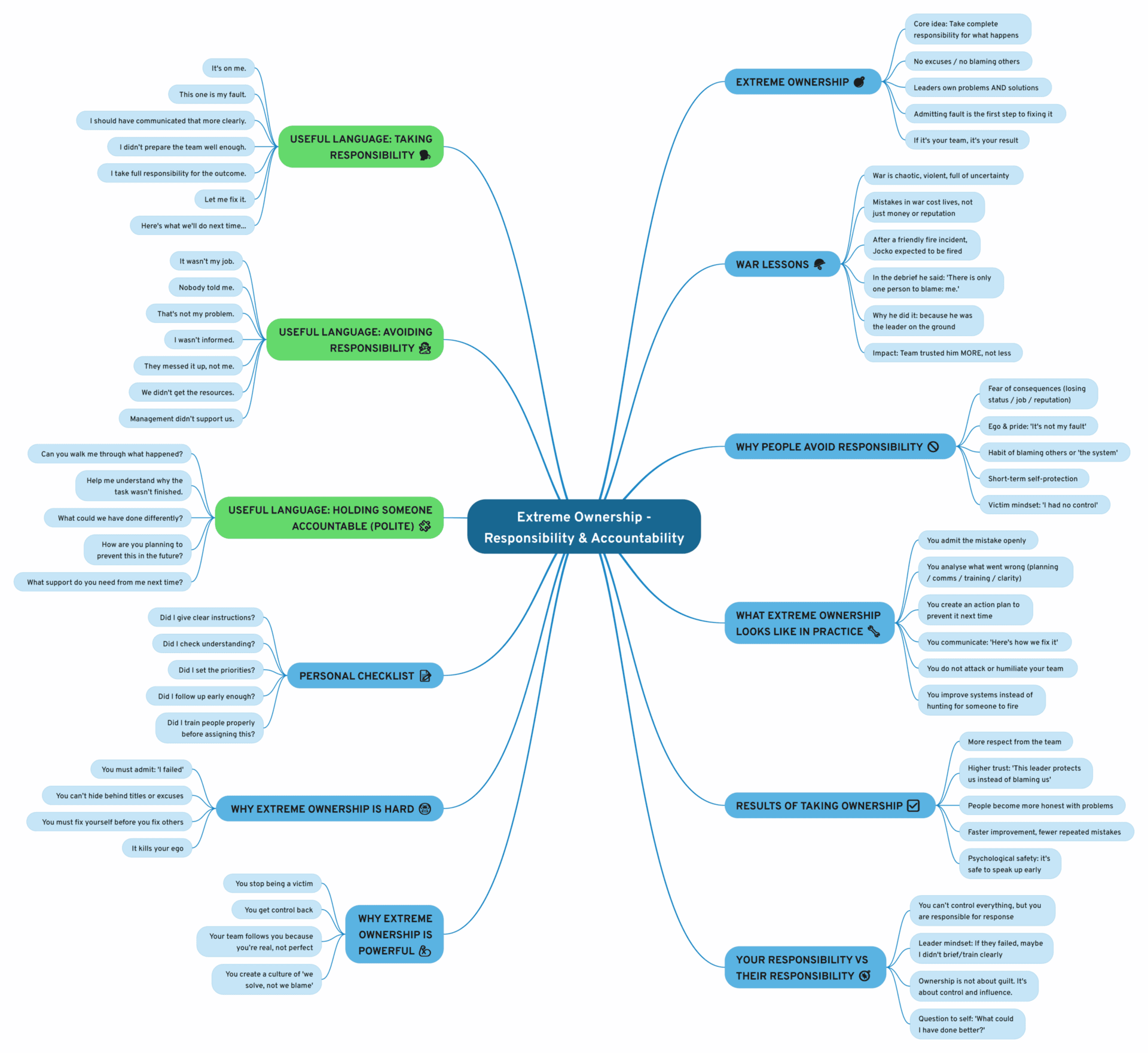
MIND-MAP
Use the mind-map below to have a more in-depth conversation about this topic.
COMMENTS
What do you think of Jocko’s concept of ‘extreme ownership’?
0 Comments