




Bardzo mi przykro, ale lekcje na platformie The Blue Tree działają jedynie na komputerze lub tablecie.
Do zobaczenia na większym ekranie 🙂
Zespół The Blue Tree
back to HOME > Personal Development > Better Communicator >

THE BLUE TREE
Better
Communicator

CEFR B2
Upper
Intermediate

warm up
Answer the questions below. Then listen to the model answers and think about how you could improve yours.
| Are you good at giving people advice? |
TRANSCRIPT
I think I’m fairly good at giving advice, but it really depends on the situation. I always try to listen carefully before saying anything because I’ve realized that people don’t always need direct advice—sometimes they just want someone to listen. If I feel like they truly want my opinion, I give it in a way that supports their decision-making, rather than just telling them what to do.
| Do you like when somebody gives you unsolicited advice? |
TRANSCRIPT
I’m not a big fan of unsolicited advice, to be honest. It can feel like the person giving it assumes they know more about my situation than I do. It’s much better when people ask if I want their input first. Then, I’m more open to considering their advice because I feel like I have the choice in whether or not to accept it.
| What can we do to help others follow our advice? |
TRANSCRIPT
To help others follow our advice, I think we need to frame it in a way that resonates with them. It’s about understanding what matters most to the person and aligning the advice with their goals or values. Also, giving them options rather than pushing one solution makes it easier for them to feel like they’re still in control of the decision.

part one

KEY LANGUAGE
Go through the flashcards below. Make sure you understand all the words and expressions.

VIDEO
Watch the first part of the video.

COMPREHENSION
Answer these questions. Refer to the information from the video.
- ⌚ 00:17 Are people generally good at giving advice?
- ⌚ 00:56 What happens when we give advice in a bad way?
- ⌚ 01:28 What are the three roles we need to consider when we give advice?
- ⌚ 02:20 What is the first question we need to answer before we give advice to someone?
- ⌚ 02:46 What should we do when someone needs social support?
part two
KEY LANGUAGE
Go through the flashcards below. Make sure you understand all the words and expressions.
VIDEO
Watch the second part of the video.
COMPREHENSION
Answer these questions. Refer to the information from the video.
- ⌚ 03:39 What is the second question you should ask yourself before you offer advice to someone?
- ⌚ 03:57 What is autonomy?
- ⌚ 04:08 How do people with high autonomy react when we give them advice?
- ⌚ 04:25 What is our role when someone is a high autonomy person?
- ⌚ 04:39 What does it mean to be an aide?
- ⌚ 05:35 What is a ‘boomerang effect”?
part three
KEY LANGUAGE
Go through the flashcards below. Make sure you understand all the words and expressions.
VIDEO
Watch the third part of the video.
COMPREHENSION
Answer these questions. Refer to the information from the video.
- ⌚ 06:33 When can we become an advisor to someone?
- ⌚ 07:40 What kind of advice can you offer to someone who is low in autonomy?
- ⌚ 08:54 How can we tell if someone needs a friend, an aide or an adviser?
POLL
Cast your vote in the poll.
DISCUSSION
Dialogue
Read or role play this conversation.
Pete: I watched this talk today about giving advice. The speaker, Al Pittampalli, said there are three roles: a friend, an aide, and an adviser. It made me think I often choose the wrong one.
Alita: What do you mean?
Pete: When Sarah complained about her job, I immediately gave her advice—update her CV, change companies, network more. But she only got more frustrated.
Alita: Because maybe she didn’t want advice—just support.
Pete: Exactly. He says we should first ask: Does this person need support? and How independent are they? Sarah is very independent, so I should have been an aide, not an adviser.
Alita: Meaning?
Pete: Instead of telling her what to do, I should have asked questions like, “What options do you see?”
Alita: That reminds me of my sister during her divorce. My mum gave her constant advice, and my sister stopped calling. Too much pressure.
Pete: That’s the “boomerang effect.” With high-autonomy people, unwanted advice can push them away.
Alita: But sometimes advice is necessary—like when someone really doesn’t know what to do.
Pete: Right. Then you become an adviser. Like when Tom asked me about fixing his car—he had no idea what he was doing.
Alita: So sometimes people need a friend, sometimes an aide, and sometimes an adviser.
Pete: Exactly. And the hardest one is being the aide—because it’s easier to tell than to ask.
Alita: I think I’ll try this with Emma and her college stress. I always jump into solution mode.
Pete: And she’ll probably tell you to let her handle it.
Alita: Which will tell me everything about her autonomy level.
Pete: Sometimes the best advice is no advice at all.
OVER TO YOU
Discuss these questions.
 | Do you agree with Pete that Al’s system is practical? Why or why not? |
| Can you think of a time when you gave advice that wasn’t well received? What role were you trying to play, and what role might have been more appropriate? |
| Alita raises a good point about cultural differences. How might advice-giving vary across different cultures or family backgrounds? |
| When, if ever, do you think it’s appropriate to give unsolicited advice, even to someone with high autonomy? |
| Pete suggests that being an “aide” is the most difficult role. Do you agree? Which role do you find most challenging? |
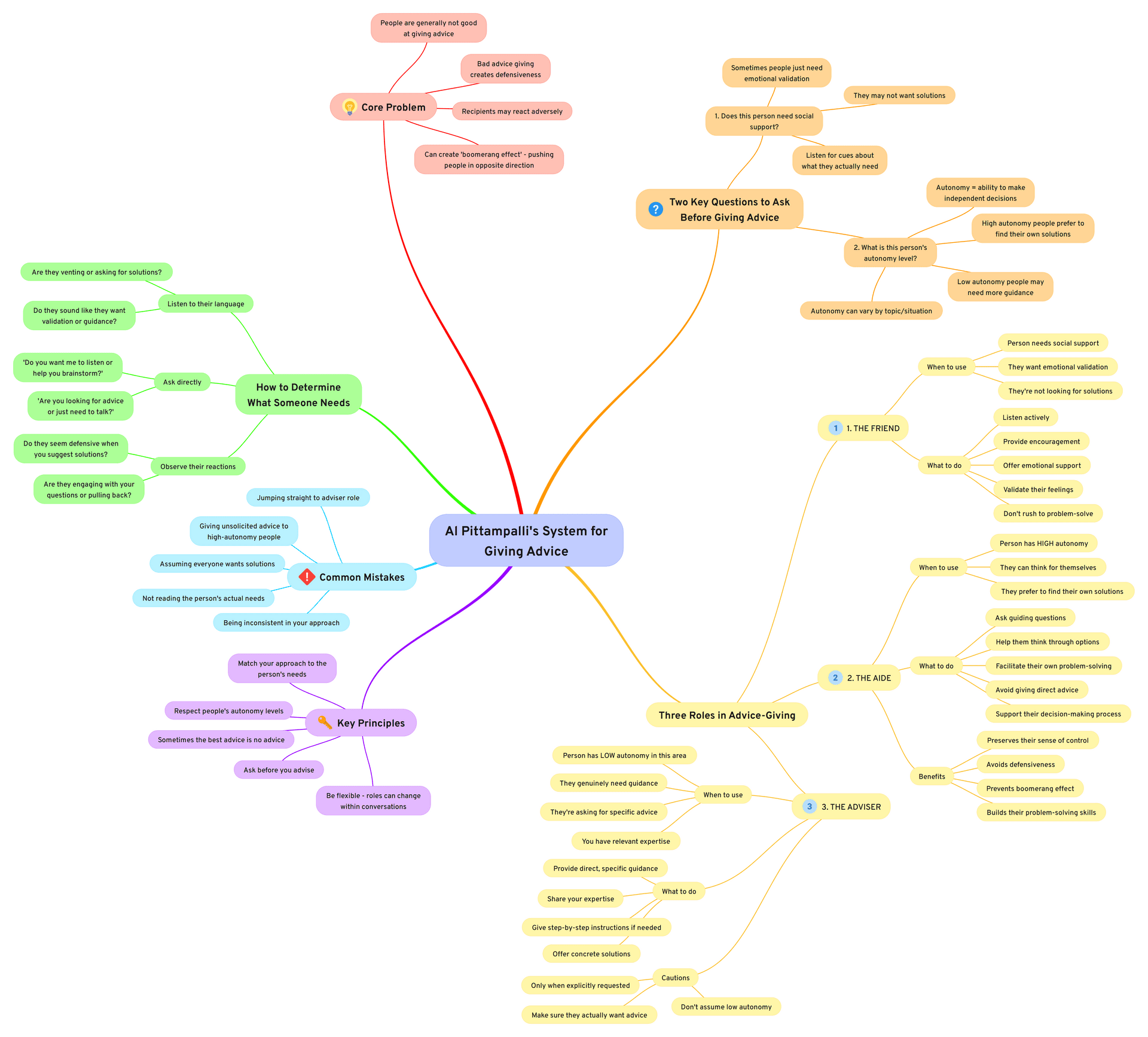
MIND-MAP
Use the mind-map below to have a more in-depth conversation about this topic.
COMMENTS
How do you feel about Al’s lecture? Is this idea of a friend/aide/adviser practical? What is your experience with offering advice?
0 Comments