


Bardzo mi przykro, ale lekcje na platformie The Blue Tree działają jedynie na komputerze lub tablecie.
Do zobaczenia na większym ekranie 🙂
Zespół The Blue Tree

THE BLUE TREE
Personal
Productivity

CEFR B2
Upper
Intermediate

warm up
Answer the questions below. Then listen to Bella and report what you heard.
| Is the New year a good time to set oneself goals? |
TRANSCRIPT
I think the New Year can be a good moment to set goals, mainly because it feels like a fresh start. People often feel more motivated when something begins — a new week, a new month, or a new year. On the other hand, you don’t need to wait for January. Any moment is good if you’re ready to change something. What matters most is clarity and consistency, not the date.
| Why, do you think, so many people fail at sticking to their New Year’s resolutions? |
TRANSCRIPT
Many people fail because their goals are too vague or too big. They say things like “I’ll get fit” or “I’ll save money,” but they don’t define the steps. The motivation from January also fades quickly, and without a clear plan, routines fall apart. Resolutions work better when they’re small, specific, and realistic — something you can fit into everyday life rather than rely only on excitement.
| Can you share a story of how you set yourself and then achieved some goal? |
TRANSCRIPT
Last year, I set a goal to improve my fitness. I chose something simple: running twice a week for 20 minutes. I made a small plan and kept track of each run. Some weeks were harder, but I stayed consistent by preparing my clothes the night before and going right after work. After two months, I felt stronger and more confident — and the habit stayed. It showed me how helpful clear goals can be.

part one
Study the language in this flashcard game.

VIDEO
Watch the first part of the video.

COMPREHENSION
Answer these questions. Refer to the information from the video.
- ⌚ 00:07 What did Zig Ziglar say about climbing Mount Everest?
- ⌚ 00:14 What does it mean in relation to goals?
part two

KEY LANGUAGE
Go through the flashcards below. Make sure you understand all the words and expressions.
VIDEO
Watch the second part of the video.
COMPREHENSION
Answer these questions. Refer to the information from the video.
- ⌚ 0:26 What answer do people give him when he asks them about their goals?
- ⌚ 0:31 How would you answer Natan’s question today?
- ⌚ 0:38 What are the two words that can describe goals?
part three
KEY LANGUAGE
Go through the flashcards below. Make sure you understand all the words and expressions.
VIDEO
Watch the third part of the video.
COMPREHENSION
Answer these questions. Refer to the information from the video.
- ⌚ 0:45 What does setting vague goals do to our brains?
- ⌚ 0:50 How does our brain feel about ambiguous goals?
- ⌚ 0:52 How do psychologists call this?
- ⌚ 1:21 What examples illustrate this effect?
- ⌚ 1:33 What can happen if our goals are too vague?
- ⌚ 1:45 Why, according to Natan, are many people unhappy?
part four
KEY LANGUAGE
Go through the flashcards below. Make sure you understand all the words and expressions.
VIDEO
Watch the fourth part of the video.
COMPREHENSION
Answer these questions. Refer to the information from the video.
- ⌚ 1:53 What’s another downside of having vague goals?
- ⌚ 2:07 How did a pscyhological magazine describe this?
- ⌚ 2:24 What’s the benefit of having clear goals?
- ⌚ 2:54 Who did researches interview about their goals?
- ⌚ 3:07 When did these people feel the best and performed the best?
part five
KEY LANGUAGE
Go through the flashcards below. Make sure you understand all the words and expressions.
VIDEO
Watch the fourth part of the video.
COMPREHENSION
Answer these questions. Refer to the information from the video.
- ⌚ 3:13 What three things do clear goals bring according to this research?
- ⌚ 3:21 Why are goals like magnets?
- ⌚ 4:01 What are the three stages of setting clear goals?

POLL
Cast your vote in the poll below.
DISCUSSION
TALKING ABOUT GOALS
Alita and Pete are in the car, driving to their holiday destination, just after listening to a podcast about goal setting.
Role Play their dialogue.
Alita:
You know, that podcast really made me think. When I was younger, my goals were… well, pretty vague. “Be successful,” “get a good job,” “be happy.” All very poetic, but not very helpful.
Pete:
Same here. I had these huge dreams, but no structure. I think Natan would say my goals were “too foggy to act on.” And remember that part in the lesson about vague goals confusing the brain?
It’s so true. I kept changing direction every few months.
Alita:
Exactly! And that research they mentioned… the one by Mihaly Csikszentmihalyi — they even referenced him in the podcast. He said people feel their best and perform their best when they have crystal-clear goals and are fully engaged in the process.
Pete:
Right, that part hit me hard. When I was in my twenties, I set a goal like “improve my career,” but I never defined what that meant. No timeline, no milestones. It was the perfect example of what the lesson calls a downward cycle — vague plans leading to distraction and then frustration.
Alita:
Do you remember the first time you actually set a clear goal?
Pete:
Oh yes. I wanted to run a marathon before I turned 30. And unlike my earlier goals, this one was specific: distance, date, training plan. And because it was so clear, it actually pulled me forward — like Natan says, “clear goals act like magnets.”
Alita:
I love that metaphor. And it’s so true: when I set my goal of becoming a project manager, everything became more ordered — my studying, my weekends, even my habits. And I felt that sense of flow Csikszentmihalyi talked about.
Pete:
It’s funny… we spent our twenties trying to “figure things out,” and now we realise we simply needed better goals.
Alita:
Yes! Goals that don’t overwhelm the brain, don’t trigger the ambiguity effect, and don’t leave us distracted. Clear, meaningful, doable goals.
Pete:
So… should we set a holiday goal too? Something like: “Eat at least five amazing breakfasts”?
Alita:
Now that is a goal I’m ready to pursue immediately.
OVER TO YOU
Discuss these questions. Refer to your own experience and the information from this lesson.
 | When you think about your past goals, do you relate more to Alita or to Pete — were your goals vague and open-ended, or clear and specific? Why do you think that was? |
| Have you ever experienced what Natan describes as a “downward cycle,” where vague goals made you feel distracted or overwhelmed? How did you eventually break out of it? |
| The podcast mentioned that clear goals act like magnets. Can you think of a time in your life when a goal truly “pulled” you forward, the way Pete’s marathon goal did? What made that goal so motivating? |
| Mihaly Csikszentmihalyi’s research suggests we perform our best when we have clear goals and a sense of direction. In which area of your life would having a crystal-clear goal help you perform better right now? |
| If you could rewrite one goal from your younger years using the principles from this lesson (precision, clarity, milestones), which one would you choose — and how would you express it today? |
DIVE DEEPER INTO THIS TOPIC
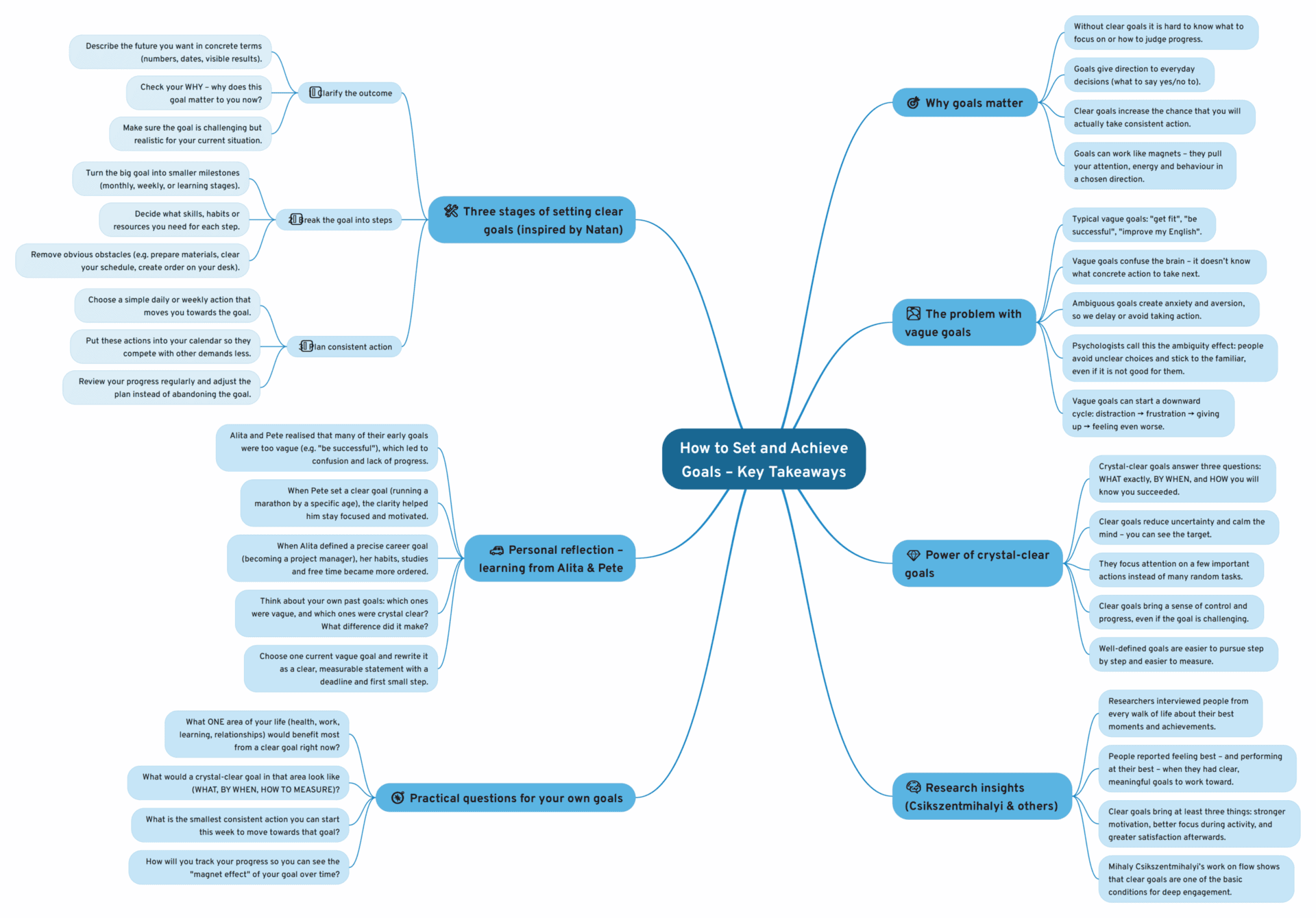
Use this mind-map to dive deeper into the topic of setting clear goals.
lesson glossary
COMMENTS
Has this lesson convinced you of the importance of setting yourself crystal clear goals?
If you already have a habit of setting such goals for yourself, what advice would you give to people who are still sceptical?
Have you ever set and then achieved some personal or professional goal? What has helped you succeed?
Share your views and experience here.
0 Comments