




Bardzo mi przykro, ale lekcje na platformie The Blue Tree działają jedynie na komputerze lub tablecie.
Do zobaczenia na większym ekranie 🙂
Zespół The Blue Tree
back to HOME > Personal Development > Personal Productivity >

THE BLUE TREE
Personal
Productivity

CEFR B2
Upper
Intermediate

warm up
Answer the questions below.
| When do you feel the most energized during the day? |
TRANSCRIPT
I feel the most energized in the late morning, usually after I’ve had my coffee and gotten into the flow of things. That’s when I try to tackle my most creative or important work. By the afternoon, though, my energy starts to dip, and it gets harder to focus, so I try to schedule easier tasks for that time.
| What do you do when your energy levels are dropping? |
TRANSCRIPT
When my energy levels drop, especially in the afternoon, I usually take a short walk or do a quick meditation. I’ve also tried power naps, and they really help to reset my mind. It’s all about finding ways to recharge, even if it’s just for 10 or 15 minutes, so I can get back on track and finish my day strong.
| How well do you know your body as regards your circadian rhythm? |
TRANSCRIPT
I’ve learned a lot about my circadian rhythm over the years. I know that my most productive time is in the morning, so I try to do all my focused work then. In the afternoon, I hit that ‘trough’ where my energy dips, so I plan more routine tasks for that part of the day. Being aware of my body’s natural rhythm has definitely helped me organize my day better.

part one

KEY LANGUAGE
Go through the flashcards below. Make sure you understand all the words and expressions.

VIDEO
Watch the first part of the video.

COMPREHENSION
Answer these questions. Refer to the information from the video.
- ⌚ 00:39 When do people perform the worst during the day according to research?
- ⌚ 00:49 What is the most unproductive time in the UK?
- ⌚ 01:07 Why does Daniel Pink call this time the Bermuda Triangle?
- ⌚ 01:18 What is the daily Circadian Rhythm?
- ⌚ 01:43 What are the three stages of our attention and mental ability during a day?
part two
KEY LANGUAGE
Go through the flashcards below. Make sure you understand all the words and expressions.
VIDEO
Watch the second part of the video.
COMPREHENSION
Answer these questions. Refer to the information from the video.
- ⌚ 1:58 What is the best thing you can do at the beginning of a trough?
- ⌚ 2:14 How long should our naps be?
- ⌚ 2:25 What effect does a 10 minute nap have?
- ⌚ 3:05 What is Nappuccino and why is it so effective?
- ⌚ 3:17 If you cannot take a nap, what should you do during a trough?
- ⌚ 3:32 If we absolutely have to do important work during a trough, what should we remember about?
- ⌚ 3:44 When should we do our most important work?
part three
KEY LANGUAGE
Go through the flashcards below. Make sure you understand all the words and expressions.
VIDEO
Watch the third part of the video.
KEY LANGUAGE
Go through the flashcards below. Make sure you understand all the words and expressions.
- ⌚ 4:00 What are the two categories of important work?
- ⌚ 4:17 What are some examples of logical work?
- ⌚ 5:18 What makes the Linda Problem a logical problem? Did you get the answer right?
- ⌚ 5:18 When did people answer this problem correctly more often?
part four
KEY LANGUAGE
Go through the flashcards below. Make sure you understand all the words and expressions.
VIDEO
Watch the fourth part of the video.
COMPREHENSION
Answer these questions. Refer to the information from the video.
- ⌚ 5:34 Which side of the brain does insight work rely on?
- ⌚ 5:40 What are some examples of insight work?
- ⌚ 6:19 Why was the coin fake?
- ⌚ 6:25 What is required to solve insight problems like the Coin Problem?
- ⌚ 6:25 When did people answer this problem correctly more often?
part five
KEY LANGUAGE
Go through the flashcards below. Make sure you understand all the words and expressions.
VIDEO
Watch the sixth part of the video.
COMPREHENSION
Answer these questions. Refer to the information from the video.
- ⌚ 7:01 How should we organize our work taking the above information into account?
- ⌚ 7:16 Who are the people who have a late chronotype? Is this you?
- ⌚ 7:38 How can we know if we have a late chronotype?
- ⌚ 8:30 What is the ultimate goal that can help us be most productive?
POLL
Cast your vote in the poll.

DISCUSSION
Dialogue
It is Friday afternoon. Alita and Pete are walking home after work. Both feel tired after a long week. They start talking about energy levels and the ideas from When by Daniel Pink.
Read or role-play this dialogue.
Alita:
I can’t believe how exhausted I feel. It’s only 4:30, but my brain has completely switched off.
Pete:
That’s actually normal. According to Daniel Pink, this is probably your trough.
Alita:
My trough?
Pete:
Yes. During the day we usually have a peak, a trough, and then a rebound. Late afternoon on Friday? Classic trough.
Alita:
That explains why my last meeting felt so difficult. I couldn’t think clearly.
Pete:
Exactly. Pink says we shouldn’t do analytical work during the trough. Our attention and logic are weaker then.
Alita:
So what should I do at this time? Just go home and sleep?
Pete:
Not necessarily. A short nap helps. Or you can do simple, routine tasks. Save important decisions for your peak hours.
Alita:
That makes sense. I usually try to push through and finish complex tasks at the end of the day. No wonder I feel frustrated.
Pete:
I used to do the same. But now I try to schedule my most demanding work in the morning, when my mind is sharpest.
Alita:
Maybe I should start observing my energy more carefully instead of blaming myself for being “lazy.”
Pete:
Exactly. It’s not about laziness. It’s about timing.
Alita:
Interesting… Maybe the problem isn’t how hard we work — but when we work.
Pete:
That’s exactly Pink’s point.
OVER TO YOU
Discuss these questions.
 | Many people believe productivity depends more on energy than on motivation. What arguments support this idea? |
| What’s the best way to organize analytical and creative tasks during a typical working day? |
| Some people push through their tiredness instead of taking a break. What might be the long-term consequences of this habit? |
| Why might late afternoon be a risky time for making important decisions? |
| Many professionals ignore their circadian rhythm. What could change if companies took timing more seriously? |
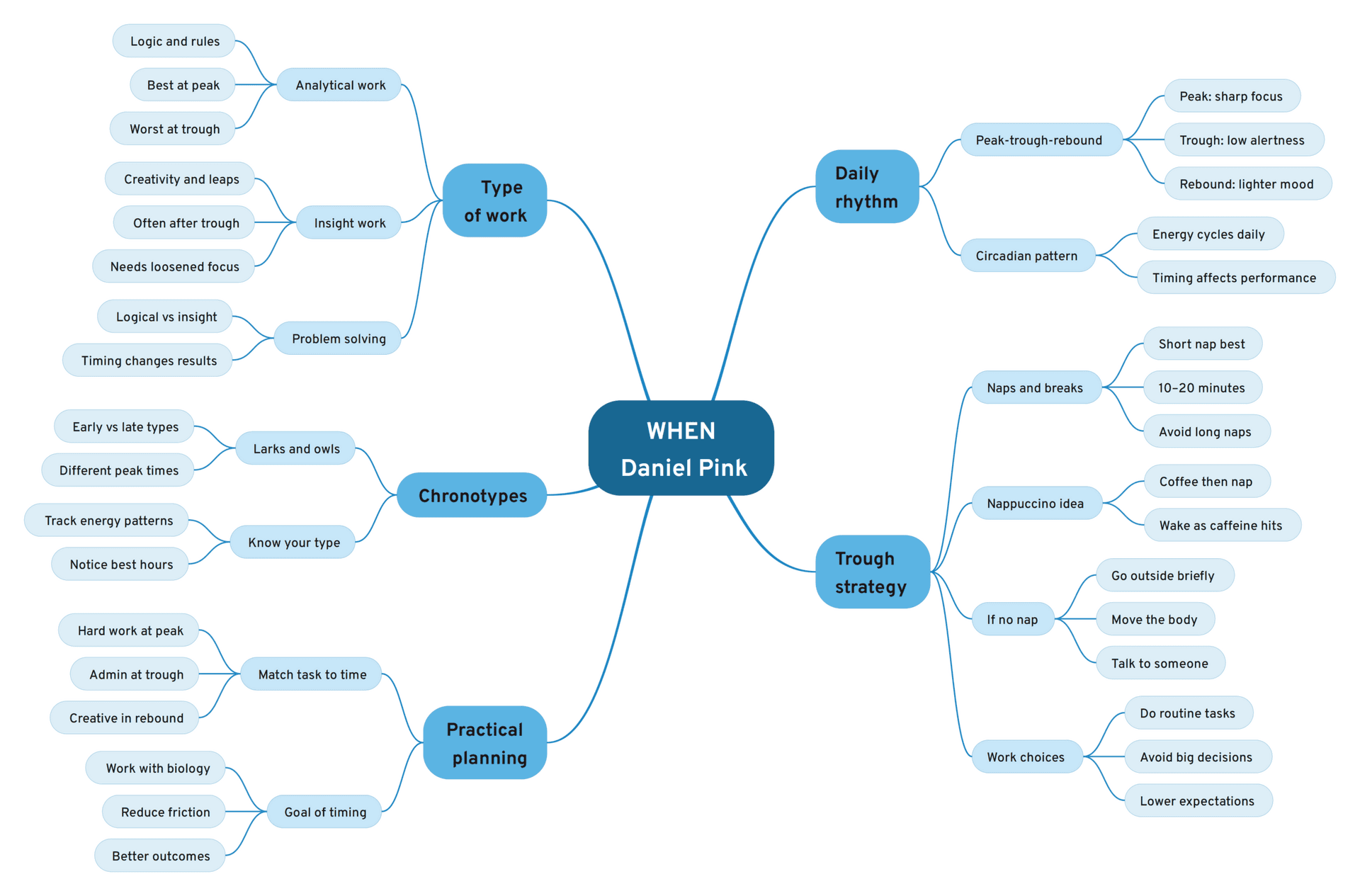
MIND-MAP
Use the mind-map below to have a more in-depth conversation about this topic.

COMMENTS
Do you agree that it as important to know when your trough? What do you do when your energy levels are dropping? How well do you know your own Circadian Rhythm?
Share your views and experience here.
0 Comments