




Bardzo mi przykro, ale lekcje na platformie The Blue Tree działają jedynie na komputerze lub tablecie.
Do zobaczenia na większym ekranie 🙂
Zespół The Blue Tree
back to HOME > General Interest > Travel and Nature >

THE BLUE TREE
Travel & Nature

CEFR A2
Pre-Intermediate
warm up
Answer the questions below.
| Have you ever bought a souvenir while traveling? What was it? |
TRANSCRIPT
Yes, I usually buy small magnets when I travel. I like putting them on my fridge because they remind me of my trips and make my kitchen more colorful.
| Do you collect anything? Why or why not? |
TRANSCRIPT
I don’t really collect anything myself, but my brother collects coins from different countries. He has a small album where he keeps them. He says it’s fun to find rare ones, especially from places he has visited. He also likes learning about the history behind each coin — like who or what is on it and when it was made. I think it’s an interesting hobby, just not for me.
| Do you think it’s a good idea to visit places just to say you’ve been there? |
TRANSCRIPT
Not really. I think it’s better to spend more time in one place and really enjoy it. Some people just take a photo and leave, but they don’t learn anything about the place. I prefer to walk around, try local food, and talk to people. For me, it’s more interesting than just ticking a place off a list.
part one

KEY LANGUAGE
Go through the flashcards below. Make sure you understand all the words and expressions.

VIDEO
Watch the first part of the video.

COMPREHENSION
Answer these questions. Refer to the information from the video.
- What is a zero euro banknote?
- Why are European banknotes dull?
- How many zero euro are there in the world?
- How can you get a zero euro?
- Which French landmarks are depicted on zero euro notes?
- Why is the Marineland zero euro the rarest note?
part two
KEY LANGUAGE
Go through the flashcards below. Make sure you understand all the words and expressions.
VIDEO
Watch the second part of the video.
COMPREHENSION
Answer these questions. Refer to the information from the video.
- What is Monaco famous for?
- Which Barcelona landmarks are depicted on the notes?
- Where is the Belem Tower?
- Which landmark did the Belem Tower replace on the back of the zero euro note?
- Are there many zero euro in the UK?
- What is the Titanic famous for?
- Are there many notes in Northern Ireland?
- Do countries that don’t use euro have zero euro notes?
- What is Chris’s favourite design?
part three
KEY LANGUAGE
Go through the flashcards below. Make sure you understand all the words and expressions.
VIDEO
Watch the third part of the video.
COMPREHENSION
Answer these questions. Refer to the information from the video.
- What does the only note from Sweden show?
- Where can you buy a zero euro note with Santa Claus?
- What are the names of the two buildings on the zero euro note from Moscow?
- What happened to the house of the Blackheads which is shown on the note from Latvia?
- What is so special about the notes from Poland?
- Where is Hallstatt and what is it famous for?
- Who was born in Salzburg?
- Are there euro zero notes from countries outside of the EU?
POLL
Cast your vote in the poll.
DISCUSSION
DIALOGUE
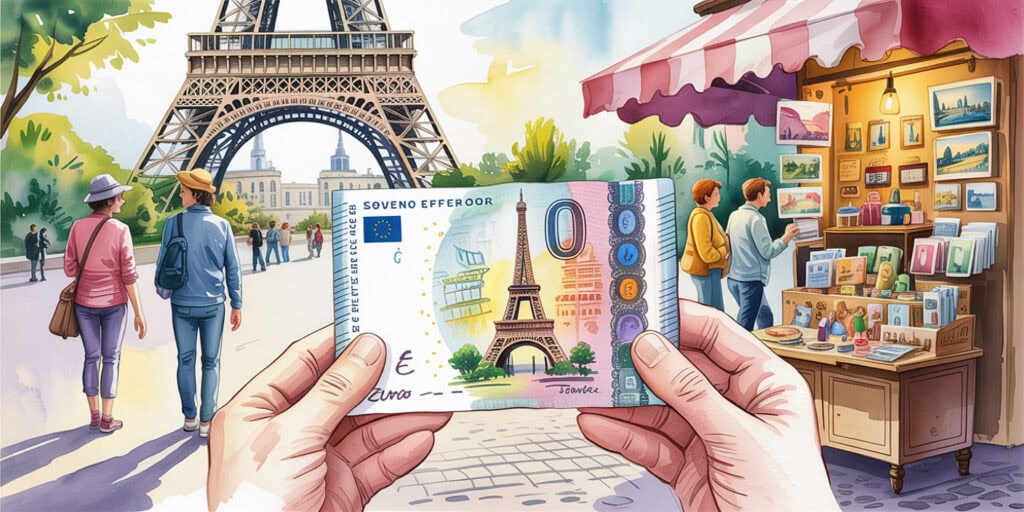
Alita and Pete are taking a coffee break at work. They recently saw a souvenir “zero euro” note in a shop and are curious about it.
Read or role-play this dialogue.
Alita: Hey Pete, did you see that strange note in the gift shop? It said “zero euro”! What kind of money is that?
Pete: Yeah, I saw it too. It’s not real money. It’s a souvenir. But it features famous places or people, like landmarks or castles.
Alita: Oh, so it’s not genuine? I thought maybe it was used for something special.
Pete: No, not really. But it’s quite popular. Some designs are very sought after by collectors.
Alita: That’s funny. A banknote with zero value! Why do people buy it?
Pete: It’s to commemorate something—like a special event or a place. And it can serve as a cool memory from a trip.
Alita: I guess that makes sense. Some of them look really nice. They even have a watermark and security design.
Pete: Yes, and as far as I can tell, they try to look real to feel like a true note, even though they are not used to pay for anything.
Alita: I read that France was the first country to issue a note like that. And now they’re in many countries, right?
Pete: That’s right. There’s even an exhaustive list of all the designs online. I checked it yesterday.
Alita: Cool! So it’s not a scam or counterfeit, just something fun to collect.
Pete: Exactly. And for tourists, it’s something different. Despite having no real value, they are quite beautiful and picturesque.
Alita: I think I’ll buy one with a medieval castle on it. It will look great in my scrapbook.
Pete: Good idea! Just don’t try to use it in a vending machine!
(Both laugh.)
OVER TO YOU
Discuss these questions. Refer to the topic of the lesson and your own experience.
 | Have you ever bought something just to commemorate a trip or event? What was it? |
| Do you think souvenir banknotes like the zero euro note are interesting or dull? Why? |
| Do you enjoy collecting things that are unique or sought after? What do you collect? |
| Have you ever seen or visited a medieval building or landmark? What was it like? |
| What do you think about the idea of issuing a note with no real value? Is it a clever idea or just marketing? |