




back to HOME > Learning English > Business English >

THE BLUE TREE
Business English

CEFR B1
Intermediate

warm up
Answer the questions beelow. Listen to model answers. Read the transcript.
| What usually influences your decisions more: data, intuition, or other people’s opinions? |
TRANSCRIPT
I try to rely on data whenever possible, especially at work. However, I’ve noticed that intuition also plays a role, particularly when I don’t have complete information. Other people’s opinions matter too, but I don’t want to depend on them too much. Ideally, I try to combine logic with experience.
| What makes a decision “good” in your opinion: the process or the result? |
TRANSCRIPT
In my view, the process is more important than the result. Sometimes you can follow a solid process and still fail because of external factors. But if the process is weak, even a good result might just be luck. A clear process increases the chances of long-term success.
| Why do people sometimes avoid making decisions, even when they have enough information? |
TRANSCRIPT
People often avoid decisions because they are afraid of responsibility. Making a choice means accepting possible consequences. Even with enough information, uncertainty can feel uncomfortable. In many organizations, the fear of criticism slows everything down.

LISTENING
Listen to the recording and try to understand the main idea from the article.

reading
Read the article below.

Design a Better Decision-Making Process for Your Organization
Unfocused meetings. 1. Competing priorities. 2. Confusion over who gets to make the final call. These are often signs that your organization has poorly designed decision-making processes. Rather than treating the symptoms, you can 3. take on the system itself. Start by breaking down the types of decisions being made across your organization, then determine who should make which ones. Distribute decision rights 4. thoughtfully to ensure everyone is clear on the 5. boundaries of their departments and roles. Of course, no one makes decisions in a 6. vacuum, and we often have to 7. rely on others to 8. execute our choices. Make sure to connect anyone who’s impacted by the decision to 9. ensure effective coordination. You might need to identify 10. liaisons to other teams, create shared calendars, or develop online portals where meeting minutes are posted. Finally, be sure to build in 11. metrics to monitor how effective decisions are. Regularly assess what’s working and what’s not, and make changes accordingly.
This tip is adapted from “How Systems Support (or Undermine) Good Decision-Making,” by Ron Carucci
konkurujące, rywalizujące
zająć się
roztropnie, w przemyślany sposób
granice
próżnia, nicość
polegać na kimś
wykonywać, wprowadzać w życie
upewnić się, zagwarantować
wskaźnik, miernik
Comprehension
Answer the questions below. Refer to the article or your own experience.
- What are some of the symptoms of a poorly designed decision-making process?
- What can be done to improve this process?
- What does it mean that ‘no one makes decisions in a vacuum’?
- Who are ‘liaisons’?
- What are the two final steps of a smooth decision-making process?
- What kind of metrics work for you and your decisions?

POLL
Cast your vote in the poll.
PRACTICE
What are the most common steps of a well-designed decision-making process? Select the right step from the drop-down list.


DISCUSSION

DIALOGUE
Monday morning. Alita and Pete have just finished a long meeting. The team couldn’t agree on who should make the final decision about launching a new product feature. The discussion went in circles.
They grab coffee and continue talking.
Read (role-play) this dialogue.
Alita:
That meeting was exhausting. We talked for an hour and still didn’t decide anything.
Pete:
I know. Everyone had an opinion, but no one knew who actually had the authority to make the final call.
Alita:
Exactly. At one point, I wasn’t even sure what the real problem was anymore.
Pete:
That’s what happens when the decision-making process isn’t clear. We focus on arguments instead of structure.
Alita:
So what do you think was missing?
Pete:
First of all, clear decision rights. Someone should have said, “This is my responsibility, but I want your input.” Instead, we all tried to decide together.
Alita:
But isn’t collaboration a good thing?
Pete:
Of course it is. But collaboration doesn’t mean everyone makes the decision. Sometimes too many voices slow everything down.
Alita:
True. And I also felt that people were afraid of taking responsibility.
Pete:
Yes. If you make the decision, you own the consequences. That’s uncomfortable.
Alita:
So what would you change?
Pete:
I’d define three things in advance:
Who decides.
Who gives input.
How we measure success.
Alita:
That sounds simple. But we rarely do it.
Pete:
Simple doesn’t mean easy. It requires discipline.
Alita:
Maybe we should suggest a clearer structure next time.
Pete:
Good idea. If we don’t design the process, the confusion designs it for us.
Alita:
I like that. We should write it down.

OVER TO YOU
Discuss these questions. Find ways to use the language you were learning in this lesson.
 | Think about a meeting where no decision was made. What usually goes wrong in situations like that? |
| In some teams, everyone shares opinions, but no one makes the final decision. Why can this create problems? |
| Many employees are afraid of being responsible for important decisions. What might cause this fear? |
| A decision may look good on paper but fail during implementation. Why does this happen? |
| Sometimes too many people are involved in one decision. How can this affect the speed and quality of the outcome? |

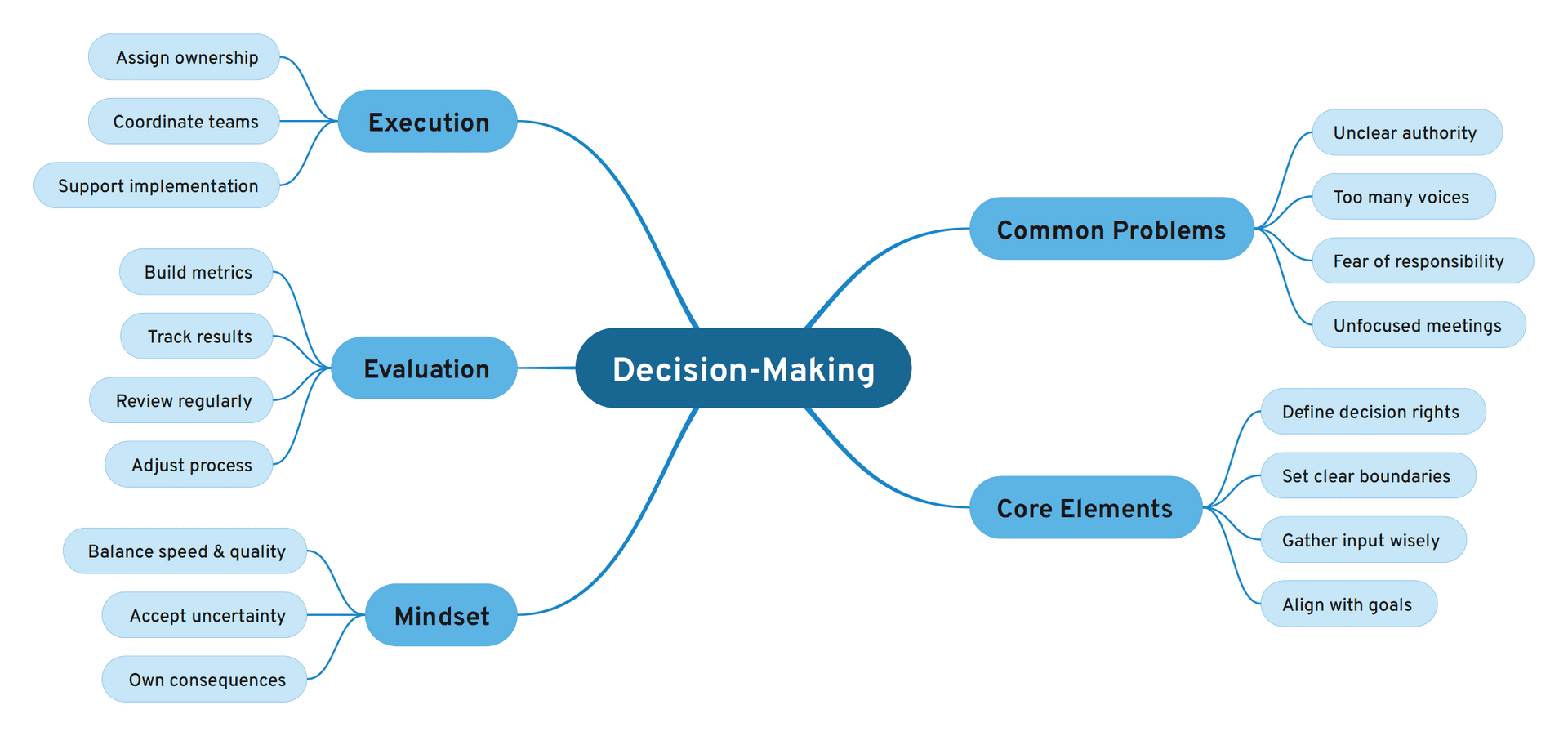
MIND-MAP
Study this mind-map to remember the ideas from this lesson better.
COMMENTS
What is your system for making better decisions?
Share your opinions below.
0 Comments