




Bardzo mi przykro, ale lekcje na platformie The Blue Tree działają jedynie na komputerze lub tablecie.
Do zobaczenia na większym ekranie 🙂
Zespół The Blue Tree
back to HOME > Personal Development > Personal Productivity > Why we do what we do

THE BLUE TREE
Personal
Productivity

CEFR B2
Upper
Intermediate

warm up
Answer the questions below.
| What is your strongest motivation? |
TRANSCRIPT
My strongest motivation is the desire to keep improving myself. Whether it’s learning something new or becoming better at my job, I love the feeling of making progress. It’s what pushes me to set goals and keep going, even when things get tough.
| What can affect our motivation positively or negatively? |
TRANSCRIPT
Motivation can be influenced by a lot of things. When I feel appreciated or see the positive impact of my work, my motivation gets a real boost. But when I’m overwhelmed or when it feels like my efforts aren’t being recognized, it can take a hit. Staying connected to my purpose helps me stay on track.
| Do you prefer to do what you want or to be told what to do? |
TRANSCRIPT
I definitely prefer to do what I want. I like having the freedom to make my own decisions and figure things out on my terms. I think it helps me stay more engaged and motivated when I have control over how I approach my work.

part one

KEY LANGUAGE
Go through the flashcards below. Make sure you understand all the words and expressions.

VIDEO
Watch the first part of the video.

COMPREHENSION
Answer these questions. Refer to the information from the video.
- How long have they been working on the Theory of Self-Determination?
- What is the primary distinction which Deci and Ryan introduced?
- What does it mean to be autonomously motivated?
- What does it mean to be controlled in your motivation?
part two
KEY LANGUAGE
Go through the flashcards below. Make sure you understand all the words and expressions.
VIDEO
Watch the second part of the video.
COMPREHENSION
Answer these questions. Refer to the information from the video.
- What are the three basic psychological needs?
- What is competence?
- What is relatedness?
- What is autonomy?
- What does it mean to be intrinsically motivated?
- What does it mean to be extrinsically motivated?
- How can one promote better motivation in others?
POLL
Cast your vote in the poll.
DISCUSSION
Dialogue
Read or role-play a dialogue between two psychology students discussing the ideas from Edward Deci.
Anna:
So, what really stayed with me from the video was this idea that motivation isn’t about how much you have, but what kind it is. I’ve always thought that if I pushed myself harder, I’d get better results.
Marek:
Same here. I was raised on deadlines, grades, and pressure. It worked in the short term, but I was often exhausted. When Deci talked about controlled motivation, it honestly sounded like my entire school experience.
Anna:
Exactly. I recognized myself when he described doing things just to avoid guilt or disappointment. I used to study just so I wouldn’t feel bad about myself later. I was motivated, but it didn’t feel healthy.
Marek:
What surprised me most was how much better autonomous motivation works. Last year, I chose a research topic that genuinely interested me, not one that I thought would impress the lecturer. I worked longer hours, but I didn’t feel drained.
Anna:
That’s a great example of competence and autonomy working together. For me, relatedness was the missing piece. During my internship, my supervisor actually listened to my ideas. I felt respected, and suddenly I wanted to contribute more.
Marek:
Yes, that sense of belonging really changes things. It’s interesting how rewards can sometimes backfire. I used to think bonuses or grades were always motivating, but now I see how they can reduce internal motivation.
Anna:
I also liked the part about internalized extrinsic motivation. Not everything we do has to be fun. I don’t love statistics, but once I understood why it matters for research, I stopped resisting it so much.
Marek:
Same with my part-time job. I wouldn’t say I’m passionate about it, but I value what it gives me—independence and experience. That makes a huge difference in how I approach my work.
Anna:
Overall, the video made me rethink how motivation works in real life. Especially as future psychologists—we shouldn’t just ask how to motivate people, but how to support their basic needs.
Marek:
Absolutely. It’s not about pushing people harder. It’s about creating conditions where motivation can grow naturally.
OVER TO YOU
Discuss these questions.
 | People are often motivated by pressure, grades, or rewards. How can this help people, and how can it cause problems? |
| Many people work better when they feel they have a choice. Why does having a choice make motivation stronger? |
| According to the theory, people need competence, autonomy, and connection. Which of these is most often missing at school or at work, and what happens then? |
| Some tasks are not enjoyable, but people still do them well. How does knowing why a task is important change people’s attitude to it? |
| Schools and companies often use rewards and punishment. What other ways could they use to motivate people more effectively? |
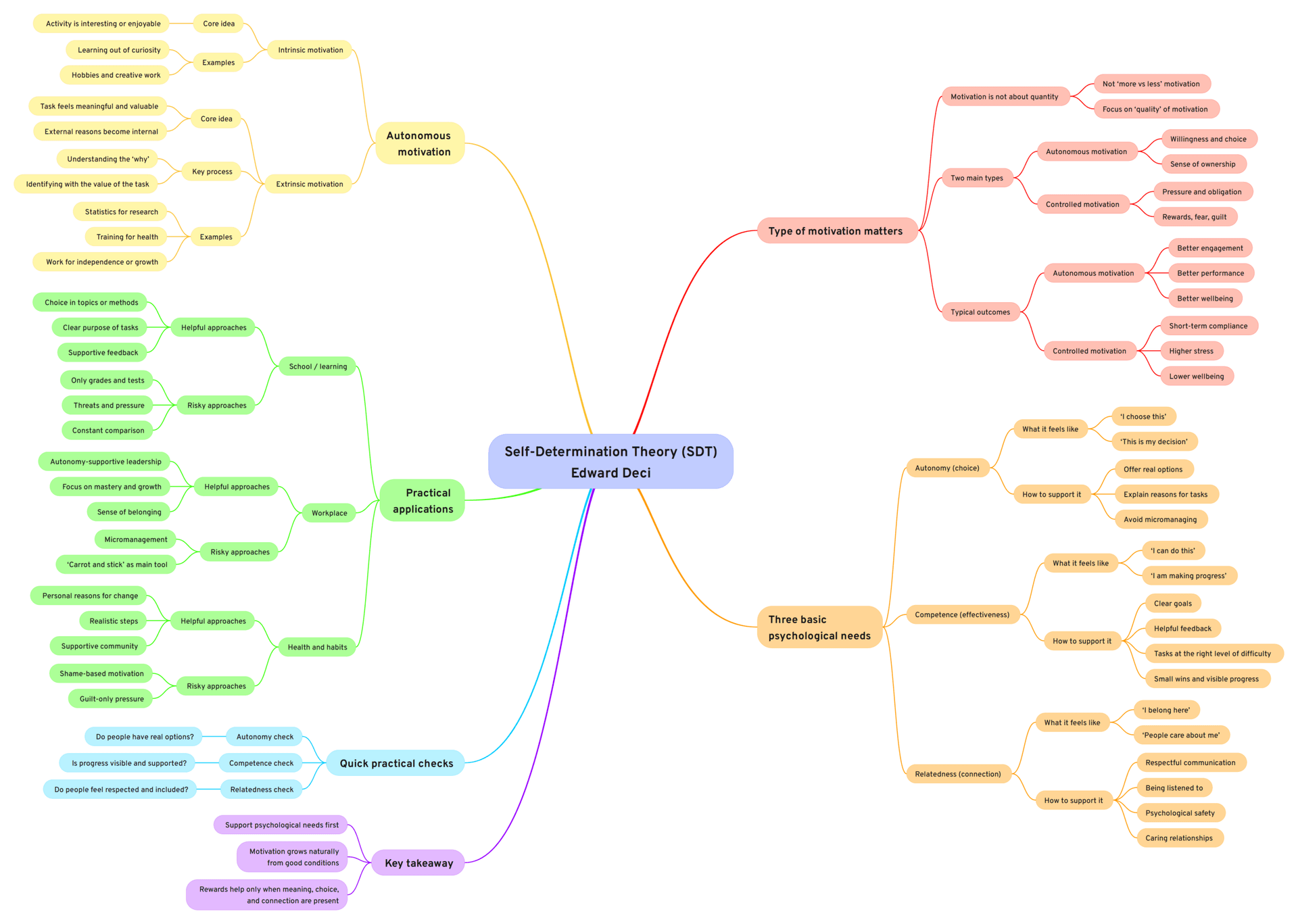
MIND-MAP
Use the mind-map below to have a more in-depth conversation about this topic.
COMMENTS
What do you think of Edward Deci’s explanation of what motivates us to do things? Do you agree with him? What is your strongest drive?
Share your views and experience here.
0 Comments